


Sommaire
- 1 Introduction
- 2 When may a director file a trademark or register a domain name in their own name?
- 3 The criteria applied by French courts
- 4 The decision of the Douai Court of Appeal, June 12, 2025, No.22/05989
- 5 Trademarks and domain names: a converging legal approach
- 6 Best practices to secure ownership of rights
- 7 Conclusion
- 8 FAQ
Introduction
In corporate life, the issue of ownership of intangible assets is far from secondary. The filing of a trademark or the registration of a domain name in the personal name of a company director, even though such signs identify the company’s business, regularly gives rise to disputes. This practice is not automatically unlawful. However, it may become fraudulent where the filing is carried out with knowledge of the company’s prior rights or use, or as part of a strategy aimed at the personal appropriation of a strategic asset. This issue was recently illustrated by a noteworthy decision of the Douai Court of Appeal dated June 12, 2025.
The stakes are significant: judicial transfer of the trademark, loss of the domain name, civil liability, and potentially unfair competition claims.
When may a director file a trademark or register a domain name in their own name?
The principle: freedom to file
Under French law, the right to file belongs to the first applicant. As a matter of principle, no provision prohibits a director from filing a trademark or registering a domain name in their personal name, including where a company is still in the process of being formed. This formal freedom explains many “anticipatory” filings, particularly prior to incorporation.
The limit: corporate interest and loyalty
This freedom nevertheless reaches its limit where the filing takes place in the context of a joint project, a company in formation, or collective exploitation of the sign. A director may not divert to their own benefit an asset intended to identify the company.
To learn more about recent case law developments relating to trademarks filed on behalf of companies in formation, we invite you to consult our previously published article.
The criteria applied by French courts
Prior use for the benefit of the company
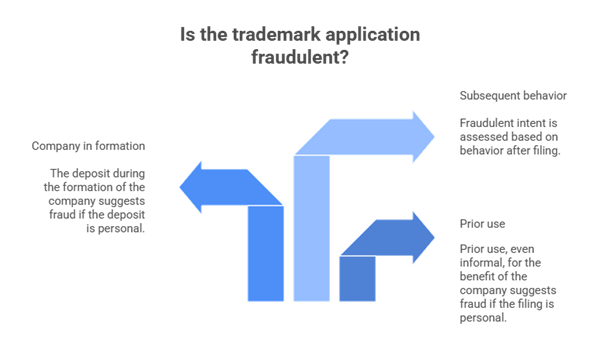
Use of the sign prior to filing, even informal, for the benefit of the future company or its associates constitutes a strong indication of fraud where the filing is made in a personal capacity.
The context of a company in formation
Where the filing takes place while the company is in the process of being formed, and the sign has been chosen collectively, courts frequently consider that the applicant acted in the corporate interest, even if the company had not yet acquired legal personality.
The director’s subsequent conduct
Fraud is not presumed. It is based on an intentional element: the applicant’s knowledge of existing rights or prior use that they seek to neutralise or appropriate. Case law consistently recalls that fraudulent intent must be assessed in light of all the circumstances, including those arising after the filing. Fraud is often revealed by subsequent conduct, such as:
- Proposing a licence agreement to the company,
- Threatening to prohibit use of the sign,
- Retaining control of the domain name or professional email addresses.
In a recent case, the Douai Court of Appeal ruled on this issue.
The decision of the Douai Court of Appeal, June 12, 2025, No.22/05989
Facts of the case
A founding associate, who later became president of a company in formation, personally filed several trademarks and registered a domain name corresponding to the sign intended to identify the company’s business. After his dismissal, he claimed ownership of these rights and proposed a licence agreement to the company, while retaining control over the domain name and the professional email addresses.
Decision of the Douai Court of Appeal
In its decision of 12 June 2025, the Douai Court of Appeal held that these filings constituted fraudulent filings, as they had been carried out with full knowledge of the circumstances, within the framework of a collective business creation project, and exclusively in the interest of the company in formation. The Court ordered the transfer of the trademarks and the domain name to the company, finding that the director had sought to appropriate a strategic intangible asset for personal purposes.
The Court also found the existence of acts of unfair competition and parasitism, as the former president, following his dismissal, pursued a competing activity through a newly created company while improperly exploiting the signs and identifying elements of the original company.
Scope of the decision
This decision confirms settled case law: the filing of a trademark or the registration of a domain name by a director is not unlawful per se, but becomes fraudulent where it diverts a sign intended to identify and develop the company’s business, in disregard of the collective interest and the duty of loyalty.
Trademarks and domain names: a converging legal approach
Courts apply a similar line of reasoning to domain names. Personal registration of a domain name corresponding to the corporate name or an exploited trademark may be characterised as fraud or unfair competition where it disrupts the company’s operations or diverts an element of its intangible assets.
Issues relating to identification data and access retention are also assessed in light of loyalty requirements and, where applicable, the principles recalled by the CNIL regarding the use of professional data.
Best practices to secure ownership of rights
- Anticipate ownership issues from the creation phase.
- Include an asset transfer clause in the articles of association or shareholders’ agreements.
- File trademarks directly in the name of the company once incorporated.
- Centralise domain name management at company level.
- Document collective decisions relating to the choice and exploitation of distinctive signs.
Conclusion
The filing of a trademark or the registration of a domain name in the name of a director is not, in itself, fraudulent. It becomes so when the facts demonstrate a disloyal appropriation of a sign intended to identify the company’s business, to the detriment of the company and its associates.
Dreyfus & Associés assists its clients in managing complex intellectual property cases, offering personalized advice and comprehensive operational support for the complete protection of intellectual property.
Nathalie Dreyfus with the support of the entire Dreyfus team
FAQ
1. Can a company recover a trademark filed by its director?
Yes, through an action for ownership claim where fraud is established.
2. What if the articles of association do not provide for the transfer of trademarks?
The absence of a transfer clause does not prevent legal action, but it weakens the company’s position and makes proof of fraudulent intent more complex.
3. Is an oral agreement between associates sufficient?
It is risky. A written agreement is strongly recommended.
4. Is payment of filing fees by the company decisive?
It is a strong indication, but not an exclusive one.
5. Is the registration of a domain name treated in the same way as a trademark?
The legal reasoning is largely similar, particularly where company operations are disrupted.
This publication is intended to provide general public guidance and to highlight certain issues. It is not intended to apply to specific circumstances or to constitute legal advice.