


Sommaire
- 1 Introduction
- 2 What is a Zombie Trademark?
- 3 Legal risks associated with the revival of an abandoned trademark
- 4 The Question of Good Faith According to the European Approach
- 5 Diverging National Approaches in Europe on the Good Faith Issue
- 6 What are the major legal risks identified in reviving a trademark?
- 7 Conclusion
- 8 Q&A
Introduction
In an environment where competition is growing increasingly fierce, the idea of resurrecting abandoned trademarks, known as zombie trademarks , has become a major strategic shift. Far from being a mere trend, trademarks revival has become a true economic lever. This article explores the assessment criteria, differences in treatment between jurisdictions, and the often underestimated legal risks associated with the reactivation of dormant trademarks.
What is a Zombie Trademark?
Zombie trademarks are those that have been registered but are no longer actively used, either because they have expired or because they have not been put to genuine use. These brands are often considered “dead” in the sense that they are not exploited commercially. However, under certain circumstances, they can be reactivated or “resurrected.”
What motivates the resurrection of old Trademark ? Nostalgia is a key factor: consumers are drawn to the nostalgic aspect of these trademarks, especially when they evoke cultural memories. Furthermore, reviving trademarks can provide a competitive advantage by reducing the need to build a new brand identity while capitalizing on some residual reputation.
An emblematic example of this strategy is Old Spice, a men’s grooming brand, which was relaunched in the 2010s with a modern marketing approach and saw its sales double.
Legal risks associated with the revival of an abandoned trademark
Reactivating a trademark after revocation for non-use
Trademark law is based, inter alia, on the concept of use, the effective absence of which may lead to the revocation of the trademark registration. Failing serious use over an uninterrupted period of five years, a trademark is exposed to revocation, in accordance with Regulation (EU) 2017/1001 on the European Union trade mark. Once revocation is declared, the exclusive rights on the trademark cease to exist. From a strictly legal standpoint, the sign then becomes available again and may, in principle, be the subject of a new filing by a third party.
For a new applicant, the disappearance of the earlier right may appear to create an opportunity. Nevertheless, this opportunity remains fragile, particularly where the sign continues to enjoy a lasting presence in the public’s mind.
The role of residual reputation
Certain historical trademarks, although legally revoked, continue to benefit from persistent public recognition. This phenomenon is commonly referred to as residual reputation.
When a third party files a trademark that was previously well known, it may be exposed to the risk that the new filing is characterised as an opportunistic appropriation of pre-existing goodwill. In such circumstances, the challenge no longer concerns the existence of an earlier trademark right, but rather the legitimacy of the new applicant’s conduct.
The Question of Good Faith According to the European Approach
Reactivating a trademark must be done carefully. If a third party attempts to re-register an abandoned trademark and uses it in a way that could create a misleading impression of continuity, it could be interpreted as bad faith.
In the Nehera case (T-250/21, judgment of July 6, 2022), the European Court ruled that the lack of use and protection of the “Nehera” trademark for several decades, combined with the absence of any surviving reputation and exploitation, excluded any bad faith on the part of the applicant. Mere knowledge of past use was not sufficient to establish bad faith.
In the present case, the applicant had undertaken its own commercial efforts to relaunch the mark without creating a misleading impression of continuity, such that bad faith could not be established.”
In contrast, in the Simca case (T-327/12, judgment of May 8, 2014), the European Court confirmed that the Simca brand still enjoyed a residual reputation in 2007 despite its historical use. The applicant, fully aware of this reputation and the absence of serious prior use, filed the application intending to exploit that reputation, which constituted parasitism.
Therefore, the existence of a surviving reputation, combined with positive knowledge and the intent to take advantage of that reputation, led to the determination of bad faith, resulting in the invalidation of the European Union trademark.
Diverging National Approaches in Europe on the Good Faith Issue
An analysis of national case law reveals a marked divergence among EU Member States in the assessment of good faith in the context of the re-filing of abandoned trademarks. This heterogeneity highlights the absence of a unified approach as regards the weight given to a sign’s past notoriety and to the applicant’s intention at the time of filing.
In Germany, in the Testarossa case involving Ferrari (29 W (pat) 14/21), the court adopts a restrictive conception of bad faith. It holds that the residual reputation of a sign, taken in isolation, is not sufficient to preclude a new filing. In the absence of a current likelihood of confusion or a clearly established infringement of an existing protected trademark, the re-filing is not considered unlawful.
By contrast, the Court of Appeal of Paris, in the VOGICA case (May 16, 2025, RG No. 23/17886), adopts a significantly more protective approach. Although the trademark had not been subject to any genuine use since 1991, the court acknowledged the existence of a substantial residual reputation on the French market. Noting, moreover, the applicant’s inability to substantiate an autonomous and credible economic project, the court inferred an intention to unduly appropriate the economic value attached to the sign’s past notoriety. This strategy was characterised as parasitic behaviour, leading to the invalidation of the filing.
More generally, national courts do not assess good faith in a uniform manner when it comes to the re-filing of trademarks that have been abandoned or revoked for non-use.
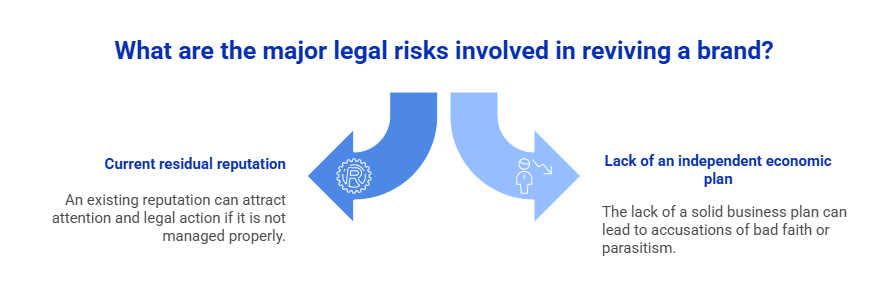
What are the major legal risks identified in reviving a trademark?
Reviving a brand becomes legally risky when the following conditions are met:
- A current residual reputation, a proven knowledge of this reputation,
- And the absence of an independent economic project,
which exposes the applicant to:
- Invalidity for bad faith,
- Parasitic actions,
- And the lasting blockage of any revival strategy.
Conclusion
The revival of brands is a powerful strategy, but it must be approached with caution. A zombie brand can offer a significant competitive advantage, but the legal risks are also substantial. A successful resurrection relies on good faith, genuine use, and a thorough understanding of European case law. Therefore, a detailed analysis of the brand’s history, its prior use, and its residual reputation is essential.
Dreyfus & Associés works in partnership with a global network of specialized intellectual property lawyers.
Nathalie Dreyfus with the support of the entire Dreyfus team.
Q&A
1. What is a parasitic act in the context of brand revival?
A parasitic act involves exploiting the reputation of a historical brand without bringing any real innovation or added value, with the aim of unduly benefiting from its image.
2. What are the legal risks associated with reviving a dormant trademark?
Reviving a brand involves several legal risks, including cancellation for non-use if the brand has not been used for an extended period, bad faith, or a risk of confusion with other brands.
3. Can a dormant trademark be revived if it has been cancelled for non-use?
Reviving a dormant brand cancelled for non-use is possible, but it is subject to strict conditions. If a brand has been cancelled for non-use, it is necessary to prove that it has been used again in a serious and continuous manner in commerce.
4. Does residual good faith protect a trademark?
It depends on the assessment of the courts, based on whether the brand’s notoriety is still active in the public’s mind.
This publication is intended for general public guidance and to highlight issues. It is not intended to apply to specific circumstances or to constitute legal advice.