


Sommaire
- 1 Introduction
- 2 Distinctiveness, descriptiveness, and bad faith : securing the validity of the filing
- 3 Use and proof of use : anticipating enforcement from the outset
- 4 Specifications and foreign office practices : focus on the United States and Canada
- 5 Clearance searches and territorial strategy
- 6 Cumulative protection and portfolio structuring
- 7 Rationalisation and optimisation : audit and article 4bis of the Madrid Protocol
- 8 Conclusion
- 9 Q&A
Introduction
In 2026, filing a trademark is no longer merely about “reserving a name.” The filing has become a fully-fledged legal and strategic act, directly engaging the applicant’s responsibility and determining the future strength of the portfolio. This evolution results from a now-structuring triptych : the continuous increase in trademark filings, the tightening of office practices (INPI, EUIPO, and foreign offices), and the rise of opportunistic behaviour.
A poorly anticipated strategy exposes applicants to refusals at the examination stage, multiple opposition proceedings, and subsequent invalidity or revocation actions. Above all, registration only confers a presumption of ownership. A trademark may be registered without opposition due to the absence of monitoring, and later challenged once the project is already established, thereby jeopardising substantial marketing investments.
In 2026, the objective is therefore clear : to file more effectively and manage rights proactively. This requires securing registration, structuring the portfolio, anticipating evidence, and organising enforcement within a sustainable framework.
Distinctiveness, descriptiveness, and bad faith : securing the validity of the filing
The tightening of practices relating to distinctiveness and descriptiveness has become a fundamental parameter. Offices and courts now require more strictly that a sign fulfil its essential function of indicating commercial origin. This severity is directly linked to the progressive saturation of registers, with filings having tripled over the past twenty years.
Signs closely related to professional jargon, evoking product characteristics, or bearing strong sector-specific connotations are now subject to heightened scrutiny. Assessment is carried out exclusively as of the filing date, based on the perception of the relevant public, without any binding precedent drawn from earlier registrations.
This requirement fully extends to descriptive signs. In this respect, the cancellation by the EUIPO of OpenAI’s “GPT,” “GPT-3,” “GPT-4,” and “GPT-5” trademarks provides a particularly significant illustration. The Office held that the term “GPT,” meaning “Generative Pre-Trained Transformer,” refers to a language model architecture based on machine learning commonly used in artificial intelligence. Due to its widespread use to describe a technology rather than a commercial origin, the term was deemed generic and devoid of distinctive character.
At the same time, bad faith has become a central ground in trademark litigation. Authorities examine, in particular, knowledge of prior rights, lack of intent to use, refiling strategies, and the appropriation of abandoned trademarks. Attempts to revive “zombie” trademarks are assessed in light of the economic context and the effective reputation at the filing date.
Securing the validity of a filing therefore requires thorough preliminary analysis, addressing both the inherent distinctiveness of the sign and the risk of challenges based on bad faith.
Use and proof of use : anticipating enforcement from the outset
Consistency between the specification and actual or foreseeable use has become a major vulnerability in 2026. From the filing stage, the owner must anticipate the creation of a structured evidentiary file.
This file should include tangible materials : commercial documents, packaging, labels, invoices, catalogues, marketing content, affidavits, studies, and quantitative data. Their probative value is enhanced when they clearly indicate the trademark, date, relevant products, and territory.
Such anticipation is strategic. In certain jurisdictions, use directly conditions the validity or maintenance of rights. Moreover, once a trademark is more than five years old, adversaries may request proof of use in various procedural contexts.
The concept of sub-categories reinforces this requirement. Where a specification covers a broad category, use may need to be demonstrated for each relevant autonomous sub-segment. Exploitation of a single product does not necessarily preserve rights for the entire scope.
Evidentiary anticipation thus becomes a core pillar of portfolio governance.
Specifications and foreign office practices : focus on the United States and Canada
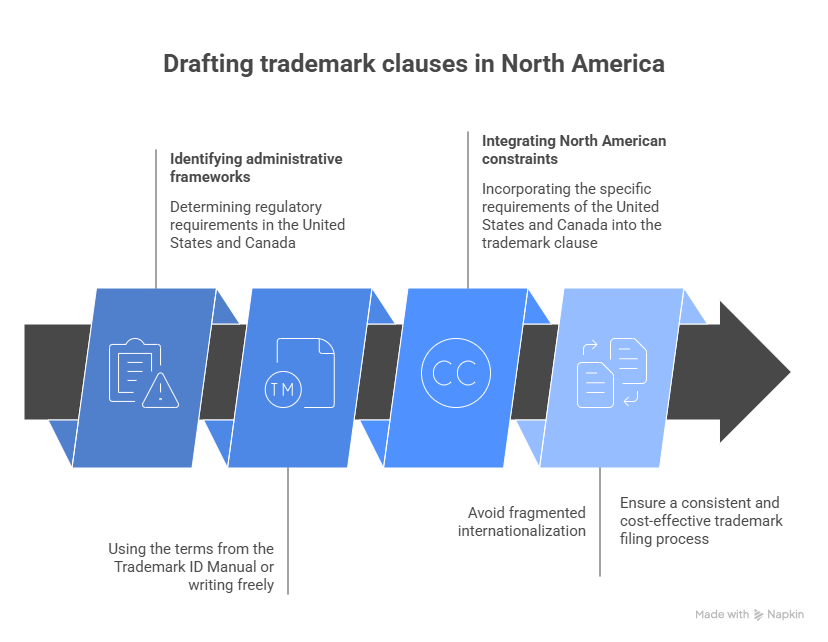
In the United States and Canada, drafting the specification represents a major procedural issue. Compliance with administrative standards directly affects costs, timelines, and objection risks.
Since 2025, the USPTO has imposed a structural choice : reliance on pre-approved terms from the Trademark ID Manual or use of customised wording. The former facilitates processing and reduces fees, while the latter entails stricter examination and increased risk of provisional refusals.
Canada applies a comparable approach, with heightened scrutiny of goods and services within an increasingly automated examination framework.
In this context, a specification drafted solely in accordance with European standards may prove inadequate. Integrating North American constraints from the outset often avoids fragmented and costly internationalisation.
Clearance searches and territorial strategy
Clearance searches have become an indispensable preventive investment. Filing without a serious search, or based on informal checks, exposes applicants to disproportionate risks.
In a saturated environment, thorough searches help identify potential obstacles, adapt the sign, strengthen distinctiveness, or adjust the specification before significant financial commitments are made.
Territorial strategy must be developed concurrently. Limiting protection to the country of headquarters is no longer sufficient. Production countries, distribution markets, and structurally high-risk regions must be considered.
Cumulative protection and portfolio structuring
Protection based solely on a word trademark is not always optimal. Depending on the sector, cumulative rights significantly enhance overall defensibility.
Trademarks protect distinctive signs. Designs protect appearance. Figurative or semi-figurative trademarks secure visual elements. Each title has its own criteria and provides complementary enforcement tools.
In creative industries, particularly fashion and cosmetics, this combination enables more effective responses to duplication and parasitic practices.
The European design law reform, gradually applicable from 2026, further reinforces the value of an integrated and anticipatory approach.
Rationalisation and optimisation : audit and article 4bis of the Madrid Protocol
In 2026, portfolio management requires strategic oversight. Audits enable assessment of alignment between actual activities and registered rights, identification of vulnerabilities, and elimination of unnecessary costs.
Duplication situations, particularly resulting from Brexit, illustrate the importance of this approach. Without audits, redundant rights continue generating expenses without added value.
Article 4bis of the Madrid Protocol offers an additional rationalisation tool. Under strict conditions, it allows an international registration to replace national rights while preserving priority.
Use assimilation strengthens continuity. However, dependency periods and varying office practices require cautious and well-documented implementation.
Conclusion
In 2026, trademark strategy rests on a demanding balance between legal security, risk anticipation, and cost control. Filing represents a structuring investment requiring rigour, territorial coherence, drafting precision, and evidentiary organisation.
Protection does not end with registration. It requires active management, regular audits, and continuous monitoring policies to preserve the long-term distinctiveness and economic value of signs.
Dreyfus & Associés supports its clients in managing complex intellectual property matters by providing tailored advice and comprehensive operational support for the full protection of intellectual property rights.
Nathalie Dreyfus, with the support of the entire Dreyfus team.
Q&A
1. What checks should be carried out before investing in a “short” sign to limit cascading oppositions ?
Beyond identity searches, phonetic and visual proximity, registry density in relevant classes, and the descriptive load of the sign must be analysed to assess real multi-front risk.
2. How can a specification be calibrated when offerings evolve rapidly ?
It is preferable to reason in terms of foreseeable commercial uses and sub-categories, covering core activities and realistic extensions while avoiding generic formulations likely to trigger objections or bad faith claims.
3. What warning signs indicate a risk of invalidity for bad faith before filing ?
Disproportionate specifications, lack of a credible exploitation project, a history of defensive filings without use, or conflict contexts (former partners, employees, distributors) are major red flags.
4. When should trademark monitoring be implemented, and with what minimum scope ?
From filing, ideally at launch, as lack of monitoring may allow oppositions to lapse. A baseline covering trademarks, company names, and domain names in key territories limits unexpected challenges.
5. When is a figurative or position trademark more wise than a word trademark alone ?
When the verbal element is weak or overcrowded, protection of a distinctive visual configuration or position may provide a stronger enforcement angle.
This publication aims to provide general guidance to the public and highlight certain issues. It is not intended to apply to specific situations or constitute legal advice.