

Sommaire
- 1 Introduction
- 2 What is trademark invalidity under French and EU law ?
- 3 Absolute and relative grounds for trademark invalidity
- 4 Invalidity proceedings before the INPI and the EUIPO
- 5 What evidence is required to obtain trademark invalidity ?
- 6 Invalidity, opposition or revocation : which strategy should be chosen ?
- 7 Conclusion
- 8 FAQ
Introduction
Trademark invalidity in France and in the European Union has become a major strategic tool for securing a portfolio of rights, defending a competitive position, or neutralizing an opportunistic filing. Since the reform introduced by the Ordinance of November 13, 2019 and the transfer of jurisdiction to the French National Institute of Industrial Property (INPI) for a large portion of intellectual property administrative disputes, invalidity actions have become more structured, professionalized, and significantly faster.
When can an invalidity action be brought ? On what legal grounds ? What procedure should be followed before the INPI or the EUIPO ? And above all, how can the chances of obtaining cancellation of a registered trademark be maximized ?
We provide here a structured, practical analysis grounded in experience.
What is trademark invalidity under French and EU law ?
Trademark invalidity consists of establishing that a sign registered as a trademark should never have benefited from the protection granted under trademark law. It is not a matter of sanctioning conduct occurring after registration, but rather of identifying a legal defect that existed at the filing date. In other words, invalidity is based on the principle that the trademark was irregular ab initio.
Since the reform that entered into force in 2020, the INPI has jurisdiction over administrative invalidity actions. This development has profoundly transformed practice by making proceedings more accessible and considerably faster.
At EU level, Regulation (EU) 2017/1001 governs invalidity proceedings before the EUIPO. Although principles are harmonized, the analysis remains demanding, particularly with regard to evidence and the assessment of likelihood of confusion.
The effect of an invalidity decision is particularly powerful : the trademark is deemed never to have existed. This retroactive effect may weaken license agreements, coexistence agreements, or infringement actions based on the cancelled title. In strategic litigation, invalidity can therefore neutralize a competitor’s legal weapon.
Absolute and relative grounds for trademark invalidity
The distinction between absolute and relative grounds structures the entire invalidity framework. The former protect the public interest; the latter safeguard earlier private rights.
-
Absolute grounds for invalidity :
A trademark is liable to invalidity if, at the time of filing, it did not meet the essential validity requirements. This is the case where it lacks distinctive character, merely describes the goods or services concerned, has become customary in everyday language, or is misleading as to the nature, quality, or origin of the goods.
Contrary to public policy or morality may also constitute an independent ground, although its application remains rare and strictly interpreted.
Bad faith of the applicant has become central in contemporary case law. French and European courts carefully scrutinize massive, defensive, or speculative filing strategies. A filing made solely to prevent a competitor from accessing the market, without any genuine intention to use the sign, may constitute abusive conduct justifying cancellation.
In technological sectors, we frequently observe filings anticipating emerging trends, such as artificial intelligence, blockchain, or the metaverse, made by entities with no actual development project. In such situations, the chronology of events, the relationship between the parties, and the competitive context become decisive.
-
Relative grounds for invalidity :
Invalidity may also be based on the existence of an earlier right. This may include a French trademark, an EU trademark, or an international trademark designating the relevant territory. Other rights may also be invoked, such as a prior company name, trade name, domain name effectively used in the course of trade, copyright, or personality rights.
The analysis is based on the concept of likelihood of confusion, assessed globally. Authorities examine the visual, phonetic, and conceptual similarity of the signs, the proximity of the goods or services, and the distinctiveness of the earlier right. This assessment is contextualized: the relevant public, the level of consumer attention, and the possible reputation of the earlier right all play a determining role.
Practice shows that mere chronological priority is insufficient. It is also necessary to demonstrate effective use and real economic impact. Evidentiary strategy therefore lies at the heart of a successful action.
Invalidity proceedings before the INPI and the EUIPO
Since the reform, proceedings before the INPI have become a particularly effective tool. The procedure is fully digital and based on a strictly regulated timetable. Exchanges are written and adversarial. Each party must present all arguments and evidence within the prescribed deadlines, failing which submissions may be declared inadmissible.
A decision is generally issued within six to ten months, which represents a significant gain in time compared to traditional judicial proceedings. This speed allows invalidity actions to be integrated into broader commercial strategies, including fundraising operations or portfolio restructuring.
Certain complex situations, particularly where invalidity is based on copyright or contractual issues, remain within the jurisdiction of judicial courts.
For further information on the invalidity procedure before the INPI, we invite you to refer to our article, previously published on this subject.
Before the EUIPO, proceedings follow a similar logic within a harmonized European framework. The application must be precisely reasoned and accompanied by all relevant evidence. The trademark holder has the right to respond, and the decision may be appealed before the Boards of Appeal.
The evidentiary requirement is particularly high. Applications that are insufficiently substantiated are systematically rejected. Drafting rigor and strategic coherence are therefore essential.
What evidence is required to obtain trademark invalidity ?
The success of an invalidity action largely depends on the quality of the evidence produced. For absolute grounds, it may be necessary to demonstrate the descriptive nature of a term through linguistic analyses, specialized dictionary extracts, sector publications, or examples of common market usage.
In cases involving bad faith, email exchanges, the chronology of business relationships, competing initiatives, or a manifest absence of intent to use may constitute decisive indicators.
Where invalidity is based on an earlier right, registration certificates alone are not always sufficient. If the earlier trademark is more than five years old, its holder must demonstrate genuine use. Invoices, catalogs, advertising campaigns, dated screenshots, and sector-specific turnover figures then become essential.
Recent case law strictly regulates the late submission of evidence. Methodical anticipation is therefore indispensable from the outset of the action.
Invalidity, opposition or revocation : which strategy should be chosen ?
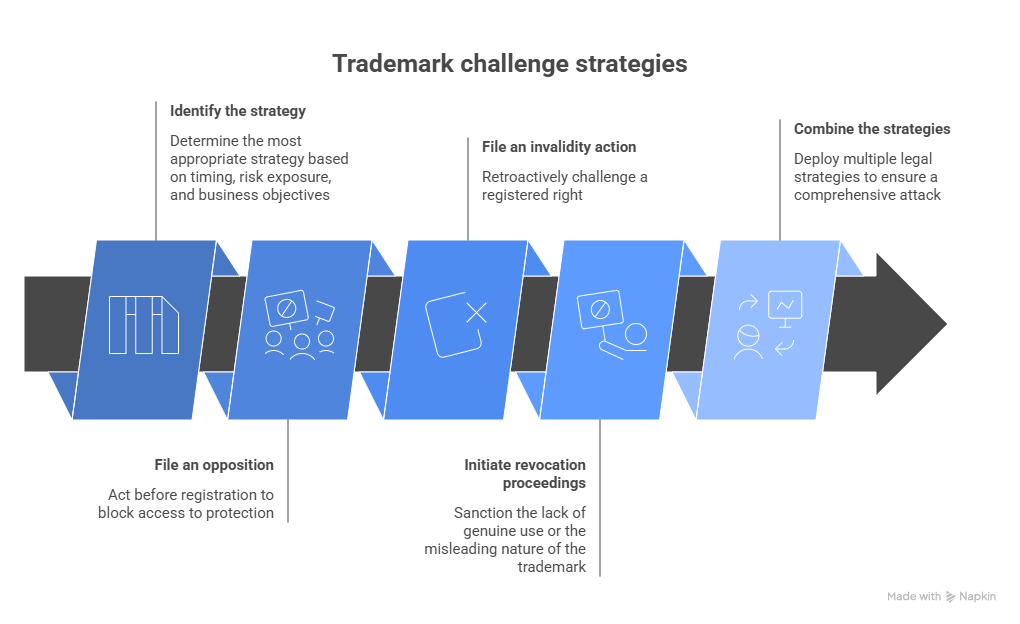
The choice between opposition, invalidity and revocation is not merely a procedural preference ; it forms part of a broader strategic approach that takes into account timing, legal risk exposure and underlying business objectives.
Opposition is the preventive tool by excellence. It allows action to be taken upstream, before the contested trademark is registered. In France, opposition must be filed within two months from the publication of the application in the official bulletin (BOPI). At European Union level, the time limit is three months from the publication of the European Union trademark application by the EUIPO. The decisive advantage of opposition lies in its ability to block registration and prevent the trademark from producing legal effects. However, it requires active monitoring of trademark filings and immediate responsiveness.
Invalidity, by contrast, operates after registration. It enables a party to challenge retroactively a right that has already been entered on the register. Invalidity becomes a central strategic instrument when the opposition deadline has expired or when the dispute arises within broader litigation, particularly as a defense in infringement proceedings. In such cases, invalidity can neutralize the very foundation of the opposing party’s claim by eliminating the invoked trademark altogether.
Revocation follows a different logic. It sanctions the absence of genuine use of a trademark over an uninterrupted five-year period, or circumstances where the mark has become misleading or generic. Revocation is rooted in post-registration conduct and relies on a factual assessment of the effective commercial exploitation of the sign. In complex matters, revocation may be strategically combined with an invalidity action, allowing the claimant to articulate multiple lines of attack, one based on the initial irregularity of the filing, the other on the lack of subsequent use.
Ultimately, opposition protects proactively, invalidity corrects retroactively, and revocation penalizes inactivity. The appropriate choice depends less on the nature of the right itself than on procedural positioning and the competitive strategy pursued.
Conclusion
Trademark invalidity in France and in the European Union is a powerful strategic instrument for the protection of intangible assets. Early analysis and rigorous structuring of the case significantly increase the likelihood of success.
Dreyfus & Associés assists its clients in managing complex intellectual property matters by providing tailored advice and comprehensive operational support for the full protection of intellectual property rights.
Nathalie Dreyfus with the support of the entire Dreyfus team.
FAQ
1. Can a trademark be invalidated for lack of genuine intention to use at the time of filing ?
Yes. If the filing was made without a serious intention to use the mark, in a blocking or speculative strategy, this may constitute bad faith and justify cancellation, provided consistent and objective evidence is produced.
2. Can a prior domain name be relied upon to obtain trademark invalidity ?
Yes, provided that effective prior use of the domain name in the course of trade and a likelihood of confusion are demonstrated. Mere registration is insufficient; commercial exploitation is decisive.
3. Can a weakly distinctive trademark be invalidated several years after registration ?
Yes, if the lack of distinctiveness existed from the outset and has not been remedied by intensive use conferring acquired distinctiveness. The burden of proving such acquired distinctiveness lies with the trademark holder.
4. Can an invalidity action be brought defensively in infringement proceedings ?
Absolutely. Invalidity is frequently used as a strategic defense. If the invoked trademark is cancelled, the infringement action becomes legally unfounded.
5. Does peaceful coexistence between two trademarks prevent an invalidity action ?
Not necessarily. However, conscious and prolonged tolerance of more than five years may, in certain circumstances, deprive the earlier right holder of the ability to act, except in cases of bad faith.
This publication is intended for general public guidance and to highlight issues. It is not intended to apply to specific circumstances or to constitute legal advice.