

Sommaire
Introduction
With the rapid development of generative AI systems capable of simulating voices and faces with striking realism, the legal protection of digital identity remains fragile. In this context, American actor Matthew McConaughey recently filed several trademark applications with the United States Patent and Trademark Office (USPTO), including movement trademarks depicting him.
Such an initiative has surprised many legal practitioners, as it challenges the traditional boundaries of trademark law and raises novel questions regarding the legal protection of digital identity.
The limits of personality rights in the face of generative AI
Under French law, a person’s image and voice are protected as personality rights, primarily pursuant to Article 9 of the French Civil Code related to the right to privacy. This provision protects any unauthorized use of elements enabling the identification of a person, irrespective of whether a pre-existing material medium exists. An infringement may therefore be established whenever the public is capable of recognizing the individual concerned.
Although protective, this regime relies on demanding evidentiary requirements. The claimant must demonstrate the existence of an infringement, fault, identification of the responsible party, and, where applicable, the extent of the damage suffered.
The emergence of generative AI complicates each of these elements. AI systems may produce “resembling” voices or faces without directly reproducing an identifiable recording or photograph. The legal issue lies less in the distinction between reproduction and simulation than in the assessment of identifiability: at what level of resemblance can a person be deemed legally recognizable?
Further uncertainty arises from issues of attribution. The generation of AI content may involve multiple actors, developers, infrastructure providers, end users, and distribution platforms, thereby rendering the allocation of liability more complex. Existing mechanisms remain primarily corrective and intervene only after the dissemination of the contested content.
The evolution of filing requirements for distinctive signs
Since the entry into force of French Ordinance No. 2019-1169 of November 13, 2019 implementing the EU Trademark Package (Directive (EU) 2015/2436), French trademark law has undergone significant modernization.
The abolition of the requirement of graphic representation replaced by the obligation to represent the sign in a manner that is clear, precise, self-contained, easily accessible, intelligible, durable and objective in the register, has considerably broadened the range of registrable signs. This reform follows the criteria established by the Court of Justice of the European Union in the Sieckmann judgment (CJEU, December 12, 2002, Case C-273/00), which are now fully integrated into the practice of trademark offices.
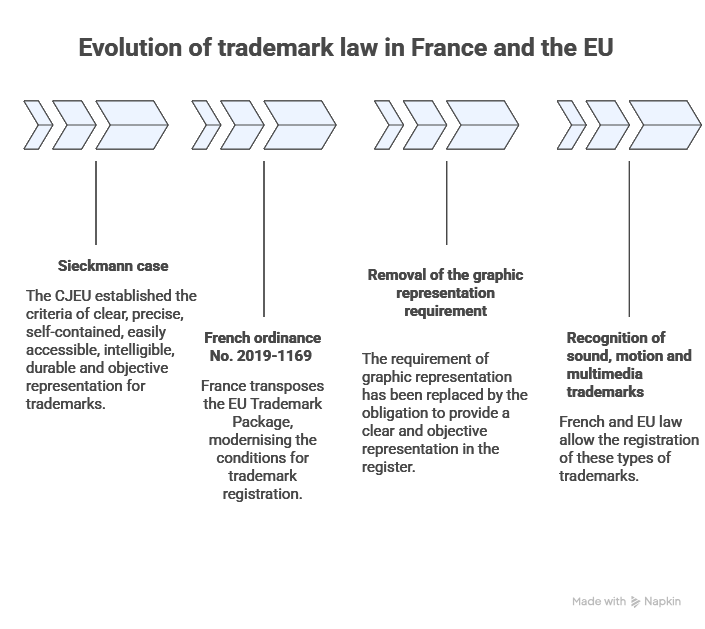
Within this updated framework, French and EU law expressly permit the registration of sound trademarks, movement trademarks and multimedia trademarks, provided that they are represented in an appropriate technological format, such as an audio file (MP3) or video file (MP4). A sound trademark may therefore consist of a precisely fixed sequence, such as a jingle, a distinctive intonation or a recurring expression used in a commercial context, provided that the relevant public perceives it as an indication of commercial origin.
The protection of voice and image through trademark law under French and EU Law
Pursuant to Article L.711-2 of the French Intellectual Property Code, a sign may be registered only if it is linked to designated goods or services and used as a trademark to distinguish the goods or services of one undertaking from those of others. When applied to a sound or audiovisual sequence, this principle requires that the relevant public perceive the sequence as an indication of commercial origin.
It is essential to emphasize the precise scope of the monopoly conferred. Protection extends exclusively to the sign as filed and exploited, namely, the specific sound or audiovisual sequence recorded in the register. Trademark law does not grant a general appropriation of a person’s identity; rather, it secures a defined expression integrated into commercial activity.
The primary advantage of relying on trademark law lies in its litigation framework. The proprietor of a registered trademark holds a constitutive right benefiting from a presumption of validity and may initiate counterfeiting proceedings where a third party reproduces or imitates the sign in the course of trade for identical or similar goods or services.
Such action is based on the infringement of the registered sign itself, independently of the need to demonstrate personal moral damage, and allows for effective injunctive relief, including through internal procedures implemented by digital platforms.
Nonetheless, a measured approach remains necessary. Registering a sound or audiovisual excerpt as a trademark is legally demanding. Trademark law is not intended to protect an individual’s personality but to identify the commercial origin of goods or services.
Attempting to secure a voice or image through trademark law may therefore conflict with its economic rationale. It must be demonstrated that the sign genuinely fulfills the essential function of a trademark and is not merely perceived as a representation of the individual. Failing genuine use within the meaning of trademark law, the registration risks being challenged or revoked for non-use.
Conclusion
Trademark law protects only a specific sign exploited as an indication of origin in the course of trade. Its effectiveness will therefore depend, in practice, on the proprietor’s ability to demonstrate genuine, distinctive use as a trademark.
In the context of generative AI, trademark law does not constitute a universal solution. Nevertheless, it offers a more structured legal framework than personality rights alone, allowing certain uses to be anticipated and supported by an enforceable registered title. Such a strategy must, however, be embedded in a coherent and sustained commercial exploitation.
Dreyfus & Associés assists its clients in managing complex intellectual property cases, offering personalized advice and comprehensive operational support for the complete protection of intellectual property.
Nathalie Dreyfus with the support of the entire Dreyfus team
Q&A
1.Does trademark law protect against non-commercial deepfakes?
No. Trademark law requires use in the course of trade. Deepfakes disseminated for parody or private purposes are more likely to fall under image rights or other legal mechanisms.
2.Does celebrity status provide an advantage when registering a voice excerpt?
Not automatically. While notoriety may facilitate the acquisition of distinctiveness through use, it does not exempt the applicant from satisfying the statutory conditions.
3.Does parody limit trademark protection?
In certain circumstances, freedom of expression may be invoked, particularly where the use does not undermine the essential function of the trademark.
4.Does a multimedia trademark offer broader protection?
It may provide more precise protection where the combination of sound and image constitutes the core element of commercial identification.
5.Why does registering a trademark simplify judicial proceedings in cases involving voice or image misuse?
Because infringement proceedings are based on the existence of a registered and presumed valid right, shifting the debate from the subjective assessment of personal harm to the more objective issue of infringement of a protected sign. This may render the evidentiary analysis clearer and more structured before court.
The purpose of this publication is to provide general guidance to the public and to highlight certain issues. It is not intended to apply to particular situations or to constitute legal advice.