


Sommaire
- 1 Introduction
- 2 The background of the case: A revealing illustration of contemporary creative practices
- 3 Fundamental reminder: no “minimum degree of creativity” required for design protection
- 4 The informed user and the requirement of a global comparison
- 5 Practical implications of the case for fashion stakeholders
- 6 Conclusion
- 7 Q&A
Introduction
In its Deity Shoes case of December 18, 2025, the Court of Justice of the European Union (CJEU) clarified with remarkable precision the conditions for protection of community designs.
Through this decision, the Court reaffirmed two fundamental principles: first, that protection under Regulation (EC) No 6/2002 is subject solely to novelty and individual character. Second, that the existence of fashion trends cannot lower the threshold required to establish individual character.
In recent years, fast fashion has profoundly transformed the fashion industry. Within weeks sometimes days a trend spotted on a runway or social media platform is reproduced on a large scale. The phenomenon of “dupes” products openly marketed as near-identical alternatives at lower prices further intensifies this pressure. We invite you to read our article previously published on this issue.
This judgment arises in a context marked by increasing litigation related to fashion, product customization and rapid reproduction practices. It now stands as a key reference for design right holders throughout the European Union.
The background of the case: A revealing illustration of contemporary creative practices
Deity Shoes marketed footwear protected by community design registrations. Its creative process relied on selecting and combining components sourced from catalogues of Asian suppliers. Colors, materials, decorative elements and accessories were chosen from pre-defined options and assembled into a final product intended for the European market.
When sued for counterfeiting, the defendant companies challenged the validity of the asserted rights. In their view, the designs merely resulted from the juxtaposition of pre-existing elements, without genuine creative contribution, and therefore could not meet the statutory requirements.
The CJEU was asked to clarify two sensitive issues:
- Whether a minimum threshold of creativity exists under EU design law;
- Whether fashion trends affect the assessment of individual character.
Fundamental reminder: no “minimum degree of creativity” required for design protection
One of the central questions referred to the Court concerned the possible existence of a minimum creativity threshold. The defendants argued that the contested designs reflected nothing more than combinations of existing elements and did not demonstrate any particular intellectual effort.
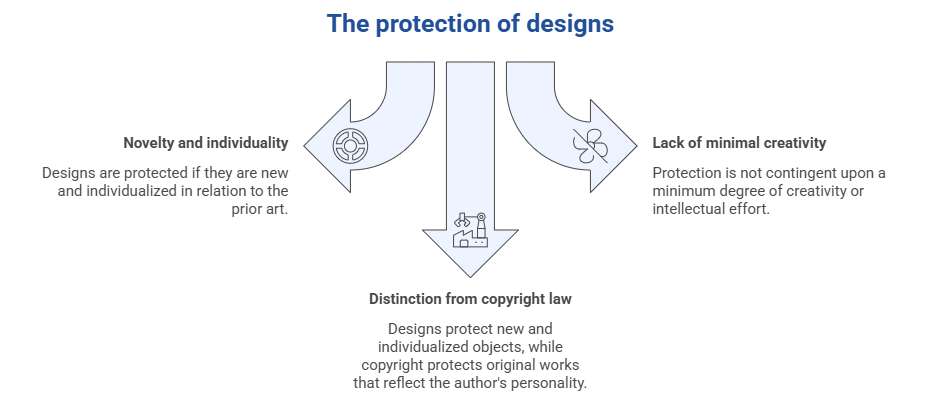
The Court rejected this reasoning unequivocally. Protection under Regulation No 6/2002 cannot be made conditional upon a “minimum degree of creativity” or a “particular intellectual effort.”
The Court clearly distinguished design law from copyright law. While copyright protects original “works” reflecting the author’s personality, design law protects new and individualized objects, often of an utilitarian nature and intended for mass production.
Accordingly, the assessment does not focus on the intensity of the creative process but on the final product. Novelty and individual character must be evaluated through an objective comparison with prior designs. The concept of “designer,” referred to in Article 14 of the Regulation, is relevant only for determining ownership and does not introduce any additional substantive condition for protection.
Design law: is the customization of a pre-existing design sufficient to establish individual character?The Court further clarified that “the fact that a design results from the personalization of a basic model […] is not, in itself, an obstacle to recognizing its individual character.”
The decisive factor remains the overall impression produced on the informed user. Even when composed of known elements, a design may be protectable if the specific combination creates an overall impression that differs from that produced by any individual prior design.
This clarification is crucial for the fashion industry, where creativity often operates through selection, adaptation and recombination rather than radical invention.
The informed user and the requirement of a global comparison
The Court adopted a rigorous approach to the assessment of individual character. The analysis must be conducted from the perspective of the informed user, defined as a person possessing a high degree of attention and extensive knowledge of the sector concerned.
This informed user is familiar with prevailing fashion trends. However, such knowledge does not reduce the level of scrutiny. On the contrary, it makes the user more attentive to differences in detail.
The Court emphasized that the assessment must be based on a global comparison, independent of aesthetic considerations, commercial positioning or the popularity of certain elements. The reasoning cannot rely on the notoriety of a trend or market saturation.
Practical implications of the case for fashion stakeholders
The judgment comes at a time of modernization of EU design law. The ongoing reform seeks to adapt the system to digital environments, clarify key concepts and enhance legal certainty.
In this context, the Deity Shoes ruling consolidates the theoretical foundations of the regime. It reassures right holders by confirming that protection is not dependent on fluctuating subjective criteria. At the same time, it prevents an excessive dilution of the individual character requirement in a sector heavily influenced by trends.
For businesses, this case law calls for a structured filing strategy. It is essential to:
- Clearly define the scope of claimed protection;
- Identify the visually dominant features of the design;
- Anticipate potential comparisons with prior art.
A proactive and strategic approach significantly enhances enforceability against fast fashion operators.
Conclusion
Design rights constitute an effective legal weapon against fast fashion, provided they are deployed within a coherent strategy. The Deity Shoes ruling clarifies that protection does not depend on subjective creative effort or the existence of fashion trends, but rather on the overall perception of the product by the informed user.
This strengthens business models based on adaptation and combination while maintaining a high and objective threshold for individual character. For fashion creators who invest in structured intellectual property protection, the legal framework offers robust and predictable safeguards.
Dreyfus & Associés assists its clients in managing complex intellectual property matters by providing tailored advice and comprehensive operational support for the full protection of their intellectual assets.
Dreyfus & Associés works in partnership with a global network of Intellectual Property attorneys.
Nathalie Dreyfus with the support of the entire Dreyfus team
Q&A
1. Can fast fashion reduce the effectiveness of design protection?
Fast fashion does not alter the legal validity criteria. However, rapid production cycles and widespread copying may complicate enforcement. Effectiveness therefore largely depends on the filing, monitoring and enforcement strategy implemented by the right holder.
2. Can a design inspired by a supplier’s catalogue be protected?
Yes. The CJEU confirmed that a design resulting from the personalization or combination of pre-existing elements may be protected, provided that the chosen combination produces a distinct overall impression. The originality of each component taken individually is irrelevant.
3. Does commercial success influence the assessment of individual character?
No. The analysis is strictly legal and objective. Market popularity, aesthetic appeal or branding strategy do not affect validity. Only the overall impression on the informed user is decisive.
4. How long does protection of a community design last?
A registered community design is protected for an initial period of five years, renewable in five-year increments up to a maximum of 25 years. An unregistered community design benefits from three years of protection from the date of disclosure within the European Union.
5. Is it necessary to demonstrate significant creative effort to obtain protection?
No. Unlike copyright law, EU design law does not require a minimum degree of creativity or particular intellectual effort. Novelty and individual character are the only substantive requirements.