


Sommaire
Introduction
The Uniform Domain Name Dispute Resolution Policy (UDRP) constitutes the principal extrajudicial mechanism for resolving domain name disputes at the international level. Established by ICANN (Internet Corporation for Assigned Names and Numbers) in 1999, it enables trademark owners to challenge the abusive registration and use of domain names commonly referred to as cybersquatting without resorting to traditional court proceedings, which are typically lengthier and more costly.
Since March 9 2026, one of the five providers accredited to administer UDRP proceedings, namely the WIPO Arbitration and Mediation Center, has introduced an optional priority processing service (“UDRP Priority Service”), enabling the expedited examination of certain UDRP complaints. This optional mechanism allows complainants, upon request and subject to the Center’s acceptance, to benefit from an accelerated review of their complaints.
Overview of the UDRP procedure
The UDRP primarily applies to domain names registered under generic top-level domains (gTLDs), including new gTLDs, as well as certain country-code top-level domains (ccTLDs) that have contractually adopted the Policy.
To succeed in a UDRP complaint, the complainant must establish the following three cumulative elements:
- Identity or confusing similarity: the disputed domain name must be identical or confusingly similar to a trademark or distinctive sign in which the complainant has rights.
- Absence of rights or legitimate interests: the domain name holder must lack rights or legitimate interests in respect of the domain name, such as prior bona fide use or legitimate non-commercial use.
- Registration and use in bad faith: the domain name must have been registered and used in bad faith, typically for purposes such as diversion, speculative resale, or exploitation aimed at harming or capitalizing on the trademark owner’s reputation.
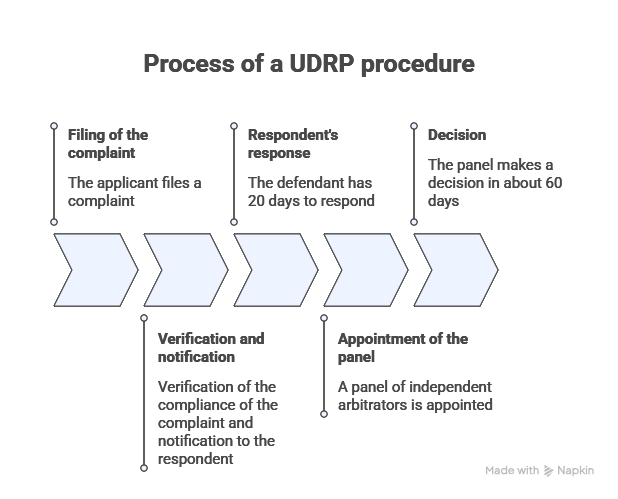
Within this framework, the administrative Panel may order the transfer or cancellation of the disputed domain name. The UDRP does not provide for monetary damages. The parties nevertheless retain the right to initiate proceedings before competent national courts.
On average, a UDRP proceeding lasts between 45 and 60 days. While significantly shorter than conventional litigation, this timeframe may remain considerable in cases involving manifest infringement of prior rights. During this period, the continued operation of the disputed domain name may cause substantial harm, including reputational damage and diversion of customers.
For more information on the classic UDRP procedure, you can read the previously published article on the subject: https://www.dreyfus.fr/en/2025/01/29/the-evolution-of-udrp-procedures-what-you-need-to-know-in-2025/
It was in this context that the Uniform Rapid Suspension (URS) mechanism was introduced to address clear-cut cases of cybersquatting more swiftly. However, while the URS enables the rapid suspension of a domain name, it does not result in either its transfer or its definitive cancellation. It applies primarily to the gTLDs launched under ICANN’s 2012 “New gTLD Program”, as well as to certain pre-existing extensions that have incorporated the URS following the renewal of their registry agreements, such as, for example, “.org, .info, .biz, .mobi, .travel, .jobs, .pro”. Its scope and remedial effect therefore remain restricted, prompting renewed consideration of genuinely expedited UDRP procedures.
Implementation of an expedited UDRP procedure
In response to the need for more rapid dispute resolution while preserving the substantive effects of the traditional UDRP, WIPO has recently introduced an expedited UDRP mechanism. This service is intended to be used in relatively straightforward or clear-cut disputes, particularly where the facts and legal arguments do not raise any particular complexity and therefore allow for expedited processing of the case.
The principal advantage of this framework lies in the fact that it remains a fully-fledged UDRP proceeding capable, in particular, of transferring the domain name while operating under a significantly compressed timeline. Accordingly, the legal criteria of the UDRP Policy remain unchanged: the complainant must still establish the three cumulative elements required under the Policy.Under this mechanism, a decision may be notified within approximately 30 days from the filing of the complaint.
It should, however, be noted that this timeframe remains subject to certain external factors, including the response times of the registrar and the parties, which may affect the overall duration of the proceedings.
How does the expedited UDRP procedure operate?
- Number of Panelists
Under this system, the case is decided by a sole Panelist. Any request for the appointment of a three-member Panel automatically removes the case from the expedited track and results in its treatment under the standard UDRP procedure.
- Number of domain names
The expedited procedure may apply up to five domain names, provided that they are all held by the same registrant.
This requirement inherently excludes any request for consolidation involving multiple respondents or necessitating proof of common control among different entities.
- Costs of the procedure
The fees are structured as follows:
- USD 4,000 in administrative fees;
- USD 3,000 corresponding to the Panelist’s fees.
Conclusion
In summary, the expedited UDRP procedure reflects an effort to adapt dispute resolution mechanisms to the need for increased speed in online infringement matters. It preserves the essential effects of the traditional UDRP while substantially reducing processing time. As such, it offers an intermediate solution between the standard UDRP procedure and the URS. Its practical effectiveness will ultimately depend on its implementation conditions and its attractiveness to rights holders.
Dreyfus & Associés assists its clients in managing complex intellectual property cases, offering personalized advice and comprehensive operational support for the complete protection of intellectual property.
Nathalie Dreyfus with the support of the entire Dreyfus team
FAQ
1. Why does the URS procedure not replace the UDRP procedure?
Because it does not allow for the transfer of the domain name and applies within a more limited scope of domain names.
2. Who may initiate a UDRP proceeding?
Any individual or entity holding prior rights (including registered or recognized unregistered trademarks, trade names, etc.).
3. What language governs the UDRP proceedings?
In principle, the language of the domain name registration agreement, unless otherwise determined by the Panel.
4. What happens if the respondent fails to reply to the complaint filed against its domain name?
The proceeding continues, and the Panel renders its decision on the basis of the evidence submitted by the complainant.
5. Is there a risk of procedural abuse by complainants?
Yes. A Panel may find that a complaint constitutes Reverse Domain Name Hijacking where the complainant has brought the UDRP proceeding in bad faith (notably where it knew, or should have known, that the Policy requirements were not met). Such a finding is purely declaratory: it entails no monetary award and no order for reimbursement of the administrative fees.
The purpose of this publication is to provide general guidance to the public and to highlight certain issues. It is not intended to apply to particular situations or to constitute legal advice.