


Sommaire
Introduction
The infringement of a Community Plant Variety Right (CPVR) raises particularly sensitive issues. Behind these technical terms often lie years of research, selection, and substantial investment. Council Regulation (EC) No 2100/94 grants the breeder an exclusive right valid throughout the European Union, enabling them to control the production, reproduction, and marketing of the protected plant material.
A recurring difficulty arises in practice: when a plant has been lawfully acquired, may it be freely propagated or commercially exploited without authorization? This raises a central legal question: can the doctrine of exhaustion of rights be invoked to defeat an allegation of infringement of a Community plant variety right? In the field of plant variety protection, the answer requires considerable caution. While European Union law recognizes the principle of exhaustion, its application in this area remains strictly circumscribed.
Understanding the boundary between lawful use and infringement of a Community plant variety right, as well as the limits of the exhaustion doctrine, is therefore essential in order to ensure the secure exploitation of a protected variety and to avoid litigation with potentially significant economic consequences.
What is the Community plant variety protection system?
Community plant variety right constitutes a sui generis industrial property right established by Council Regulation (EC) No 2100/94 and administered by the Community Plant Variety Office (CPVO), based in Angers.
Pursuant to Article 13 of the Regulation, it confers upon the breeder a unitary and exclusive right effective throughout the territory of the European Union. This right enables the breeder to authorise or prohibit the production, reproduction, conditioning for the purpose of propagation, offering for sale, marketing, export, import, or stocking for any of those purposes of propagating material of the protected variety.
The creation of a new plant variety requires years of selection, agronomic trials, genetic stabilization, and technical evaluation. Costs are substantial, biological cycles are lengthy, and the risk of failure is significant. In the absence of legal protection, third parties could easily reproduce the plant material, depriving the breeder of any return on investment. The regime therefore pursues a clear objective: to safeguard varietal innovation by granting a unitary exclusive right across the internal market.
Infringement of a Community plant variety right
Infringement of a Community plant variety right consists of any violation of the exclusive rights conferred upon the holder under Regulation (EC) No 2100/94. The breeder’s right extends to propagating material of the protected variety and, in certain circumstances, to harvested material and essentially derived varieties.
Pursuant in particular to Article 94 of Regulation (EC) No 2100/94, the following acts constitute infringement when carried out without the authorisation of the right holder:
- The production or reproduction (multiplication) of protected plant material (including grafting, cuttings, sowing, or in vitro propagation);
- Offering for sale, selling, marketing, or otherwise placing on the market the protected material;
- Exporting, importing, or stocking for commercial purposes infringing plants, grafts, or seeds.
The material element of infringement lies in the performance of one of these acts. Fault or intent is, in principle, irrelevant: infringement gives rise to strict liability, and the infringer’s good faith does not preclude a finding of liability.
By way of illustration, a nurseryman who lawfully acquires a plant of a protected variety may not, in the absence of a licence, take grafts from that plant in order to produce dozens of trees intended for commercial sale. Such a practice would constitute an act of reproduction of the protected material and could therefore be characterized as an infringement of a Community plant variety right.
Certain statutory exceptions must nevertheless be taken into account under Regulation (EC) No 2100/94, which provides for limitations to the breeder’s exclusive right, including:
- The breeder’s exemption: the use of a protected variety for the purpose of breeding a new variety remains free, except in the case of essentially derived varieties;
- The so-called “farmers’ privilege” (subject to specific conditions and limited to certain species), permitting the reuse on the holding of the product of the harvest;
- Acts done privately and for non-commercial purposes, or for experimental purposes.
Alongside these exceptions, European Union law also recognizes a distinct mechanism: the doctrine of exhaustion of rights. However, this mechanism does not constitute a comparable derogation; it does not authorize the performance of acts reserved to the right holder, but merely limits the latter’s ability to control the circulation of protected material. The question therefore arises as to whether this doctrine is applicable to plant varieties.
Absence of exhaustion of rights under Community plant variety right
Under the doctrine of exhaustion of rights, once a protected product has been placed on the market within the European Economic Area by the right holder or with their consent, the holder may no longer oppose its resale. The exclusive right is thus “exhausted” in respect of that specific item.
Within the system of Community plant variety protection, this mechanism does exist, but it remains strictly circumscribed. Exhaustion applies only to acts relating to plant material that has been placed on the market with the authorization of the right holder, and solely with regard to its resale in the same form, pursuant to Article 16 of Regulation (EC) No 2100/94.
However, exhaustion never extends to acts of reproduction, multiplication, production, or the further cultivation of protected material. Accordingly, the lawful marketing of a plant or graft does not authorize its subsequent propagation without a licence. As a result, the doctrine of exhaustion cannot, in principle, be invoked to justify such acts.
The significance of this limitation is particularly evident in the field of plant variety protection. If exhaustion were to extend to acts of multiplication, the lawful acquisition of a single plant could allow for its indefinite reproduction and the establishment of an entire commercial production, thereby depriving the breeder of any remuneration and effectively undermining the protection afforded by the Community plant variety right.
This restriction is explained by the very nature of plant material: unlike an industrial product, a plant variety can be biologically reproduced and multiplied on a large scale from a very limited number of initial plants. Allowing exhaustion to apply to acts of reproduction would therefore neutralize the effectiveness of the exclusive right granted under the Regulation and would compromise the economic balance of the plant variety protection system.
In practice, even where a professional operator has lawfully acquired propagating material, they remain bound to respect the breeder’s exclusive rights for any exploitation exceeding mere resale. The right is therefore not extinguished by the first act of marketing; it subsists in respect of any act liable to encroach upon the monopoly conferred by the CPVR, in accordance with the Regulation’s logic of enhanced protection for varietal innovation.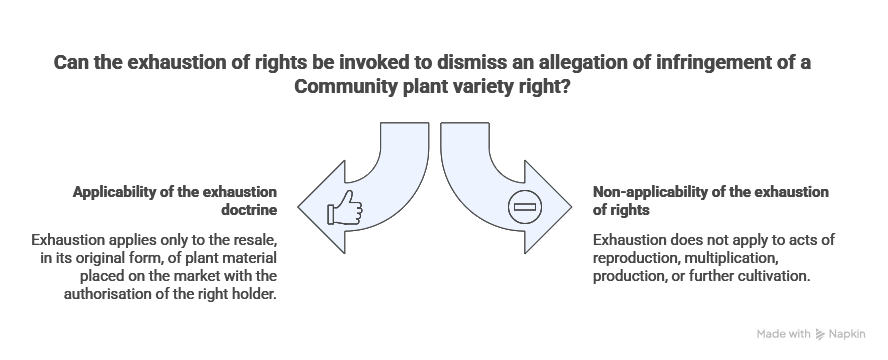
Conclusion
The infringement of a Community plant variety right engages a strong exclusive right designed to protect long-term scientific and economic investments. Although the principle of exhaustion of rights exists under EU law, it remains strictly confined to the resale of material placed on the market with the holder’s authorization and cannot be invoked to justify acts of reproduction or multiplication of the protected variety.
Any reproduction or multiplication carried out without the authorization of the right holder may constitute an act of infringement, even where the plant material has been lawfully acquired. A clear understanding of this distinction is therefore essential for operators in the sector in order to ensure the secure exploitation of protected plant varieties.
Dreyfus law firm assists its clients in managing complex intellectual property cases, offering personalized advice and comprehensive operational support for the complete protection of intellectual property.
Nathalie Dreyfus with the support of the entire Dreyfus team.
Q&A
1. What is the difference between a national plant variety right and a community right?
The national plant variety right is granted by the competent national authority (in France, the National Plant Variety Office, also known as INOV). The Community plant variety right is granted by the Community Plant Variety Office (CPVO) and produces effects throughout the entire territory of the European Union.
2. May a variety purchased in another Member State be freely exploited in France?
No. The Community plant variety right is a unitary right: the absence of authorization in one Member State applies across the entire European Union.
3. Can incorrect labeling of a variety constitute infringement?
Yes, where the marketed variety in fact corresponds to a protected variety. Mislabeling does not exclude liability.
4. May a licence agreement impose stricter restrictions than those provided by the Regulation?
Yes. The parties may agree on more stringent contractual obligations (territorial scope, quotas, traceability), subject to compliance with EU competition law.
5. How can one verify whether a plant variety is protected by a Community Plant Variety Right?
Protection may be verified through the public database of the Community Plant Variety Office, which lists both protected varieties and pending applications. Such verification is particularly recommended prior to any commercial exploitation of a plant variety.
The purpose of this publication is to provide general guidance to the public and to highlight certain issues. It is not intended to apply to particular situations or to constitute legal advice.