

Sommaire
- 1 Introduction
- 2 Registering a surname as a trademark: an accepted principle
- 3 Background of the case: a family dispute over a surname
- 4 The ruling of the French Supreme Court: judicial assessment of bad faith
- 5 Characterisation of bad faith in the absence of a specifically identified third party
- 6 Conclusion
- 7 Q&A
Introduction
Registering a surname as a trademark is a common practice in business. However, this strategy may give rise to disputes when the surname is already used by other economic actors.
The judgment delivered by the Commercial Chamber of the French Supreme Court (Cour de cassation) on November 13, 2025 (No. 24-14.355) provides important clarification regarding the notion of bad faith in the filing of a surname-based trademark and the analysis that courts must conduct.
The Supreme Court recalls an essential principle: the mere intention to protect a family name is not sufficient, by itself, to exclude bad faith on the part of the applicant. Courts must verify whether the filing reflects a genuine intention to use the trademark commercially and whether it was not carried out with the purpose of depriving a third party of a sign necessary for its business activity.
This decision forms part of established case law aimed at preventing the misuse of trademark law for anti-competitive purposes.
Registering a surname as a trademark: an accepted principle
French and European trademark law does not prohibit the registration of a surname as a trademark. A family name may constitute a distinctive sign provided it satisfies the usual validity requirements.
This practice is particularly widespread. Some of the most famous trademarks are based on surnames that have become distinctive identifiers of goods or services. A surname can therefore represent a strategic asset for a company, as it enables consumers to identify the commercial origin of a product while conveying a certain reputation.
However, this possibility may also be used opportunistically. In certain cases, the filing of a surname aims less at protecting a business activity than at preventing a third party from using the name or capturing the reputation associated with it. It is precisely in this context that the notion of bad faith plays a central role.
Background of the case: a family dispute over a surname
In this case, two brothers were carrying out competing activities in the carpentry sector. One of them had for several years operated a business using the trade name “Huynen Fermetures”, composed of the surname “Huynen” combined with the term “Fermetures”.
His brother managed another company bearing the same surname and had filed several trademarks incorporating this sign, including the trademark “Huynen Fermetures”.
Subsequently, the business assets operating under this trade name were transferred to a competing company. The latter continued to use the sign “Huynen Fermetures” in the course of its activities. The company owning the trademarks then initiated legal proceedings against it, alleging trademark infringement and acts of unfair competition.
In response, the defendant company challenged the validity of the trademarks and requested their transfer in its favor, arguing that the trademarks had been filed fraudulently and therefore in bad faith.
The Court of Appeal rejected this argument. The judges held that the filing of a trademark containing a surname could legitimately be motivated by the intention to protect one’s own family name. According to them, this circumstance alone was sufficient to rule out any fraudulent intent in the trademark filing.
The ruling of the French Supreme Court: judicial assessment of bad faith
The French Supreme Court partially overturned the decision of the Court of Appeal and criticized the lower court for failing to properly examine the issue of bad faith. More specifically, the Supreme Court held that the appellate judges should have examined several essential factors.
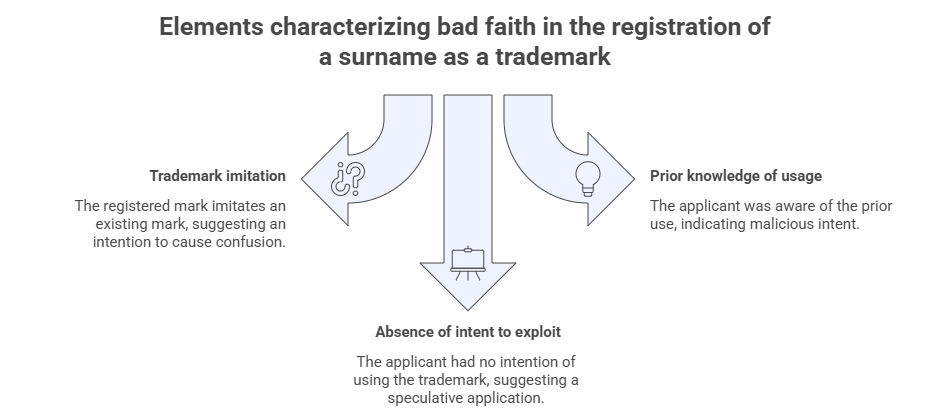
The sign filed did not consist solely of the surname
The disputed trademark did not merely consist of the surname “Huynen”, but also included the term “Fermetures”, which corresponded exactly to the trade name already used by another company.
The Supreme Court therefore considered that the lower court should have examined whether this choice revealed an intention to appropriate a sign already used in the market.
Knowledge of the prior use of the sign
The Supreme Court also emphasized that the filing company was aware of the existence of this sign in the course of trade.
Knowledge of the prior use of a sign by a third party constitutes an important indicator in the assessment of bad faith.
Failure to investigate the intention to use the trademark
The judgment particularly stresses a central issue: the lower courts should have verified whether the applicant genuinely intended to use the trademark.
The Court recalls that a filing may be considered fraudulent when:
• the applicant has never used the trademark,
• or when the applicant had no intention of using it at the time of filing.
According to European case law, particularly a judgment of the Court of Justice of the European Union of January 29, 2020, the absence of an intention to use may reveal bad faith.
Characterisation of bad faith in the absence of a specifically identified third party
Finally, the Court clarifies that bad faith does not necessarily require the applicant to have intended to harm a specific person. It is sufficient that the trademark filing was made for a purpose contrary to honest commercial practices, for example to obtain an unjustified monopoly over a sign.
The characterization of bad faith therefore becomes a decisive element in determining whether the action is admissible.
Courts must now genuinely examine:
• the existence of a real commercial project,
• the actual or intended use of the trademark,
• the circumstances surrounding the filing.
A trademark filing made without a genuine intention to use the mark may be considered contrary to the essential function of a trademark.
Conclusion
This ruling constitutes an important decision in trademark law. The French Supreme Court reiterates that registering a surname as a trademark does not exclude the possibility of bad faith. Courts must conduct a concrete analysis of the circumstances surrounding the filing, particularly by examining whether there was a genuine intention to use the sign.
The decision confirms the courts’ willingness to sanction filings intended to block competitors or to appropriate a sign already used by others.
This approach aligns with European case law, according to which a trademark filing made for purposes unrelated to the functions of a trademark may constitute an act of bad faith.
Dreyfus & Associates assists its clients in managing complex intellectual property matters by providing tailored advice and comprehensive operational support to ensure the full protection of intellectual property rights.
Dreyfus Law Firm works in partnership with a global network of intellectual property attorneys.
Nathalie Dreyfus, with the assistance of the entire Dreyfus team.
Q&A
Can a surname or pseudonym be invoked against a trademark?
Yes, under Article L.711-3 of the French Intellectual Property Code, a person’s surname or pseudonym constitutes a prior right that may prevent the registration of a trademark. However, to rely on such a right, it must be demonstrated that the name was used in the course of trade at the time the trademark was filed and that there is a likelihood of confusion with the goods or services concerned.
Can the absence of trademark use constitute evidence of bad faith?
It may constitute a relevant indicator. In particular, if the applicant had no genuine intention to use the trademark at the time of filing, the absence of use may contribute to demonstrating a fraudulent strategy.
What is the time limit to act against a fraudulently filed trademark?
In principle, an action for ownership claim must be brought within five years from the publication of the trademark application. However, when the filing was made in bad faith, this limitation period does not apply, meaning that the action may be brought without time limitation.
What is the difference between an ownership claim action and an action for trademark invalidity?
An invalidity action seeks to cancel a trademark that has been registered improperly, whereas an ownership claim action allows the injured party to obtain the transfer of ownership of the trademark that was filed fraudulently.
Is bad faith assessed at the time of filing or afterwards?
Bad faith must be assessed at the time the trademark is filed, taking into account all the circumstances surrounding the filing.
This publication is intended to provide general information to the public and highlight certain legal issues. It is not intended to apply to specific situations nor to constitute legal advice.