


Sommaire
Introduction
Can a design be protected even if it does not result from any particular creative effort?
At first glance, the question may appear counterintuitive. Legal protection is still often associated with some form of intellectual or artistic input.
However, in design law, this assumption is incorrect. Under this system, protection is not contingent on creativity, but on the product’s appearance.
A confusion rooted in the history of applied arts
The frequent confusion between copyright and design law is not coincidental. It largely stems from the history of applied arts and the historical convergence between artistic creation and industrial production.
From the nineteenth century onwards, aesthetic forms applied to industrial products, particularly in sectors such as textiles, furniture, ceramics and goldsmithing, were perceived as artistic creations applied to utilitarian objects.
This proximity between artistic creation and industrial design fostered a conceptual overlap between copyright and design law, leading to the mistaken assumption that design protection requires a creative contribution.
This historical background also explains the principle of cumulative protection, now recognized under European law. Under this principle, a single creation may benefit simultaneously from:
- Design protection, which safeguards the appearance of a product as such.
- Copyright protection, provided that the work meets the requirement of originality.
Nevertheless, these two regimes rest on fundamentally distinct legal foundations.
An autonomous legal framework: the irrelevance of creative effort
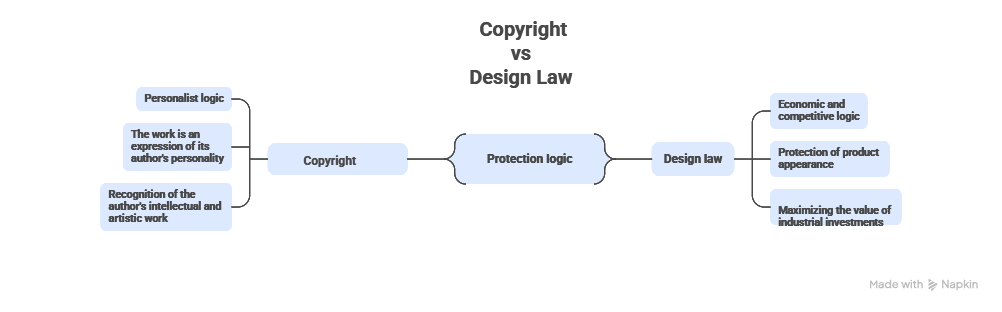
Unlike copyright, which requires an original work reflecting the personality of its author, design law does not make protection conditional upon the existence of intellectual effort or artistic creation.
Pursuant to Regulation (EC) No 6/2002, protection is granted provided that two conditions are met:
- Novelty: the design must not have been made available to the public prior to the filing date, subject to the exceptions provided for by the Regulation (EC) No 6/2002, in particular Article 7, such as the grace period or improper disclosure.
- Individual character: the design must produce, on the informed user, an overall impression that differs from that produced by earlier designs. In this assessment, the degree of freedom of the designer is a decisive factor: where such freedom is constrained by technical or functional requirements, relatively minor differences may suffice to establish individual character.
It follows that design law is concerned exclusively with the visual outcome of a product, irrespective of the creative process that led to its development.
The Deity Shoes case: a significant clarification by the Court of Justice of the European Union
The Deity Shoes case (CJEU, 18 December 2025, Deity Shoes, S.L. v Mundorama Confort, S.L. and Stay Design, S.L., Case C-323/24) is a recent yet already emblematic decision that clearly illustrates this approach.
In this case, the company Deity Shoes, S.L brought infringement proceedings based on a registered design against two competing companies.
The competing companies challenged the validity of the design, arguing that the shoes merely resulted from a combination of elements available in suppliers’ catalogues, without any genuine design activity or intellectual effort.
The Spanish court, Juzgado de lo Mercantil n° 1 of Alicante, referred several questions to the CJEU for a preliminary ruling, in particular:
- Whether it is necessary to demonstrate genuine creative activity in order to obtain protection;
- Whether the personalization of pre-existing designs may be protected.
The Court provided a clear answer. It held that the designer’s creative activity or intellectual effort does not constitute a condition for protection.
Accordingly, only the appearance of the product, its novelty and its individual character are relevant.
The Court further clarified that a combination of pre-existing elements may indeed constitute a protected design, provided that it produces a different overall impression.
This decision confirms that design law primarily pursues an economic objective, namely the protection of product appearance on the market, rather than the artistic recognition of a work.
Conclusion
It is therefore not necessary to demonstrate intellectual effort or artistic creation in order to benefit from design protection. Only novelty and individual character are relevant.
Design law thus clearly differs from copyright: it does not seek to reward creativity, but rather to protect the appearance of products from an economic perspective.
Dreyfus Law firm assists its clients in managing complex intellectual property cases, offering personalized advice and comprehensive operational support for the complete protection of intellectual property.
Nathalie Dreyfus with the support of the entire Dreyfus team
Q&A
1. Is it necessary to be a professional designer in order to obtain protection?
The status or profession of the creator is irrelevant. Any natural or legal person may apply for design protection, provided that the legal requirements are satisfied.
2. Can a simple design be protected?
The complexity of a design is not a relevant criterion. Even a very simple design may be protected if it is new and possesses individual character.
3. Can a design resulting from technical constraints be protected?
Features solely dictated by technical function are not eligible for protection. However, aesthetic choices that remain independent of such constraints may be protected.
4. Is protection automatic?
No, protection generally requires registration (registered design), except in the case of the unregistered Community design.
5. What is meant by an “informed user”?
An informed user is a notional figure situated between the average consumer and the sectoral expert, possessing a certain level of awareness of existing designs.
The purpose of this publication is to provide general guidance to the public and to highlight certain issues. It is not intended to apply to particular situations or to constitute legal advice.