


Sommaire
- 1 Introduction
- 2 Reselling lecture notes: a phenomenon amplified by digital platforms
- 3 The legal framework applicable to university lectures
- 4 Can selling lecture notes constitute infringement?
- 5 The legal liability of lecture-sharing platforms
- 6 A still limited legal response to an international phenomenon
- 7 Conclusion
- 8 FAQ
Introduction
The monetization of university lecture notes through digital platforms has become a widespread phenomenon in higher education. Specialized websites now offer thousands of educational materials uploaded by students: revision notes, structured summaries, course outlines, or detailed transcriptions of lectures.
Presented as a tool for academic collaboration and easier access to educational resources, this practice nonetheless raises a major legal question: does selling professors’ lectures constitute a legitimate student practice, or a form of disguised infringement?
Under French intellectual property law, the answer depends primarily on a decisive criterion: the originality of the lecture and the nature of its reproduction by the student. Legal analysis reveals a delicate balance between the dissemination of knowledge, academic freedom, and the protection of intellectual creations.
Reselling lecture notes: a phenomenon amplified by digital platforms
With the digitalization of higher education, numerous platforms (Studocu, Stuvia, Course Hero, OneClass) allow students to share or sell their lecture notes. These platforms function as collaborative academic libraries. Users can access content free of charge or via subscription, while contributing students may receive financial benefits or privileged access to the database.
This model is based on a simple principle: students upload their documents, which then become accessible to an international community. The materials may include personal summaries, methodological guides, but also very detailed notes reproducing the content of lectures.
This practice reflects a form of collaborative knowledge economy. However, it has drawn strong criticism from lecturers and universities, who sometimes consider that these platforms indirectly exploit their pedagogical work.
Many lecturers believe that the online dissemination of their lectures, sometimes in near-complete form, constitutes an unjustified appropriation of their intellectual work. Some institutions also fear losing control over the distribution of their educational content.
The legal framework applicable to university lectures
Under French law, copyright protection applies to works of the mind, i.e., intellectual creations bearing the imprint of their author’s personality.
Article L112-2 of the French Intellectual Property Code explicitly provides that lectures may be protected under copyright law.
A decision of the Lyon Judicial Court dated September 10, 2024 further confirmed that university lectures (both oral and supporting materials) may be protected by copyright if they are original.
Originality may be reflected in various elements, including the pedagogical structure of the lecture, the organization of ideas, the selection and arrangement of information, or the particular manner in which knowledge is presented. However, ideas, concepts, and scientific knowledge are not protected as such; only their original expression may be.
This principle is consistently upheld by case law. In the “Paradis” decision of November 13, 2008, the French Supreme Court reaffirmed that while ideas are free for all to use, their material expression, resulting from aesthetic choices and a particular arrangement, may be protected under copyright.
This position has also been confirmed in relation to educational materials (Paris, 4th Chamber, Nov. 21, 1994), lectures (Paris, 1st Chamber, Nov. 24, 1992), and in particular law lectures (Paris, 4th Chamber, Feb. 21, 1978).
Knowledge conveyed in a lecture hall belongs to the public domain of knowledge, but the way in which a lecturer chooses to present it may constitute a protected work.
This distinction explains why not all university lectures are automatically protected, although some clearly fall within the scope of copyright.
Can selling lecture notes constitute infringement?
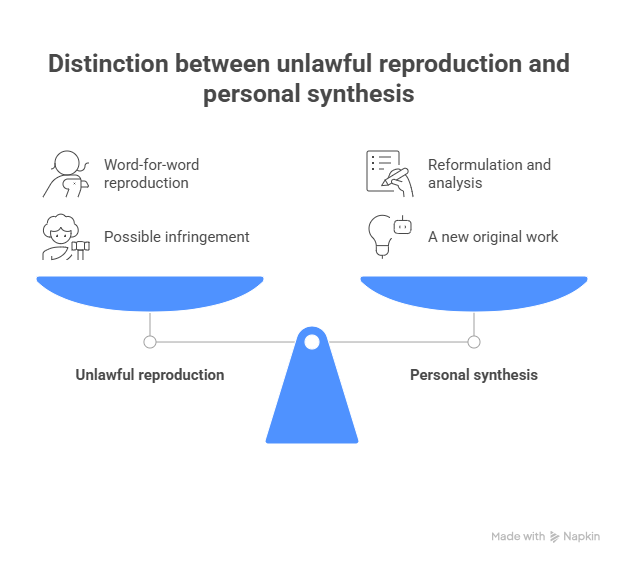
When a student uploads or sells lecture notes, the legal classification depends on how those notes were prepared. If the notes constitute a faithful transcription of the lecturer’s content, or even a word-for-word reproduction of their speech or teaching materials, they may be considered an unauthorized reproduction of a protected work.
In such cases, the dissemination or commercialization of these materials may constitute infringement. Infringement is an offense that may give rise to both civil and criminal liability. The lecturer whose course has been reproduced without authorization may seek compensation for the harm suffered.
The commercial dimension generally increases the seriousness of the infringement, as the economic exploitation of a protected work is, in principle, reserved exclusively to its author.
Conversely, not all lecture notes necessarily infringe copyright. A student who produces a personal summary, reformulation, or pedagogical analysis of a lecture may be considered the author of a new or composite work.
Article L113-2 of the French Intellectual Property Code defines a composite work as “a new work in which a pre-existing work is incorporated without the collaboration of the author of the latter.”
Thus, a composite work is characterized by the creation of a new work based on a prior work, incorporating an original contribution by its author. This originality must lie in transformations or creative choices reflecting genuine intellectual input.
In a decision dated October 24, 1995, the French Supreme Court held that a substantial and original modification of a pre-existing work may give rise to a composite work, which benefits from independent copyright protection.
In such cases, the notes may reflect the student’s own intellectual organization, presentation choices, or method of synthesis. The resulting creation may then be distinct from the lecturer’s original work.
However, the boundary between personal synthesis and unlawful reproduction may be difficult to determine. Where notes replicate the exact structure of the lecture or reproduce entire passages, the characterization of infringement may again become relevant.
The legal liability of lecture-sharing platforms
Platforms that allow students to publish their lecture notes are generally considered hosting providers under the French Law for Confidence in the Digital Economy (LCEN).
This status grants them limited liability. In principle, they are not responsible for content published by their users. However, this immunity is not absolute.
When a platform is informed of the presence of manifestly unlawful content, it must act promptly to remove it. If it fails to take action after notification, its liability may be engaged.
Some platforms argue that students create their own notes and therefore hold rights over these documents. They also maintain that the knowledge conveyed in lectures belongs to the public domain.
However, this argument may be rejected where the materials reproduce the original form of the lecture. In such cases, copyright protection remains applicable.
A still limited legal response to an international phenomenon
Most platforms specializing in the resale of lecture notes are located outside France. This international dimension makes legal action more complex, particularly due to differences in legislation and the territorial nature of copyright.
Lecturers or universities seeking to act against these platforms often face lengthy and costly cross-border proceedings.
In response, some universities may adopt internal policies regulating the dissemination of educational content. Codes of conduct or disciplinary rules may explicitly prohibit the distribution or commercialization of course materials without authorization.
At the same time, raising students’ awareness of copyright issues appears essential to limit potentially unlawful practices.
Conclusion
The resale of lecture notes now lies at the intersection between collaborative student practice and unlawful exploitation of pedagogical works. The legal qualification primarily depends on the nature of the material and the degree to which it reproduces the original lecture.
In the digital era and in the context of international platforms, this issue highlights the growing importance of protecting educational content and intellectual property in higher education.
Dreyfus & Associés assists its clients in managing complex intellectual property matters by providing tailored advice and comprehensive operational support for the full protection of intellectual property rights.
Nathalie Dreyfus with the support of the entire Dreyfus team.
FAQ
1. Can a student be prosecuted even if they earned very little money from selling their notes?
Yes. In copyright infringement matters, the amount of profit is not decisive. Even free dissemination or minimal gain may constitute unauthorized exploitation if the original lecture is reproduced.
2. Can teaching materials provided by a lecturer (slides, handouts) be freely shared online?
In principle, no. These materials are generally protected by copyright, and their public dissemination requires authorization from their author or the educational institution.
3. Can a student use excerpts from lectures in a thesis or academic work?
Yes, under certain conditions. The right of quotation allows the use of short excerpts, provided the source is cited and the use is justified by a pedagogical, critical, or scientific purpose.
4. Does the lecturer retain rights over a course taught in a public university?
As a general rule, lecturers retain copyright over their teaching materials, subject to certain exceptions linked to specific duties or contractual provisions.
5. Can platforms be required to remove lecture materials upon request from a lecturer?
Yes. A lecturer may submit a takedown notice based on copyright. If the platform fails to promptly remove the disputed content after notification, its liability may be engaged.
This publication is intended to provide general guidance and highlight certain issues. It is not intended to apply to specific situations or to constitute legal advice.