

Plant breeders’ rights in the United Kingdom : how to protect a plant variety after Brexit and in light of the SPS agreement ?
Introduction
Developing a new plant variety often requires several years of research, breeding, and investment. For plant breeders, seed companies, and horticultural businesses, the legal protection of these innovations is therefore a crucial economic consideration.
In the United Kingdom, this protection is provided through Plant Breeders’ Rights (PBR), a specific intellectual property regime that enables rights holders to control the commercial exploitation of their plant varieties.
Since Brexit, the UK plant variety protection system has operated independently of the European Union regime administered by the Community Plant Variety Office (CPVO). This development requires businesses wishing to market their varieties in both territories to adapt their filing strategies. This situation may, however, change under the sanitary and phytosanitary (SPS) agreement currently being negotiated between the United Kingdom and the European Union.
It is therefore essential to understand the protection requirements, administrative procedures, and territorial implications of the new UK framework.
The legal framework for plant variety protection in the United Kingdom
Plant variety protection in the United Kingdom is primarily governed by the Plant Varieties Act 1997, supplemented by its implementing regulations and the amendments introduced following Brexit.
This legal framework reflects the principles of the International Convention for the Protection of New Varieties of Plants, administered by https://www.upov.int/en/ (UPOV).
Unlike patents, which protect technical inventions meeting specific requirements, plant breeders’ rights protect plant varieties that satisfy particular criteria relating to novelty and botanical characteristics.
The UK system is administered by the Animal and Plant Health Agency (APHA), which is responsible for processing applications and granting rights.
Protection is available to breeders and their successors in title. Where a variety has been developed in the course of employment, the rights generally belong to the employer, subject to any applicable agreements.
The regime covers various categories of plants, including agricultural, vegetable, fruit, and ornamental species.
Requirements for Obtaining UK Plant Breeders’ Rights
Under section 4 of the Plant Varieties Act 1997, a variety must satisfy four cumulative requirements: it must be new, distinct, uniform, and stable, in line with the requirements laid down in French law by Article L. 623-2 of the French Intellectual Property Code.
Novelty of the Variety
Novelty primarily depends on the absence of prior commercialization beyond the permitted time limits.
In principle, the variety must not have been marketed with the breeder’s consent:
- In the United Kingdom, more than one year before the application date;
- Outside the United Kingdom, more than four years before the application date, or six years for trees and vines.
This requirement calls for particular vigilance where commercial trials or sales have already taken place before filing.
Distinctness, Uniformity, and Stability
The variety must also satisfy the so-called DUS criteria (Distinctness, Uniformity and Stability).
Distinctness means that the variety must be clearly distinguishable from any other variety whose existence is a matter of common knowledge.
Uniformity requires that the relevant characteristics be sufficiently consistent among the plants constituting the variety, taking into account the particular features of its propagation.
Finally, stability means that the variety’s essential characteristics must remain unchanged after successive cycles of propagation.
These requirements are assessed through technical examinations, the duration of which varies depending on the species concerned.
The Application and Registration Procedure with the APHA
Obtaining UK plant breeders’ rights requires a specific application filed in accordance with the national procedure.
Filing Through UPOV PRISMA
Applications for Plant Breeders’ Rights must be submitted online through the UPOV PRISMA platform.
Applicants must identify the variety, specify its origin, provide the information required for technical examination, and propose a variety denomination that complies with the applicable requirements.
The denomination must enable the variety to be identified without creating confusion with existing denominations.
The APHA then examines the application, the results of the DUS tests, and any oppositions.
Application Fees and Technical Examinations
The procedure involves the payment of administrative fees and, where applicable, fees relating to technical examinations.
According to the official UK fee schedule updated in 2026, the administrative application fee amounts to GBP 769, in addition to DUS examination fees, which vary depending on the plant species.
Where examination reports have already been issued by a competent authority, their reuse may be considered under certain conditions.
It is also important to distinguish the grant of intellectual property rights from the inclusion of a variety on an official list authorizing its marketing. These procedures serve different purposes, although they may be undertaken simultaneously.
Rights Granted to the Holder and Their Limitations
The holder of UK plant breeders’ rights enjoys the exclusive right to authorize certain forms of exploitation of the protected variety.
Section 6 of the Plant Varieties Act 1997 notably covers production, reproduction, conditioning for the purposes of propagation, offering for sale, marketing, importing, and exporting propagating material.
This protection enables breeders to regulate the commercial use of their varieties and negotiate licensing agreements.
In certain circumstances, these rights may also extend to harvested material where it results from the unauthorized use of propagating material.
Protection Limited in Time
The duration of protection is:
- 25 years for most plant species;
- 30 years for trees, vines, and potatoes.
The continued validity of these rights is subject to compliance with the applicable legal obligations.
Statutory Exceptions
The breeder’s exclusive rights are not absolute.
The regime provides for exceptions relating in particular to acts carried out privately and for non-commercial purposes, for experimental purposes, or for the breeding of other varieties, subject to the provisions applicable to essentially derived varieties.
For certain agricultural species, the legislation also provides for a farm-saved seed exception.
Under certain conditions, farmers may reuse part of their harvest for propagation on their own holdings. However, this right may be subject to the payment of equitable remuneration, with specific rules applying to small farmers.
The Impact of Brexit on Plant Variety Protection
Since January 1, 2021, the United Kingdom and the European Union have operated separate territorial regimes for plant breeders’ rights.
Previously, Community plant variety protection granted by the CPVO also had effect in the United Kingdom.
Today, a newly granted Community plant variety right no longer automatically provides protection in the United Kingdom.
A breeder seeking to protect a new variety in both the United Kingdom and the European Union must therefore, in principle, undertake two separate procedures:
- A UK application with the APHA;
- An EU application with the Community Plant Variety Office (CPVO).
However, transitional provisions provided for Community plant variety rights in force at the end of the transition period, on December 31, 2020, to be automatically converted into equivalent UK rights.
The rights concerned benefited from continued protection under the framework established by the Plant Breeders’ Rights (Amendment etc.) (EU Exit) Regulations 2019.
This distinction is particularly important for businesses managing international intellectual property portfolios. EU protection must no longer be regarded as automatically extending to the UK market.
Towards a Return to Unitary Protection Under the SPS Agreement?
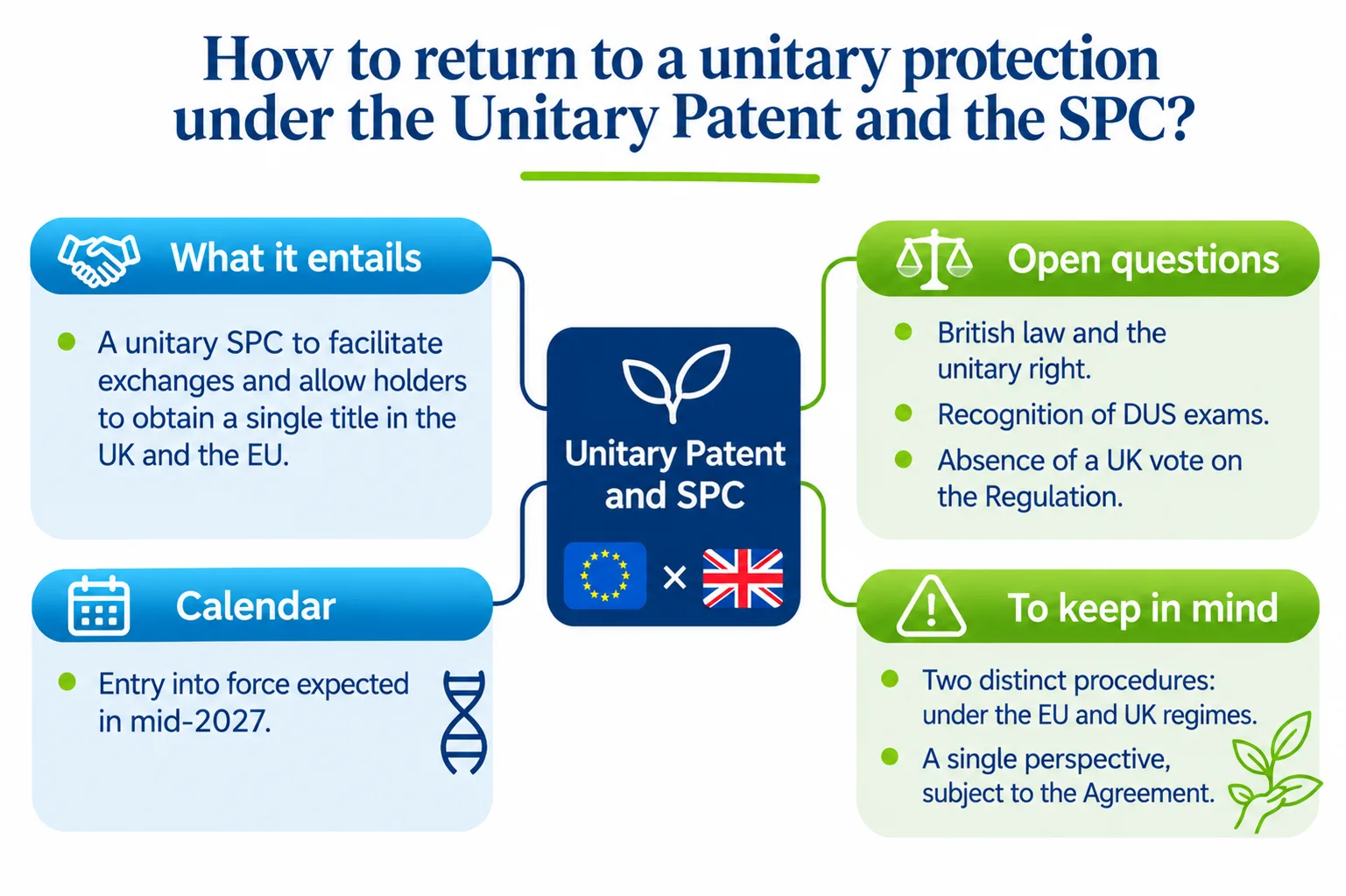
The United Kingdom and the European Union are currently negotiating a sanitary and phytosanitary (SPS) agreement intended to facilitate trade in plants and plant reproductive material. According to guidance published by the UK government, the agreement may allow breeders to protect their varieties across the United Kingdom and the European Union through a single right. It is expected to take effect in mid-2027.
Several questions nevertheless remain open: how this single right would interact with UK national law, whose scope differs in certain respects from Regulation (EC) No 2100/94, particularly regarding essentially derived varieties and harvested material (as highlighted by the High Court in Nador Cott v Asda, currently under appeal); whether DUS examinations conducted in the United Kingdom would be recognized; and the fact that the United Kingdom would have no vote on future changes to the Regulation, which is currently being evaluated by the European Commission.
The agreement also extends to plant biotechnology. The UK government has announced that it will align with EU rules on genetically modified organisms (GMOs), while the treatment of precision-bred plants, governed in England by the Genetic Technology (Precision Breeding) Act 2023, remains under negotiation. Dynamic alignment could lead to the patent transparency obligations of the new EU Regulation on plants obtained by new genomic techniques (NGTs) applying in the United Kingdom. However, the United Kingdom has reportedly requested a derogation for precision-bred crops, so these aspects may ultimately fall outside the agreement.
Until the final text of the agreement is available, breeders must continue to file two separate applications and closely monitor developments in the negotiations.
Conclusion
Plant variety protection in the United Kingdom is based on a specific legal framework, whose registration requirements and legal effects must be assessed independently of the European Union regime.
Since Brexit, breeders must pay particular attention to the territorial scope of their rights, filing deadlines, and the procedures required to obtain protection in both the United Kingdom and the European Union. The SPS agreement currently under negotiation may eventually simplify this situation by paving the way for a single right covering both territories.
An effective strategy involves anticipating commercialization, verifying protection requirements, and organizing both the enforcement and contractual exploitation of plant breeders’ rights.
Dreyfus Law Firm assists its clients in managing complex intellectual property cases, offering personalized advice and comprehensive operational support for the complete protection of intellectual property.
Nathalie Dreyfus, with the support of the entire Dreyfus team.
Q&A
How does the right of priority apply to plant variety protection applications in the United Kingdom ?
A breeder who has filed an initial application in a UPOV member State may, under certain conditions, claim a right of priority when applying for UK protection for the same variety. This mechanism generally provides a twelve-month period from the first filing, facilitating the coordination of an international filing strategy. A certified copy of the earlier application must be provided within three months, failing which the priority claim is lost.
Under what conditions can UK plant breeders’ rights be assigned to another company ?
Plant breeders’ rights are intellectual property assets that can be assigned, particularly in the context of an acquisition, corporate restructuring, or transfer of business activities. The assignment must be legally formalized, and the information concerning the rights holder must be updated with the competent authorities.
How can a foreign company obtain plant breeders’ rights in the United Kingdom without being established there ?
A foreign company is not necessarily required to have an establishment in the United Kingdom to apply for protection, subject to the applicable eligibility requirements. However, it must comply with UK administrative requirements, and, where the applicant or its chosen agent is not based in the United Kingdom, appoint an agent with a UK address.
How can a company verify whether a plant variety is already protected in the United Kingdom ?
Official plant variety records can be consulted through the relevant UK authorities. The UPOV PLUTO database is also a useful resource. Searches should focus on the variety denomination, the plant species concerned, and any identified rights holder, while taking account of the potential limitations regarding the completeness and updating of these databases.
What are the consequences of voluntarily surrendering UK plant breeders’ rights ?
Voluntary surrender may result in the early termination of protection, subject to the applicable formalities. Once the rights have expired or been surrendered, their former holder can no longer rely on them to prohibit new acts of exploitation. However, termination does not necessarily extinguish existing contractual obligations or claims relating to infringements committed while the rights were still in force.