


How can the Digital Services Act help combat online counterfeiting?
Introduction
When it comes to online counterfeiting, the Digital Services Act gives trademark owners practical tools: a mechanism for reporting illegal content and ways to challenge a platform that refuses to act. However, these tools only work if they are used properly. In practice, three steps determine whether the process succeeds:
- establishing the infringement,
- submitting an actionable notice,
- then choosing the right remedy.
Regulation (EU) 2022/2065, fully applicable since 17 February 2024, supplements intellectual property rights without creating a new infringement action.
Which platforms fall within the DSA?
The DSA applies to intermediary services that have a substantial connection with the European Union, including when they are established outside the EU. The mere fact that a website can be accessed from France is therefore not enough. The Article 16 mechanism targets hosting providers, and in particular marketplaces that host offers from third-party sellers. A trader that only sells its own products is not a hosting provider for that activity, but its hosting service provider can still be notified.
Not all platforms are subject to the same obligations: they vary according to the nature and size of the service. Arcom explains the categories of intermediaries and their corresponding duties. One useful point: Article 16 applies to all hosting providers, however small, whereas the remedies specific to online platforms follow separate rules. Before alleging that an intermediary has failed to comply, it is therefore necessary to check which obligation actually applies to it.
How can counterfeiting be reported under Article 16 of the DSA?
Establish the rights and preserve evidence
Before any notice is sent, it is advisable to check who owns the right, whether that right is valid and which territory the offer targets. An unusually low price or an unauthorised seller are indications, not proof, of counterfeiting. The pages, dates and seller references should then be preserved. Depending on what is at stake, a test purchase or a bailiff’s report can complete the file.
Prepare a legally actionable notice
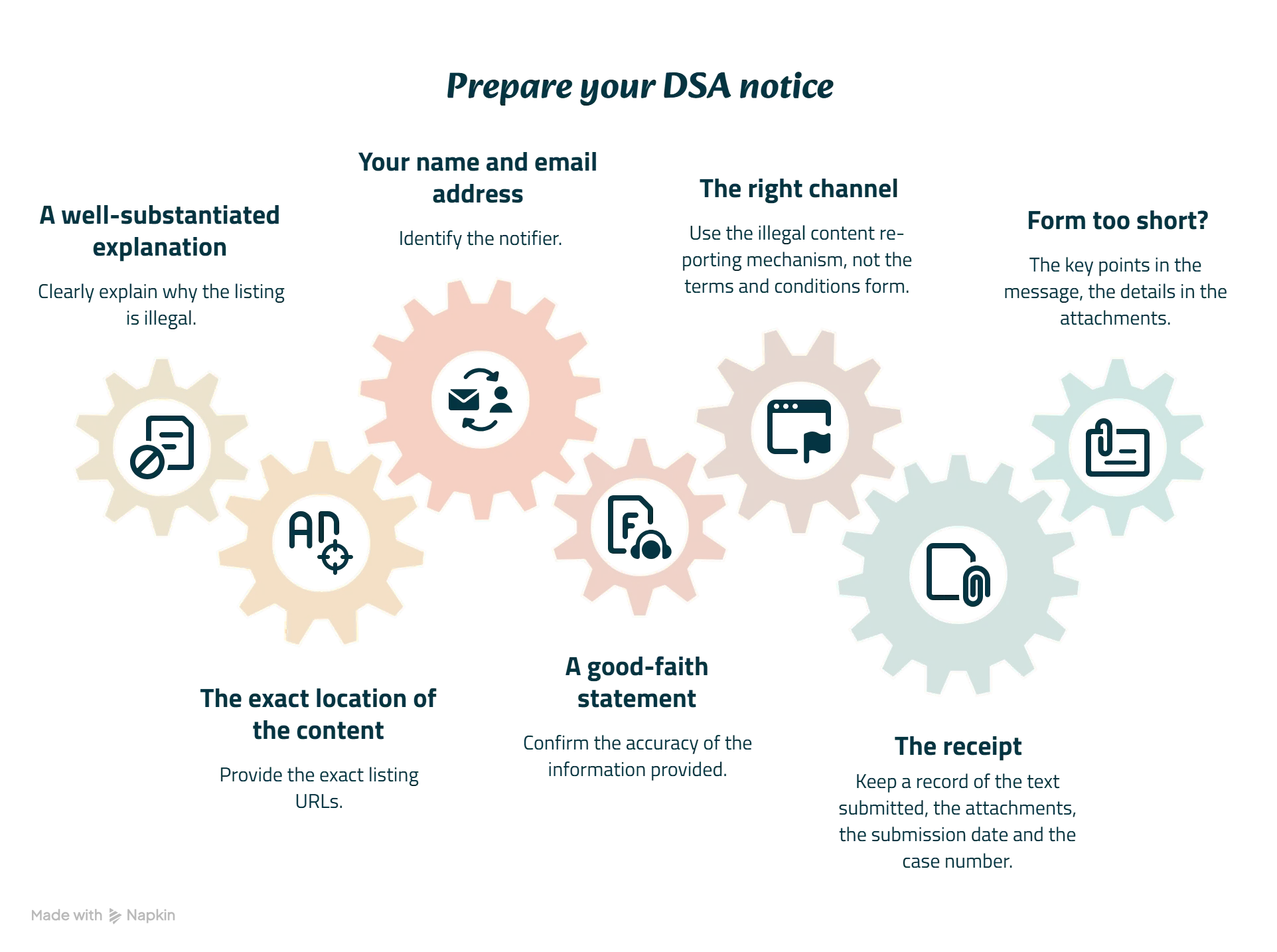
Under Article 16, the notice must contain:
- A sufficiently substantiated explanation of the alleged illegality;
- The exact electronic location, including the listing URLs;
- The notifier’s name and email address;
- A good-faith statement confirming the accuracy and completeness of the information.
The choice of channel also matters. Where the platform offers a mechanism for notifying illegal content that is separate from the form for reporting breaches of its terms and conditions, that is the mechanism to use. It is advisable to keep a record of the text submitted, the attachments, the submission date and the case number. If the form limits the number of characters, the core of the argument must appear in the message itself, with the attachments providing the detail.
To find out more about coordinating online notices with customs monitoring, we invite you to read our article “Trademark protection: coordinating customs monitoring and the fight against online infringement”.
What deadlines and remedies apply after a DSA notice?
Obtain a decision and assess liability
Where the notifier has provided an email address, the hosting provider acknowledges receipt of the notice. It must then inform the notifier of its decision and of the available remedies. Contrary to a common belief, the DSA sets no general 24-hour removal deadline: it requires notices to be processed in a diligent, objective and timely manner.
A notice that is precise enough for the illegality to be apparent without a detailed legal examination may establish actual knowledge under Article 16. The hosting provider must then act expeditiously to remove the content or disable access if it wishes to retain the liability exemption under Article 6. Losing that exemption does not, however, mean that it is liable.
To find out more about platform obligations, we invite you to read our article “EU Digital Services Act: what compliance priorities must companies secure in 2026?”.
Challenge a refusal and approach the right body
If the platform refuses to remove the listing, Article 20 allows a free internal complaint to be lodged for at least six months after notification of the decision. The complaint must be handled by qualified staff, and the decision cannot be based solely on automated processing. Article 21 also allows referral to a certified out-of-court dispute settlement body, although its decision is not binding.
Notices from trusted flaggers are handled with priority, although removal is not guaranteed. This status is not automatically granted to trademark owners or their advisers. Finally, micro and small enterprises benefit from the Article 19 exemptions for Articles 20 to 22, unless they have been designated as very large online platforms.
Where the DSA mechanism itself fails, a complaint can be lodged with Arcom, France’s Digital Services Coordinator. The complaint concerns the intermediary’s compliance with its obligations, not the infringement itself. Court proceedings remain available, in particular interim relief on the basis of Article L. 716-4-6 of the French Intellectual Property Code for trademarks.
How can removal lead to lasting trademark protection?
Document reappearances and repeat infringers
It is not unusual for a removed listing to reappear a few days later under another URL. Hence the value of ongoing trademark monitoring and of a record linking content identifiers, seller accounts, decisions obtained and new offers. A similar username is not enough to prove that the same operator is involved: each connection must be substantiated. This record is what then makes it possible to show that the infringement is not isolated, but repeated conduct attributable to the same seller.
On the platforms concerned, Article 23 provides for the suspension, for a reasonable period, of users who frequently provide manifestly illegal content, after a warning and a case-by-case assessment. The aim is no longer just to have a listing removed, but to act on the seller’s account, without this necessarily leading to permanent closure.
Identify those responsible and prepare court action
Subject to the exemptions provided for in Article 29, Article 30 requires the marketplaces concerned to collect information on their professional sellers and to make best efforts to verify that it is reliable and complete. Some of this information must be made available to users. However, sellers’ identity documents and payment details are not freely available to rights holders.
Where the available information is not sufficient to identify those responsible, a trademark infringement action makes it possible, in particular, to ask the court to order the disclosure of information on the origin and distribution networks of the infringing goods. Article 10 of the DSA governs orders to provide information issued by competent authorities, but it does not give rights holders direct access to all of the seller’s data. The strategy therefore consists in pursuing, in parallel, the identification of those responsible, the preservation of evidence and measures to stop the infringement.
Conclusion
Using the Digital Services Act against online counterfeiting requires above all a solid body of evidence and a remedy proportionate to the infringement. A well-prepared notice often leads to the removal of a listing, but only a sustained approach (ongoing monitoring, tracking of repeat infringers and, where necessary, court action) ensures truly effective online brand enforcement. The DSA does not replace intellectual property rights: it provides an additional framework for enforcing them on platforms.
Dreyfus Law Firm assists its clients in managing complex intellectual property cases, offering personalized advice and comprehensive operational support for the complete protection of intellectual property.
Dreyfus Law Firm works in partnership with a global network of attorneys specializing in Intellectual Property.
Nathalie Dreyfus, with the support of the entire Dreyfus team
Q&A
Is the notifier’s identity disclosed to the seller?
Not necessarily, but anonymity is not guaranteed. Article 17 provides that the notifier’s identity is included in the statement of reasons sent to the seller where this is strictly necessary. It is therefore advisable to limit the data disclosed, in accordance with the data minimisation principle explained by the CNIL.
What risks arise from manifestly unfounded notices?
For the platforms concerned, Article 23 allows the processing of notices from a user who frequently submits manifestly unfounded notices to be temporarily suspended, after a warning and an individual assessment. A single rejected notice is not enough to trigger this measure.
Must buyers be informed that a product is illegal?
Yes, in certain cases. Subject to Article 29, Article 32 requires a marketplace that becomes aware that an illegal product has been sold through its service to inform the buyers concerned by purchases made in the previous six months, in particular about their means of redress. If it does not have their contact details, it must publish the information on its interface.
Does the DSA impose general monitoring of listings?
No. Article 8 rules out any general monitoring obligation. Very large online platforms must nevertheless assess and mitigate systemic risks, including those linked to the dissemination of illegal content.
Can a business obtain compensation for a DSA breach?
In principle, yes. Article 54 allows recipients of the service to seek compensation for damage caused by a provider’s failure to comply with its obligations, under the conditions of applicable law. The breach, the damage and the causal link must be established. A penalty imposed by the supervisory authority does not, in itself, compensate the business concerned.
This publication is intended for general public guidance and to highlight issues. It is not intended to apply to specific circumstances or to constitute legal advice.