


How to protect your trademark and distribution networks
Introduction
Trademark protection goes beyond registration. For businesses, preserving the value of a trademark also requires controlling the conditions under which their products are marketed, presented, and distributed.
With the growth of e-commerce, online marketplaces and parallel distribution channels, businesses face increasing challenges in monitoring and controlling the marketing and distribution of their products.
Businesses may therefore face unauthorized distributors, counterfeit products, or commercial practices likely to damage their reputation.
However, a trademark owner cannot systematically prevent the resale of genuine products outside its distribution network. Within the European Economic Area (EEA), the principle of exhaustion of trademark rights limits the trademark owner's rights where the products have been placed on the market by the owner or with its consent.
How can businesses establish legally secure distribution networks? What measures can they take to combat unauthorized sales? And to what extent can they control the marketing of their products?
Protecting your trademark: an essential first step
Registering your trademark and defining the scope of protection
The first step is to secure trademark rights that correspond to the company's activities and target markets.
In France, registering a trademark with the French National Institute of Industrial Property (INPI) grants its owner exclusive rights over the protected sign for the designated goods and services.
Under Article L.713-2 of the French Intellectual Property Code, trademark owners may notably oppose the unauthorized use of an identical or similar sign for identical or similar goods or services where there is a likelihood of confusion among the relevant public.
For businesses operating in several markets, protection may be extended through a European Union trademark or international registrations.
It is also advisable to protect associated brand assets, including logos, domain names, and, where appropriate, distinctive signs used in commercial communications.
Monitoring the use of your trademark
Registration should be accompanied by regular monitoring.
This makes it possible to identify similar trademark applications, fraudulent websites, disputed domain names, or sellers using the trademark in misleading circumstances.
Such vigilance is particularly important when third parties falsely present themselves as official distributors or authorized partners.
Trademark monitoring is therefore a preventive tool that enables businesses to intervene before an infringement becomes more widespread.
Choosing and securing your distribution network
Choosing a distribution model is a strategic business decision.
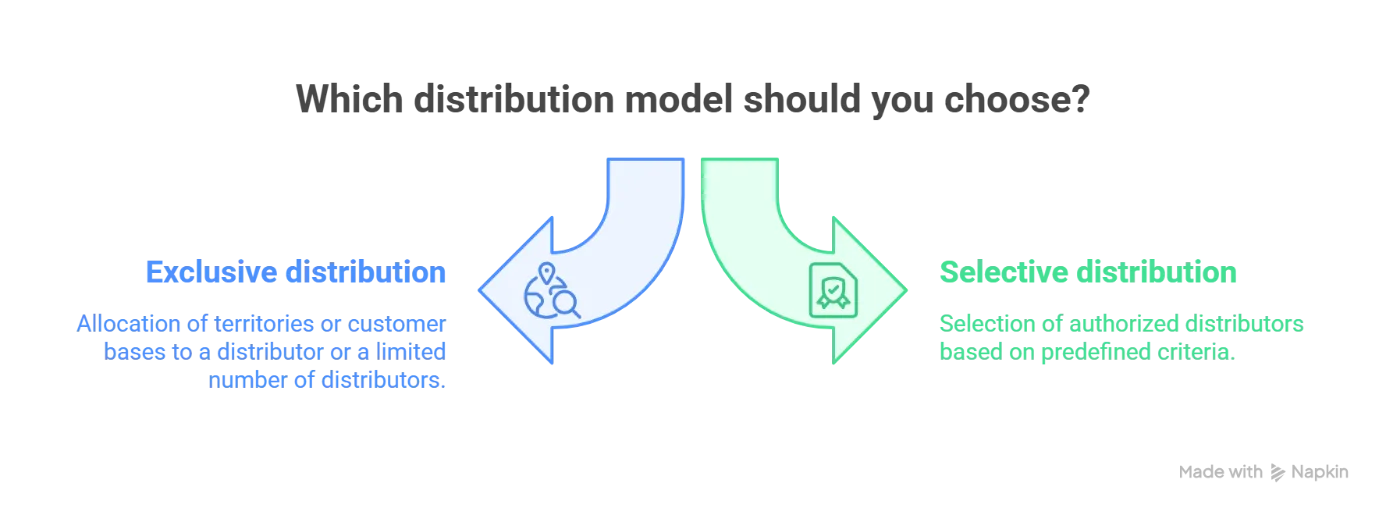
Exclusive distribution involves allocating a specific territory or customer group to one distributor or a limited number of distributors. In particular, it enables suppliers to organise the commercial coverage of a market and encourage investment by distributors by restricting certain active sales carried out by other members of the distribution network.
Selective distribution, on the other hand, is based on the selection of authorised distributors according to predefined criteria. It allows suppliers to reserve the sale of their products to members of their distribution network.
This second model is particularly suitable for products requiring specific conditions regarding presentation, customer advice, storage or marketing.
The key distinction therefore lies in the selection mechanism: exclusive distribution primarily involves the allocation of territories or customer groups, whereas selective distribution relies on the authorisation of resellers based on specific criteria.
Both models are governed by Regulation (EU) 2022/720 on vertical agreements and by EU competition law.
With regard to qualitative selective distribution in particular, the Court of Justice clarified in its Metro judgment of October 25, 1977 (Case 26/76) that the selection of resellers must be based on objective qualitative criteria, laid down uniformly and applied in a non-discriminatory manner.
Regulating relationships with distributors
Implementing appropriate distribution agreements
Protecting a distribution network also requires carefully drafted distribution agreements.
These agreements should define the conditions governing trademark use and the commercial obligations of distributors.
They may notably regulate the use of logos and promotional materials, quality requirements, online sales conditions, and procedures for monitoring contractual compliance.
Within a selective distribution network, contractual provisions may also prohibit sales to unauthorized distributors, within the limits permitted by applicable law.
It is important to establish the consequences of contractual breaches, particularly termination conditions and the cessation of the use of distinctive signs following the end of the contractual relationship.
Anticipating risks associated with e-commerce
Online sales are now a major issue for distribution networks.
Businesses must determine the conditions under which distributors may use third-party platforms, social media, or their own e-commerce websites.
In the Coty Germany judgment of December 6, 2017 (CJEU, C-230/16), the Court of Justice recognized that, under certain conditions, a supplier of luxury goods may prohibit authorized distributors from using third-party platforms in a discernible manner.
Such restrictions must pursue a legitimate objective, be applied uniformly, and remain proportionate.
However, this judgment does not mean that businesses may systematically prohibit all online sales.
Identifying conduct that can legally be challenged
The presence of products on an unauthorized website does not automatically constitute trademark infringement.
Article L.713-4 of the French Intellectual Property Code establishes the principle of exhaustion of trademark rights.
Where genuine products have been placed on the market in the European Economic Area by the trademark owner or with its consent, the owner cannot, in principle, oppose their subsequent commercialization.
Exceptions nevertheless exist, particularly where legitimate reasons justify opposition to resale, such as modifications or alterations to the condition of the products.
It is therefore essential to distinguish counterfeit products from genuine products whose resale benefits from the exhaustion of trademark rights. Furthermore, certain marketing practices may give rise to a distributor’s contractual liability or constitute acts of unfair competition, independently of any trademark infringement.
Implementing a graduated enforcement strategy
Where an infringement is suspected, the first step is to gather and preserve evidence. Depending on the circumstances, screenshots, purchase invoices or a report drawn up by a judicial officer (commissaire de justice) may help document the alleged unlawful practices, identify the sellers and establish the conditions under which the products are marketed.
Once the facts have been established and their legal classification assessed, several courses of action may be considered: sending a cease-and-desist letter, reporting listings to online platforms, or initiating legal proceedings for trademark infringement, breach of contract or unfair competition, depending on the applicable legal grounds.
In cases involving abusive domain names, a specialized procedure, such as the Uniform Domain Name Dispute Resolution Policy (UDRP) or an applicable national dispute resolution procedure, may also be considered.
The objective is to adopt a proportionate response supported by reliable evidence and tailored to the desired outcome.
Balancing distribution network protection and competition law
The protection of a distribution network must comply with EU competition rules, which govern, in particular, the restrictions that may be imposed on distributors.
Regulation (EU) 2022/720 of May 10, 2022 provides for a block exemption for certain distribution agreements, subject in particular to the supplier's and buyer's respective market shares not exceeding 30% and the agreement containing no hardcore restrictions.
Certain practices are subject to particularly strict rules, including the imposition of fixed or minimum resale prices, restrictions on territorial sales or sales to specific customer groups outside the permitted exceptions, and measures preventing distributors from effectively using the Internet to sell products.
Businesses must therefore ensure that their distribution agreements and commercial practices comply with these requirements. Preserving brand image and maintaining control over distribution channels cannot justify restrictions that infringe competition law.
Conclusion
Protecting a trademark and its distribution networks requires a comprehensive strategy combining intellectual property law, contract law, and competition law.
Trademark registration provides an essential foundation, but it must be complemented by appropriate contracts, legally justified distribution criteria, and monitoring of sales channels.
Businesses must also distinguish conduct that can legitimately be challenged from the lawful resale of genuine products.
A proactive approach therefore helps preserve brand reputation, secure relationships with distributors, and reduce litigation risks.
Dreyfus Law Firm assists clients in protecting and enforcing their trademarks by developing strategies tailored to the specific characteristics of the fashion, luxury and jewellery industries.
Nathalie Dreyfus, with the assistance of the entire Dreyfus team.
Q&A
Can a trademark owner impose selection criteria on its distributors?
Yes, a trademark owner may impose selection criteria on its distributors, provided that such criteria are objective, proportionate, uniformly applied and non-discriminatory, in compliance with competition law.
How can a business protect its distribution network if a distributor becomes insolvent?
It is advisable to anticipate this situation in the distribution agreement, particularly by addressing the treatment of stock, pending orders, and promotional materials. However, the opening of insolvency proceedings may restrict the possibility of terminating the agreement or recovering goods.
How can a business protect its trademark within an international distribution network?
It is essential to secure trademark protection in the relevant territories and adapt distribution agreements to local legislation. Particular attention should be paid to competition rules, contractual termination conditions, and parallel imports, which may be subject to different legal regimes depending on the country.
Who is liable when a distributor sells defective products?
Liability depends on the nature of the defect and the role of the various parties involved. In France, Articles 1245 et seq. of the French Civil Code establish a product liability regime under which producers are liable for damage caused by defects affecting the safety of their products. Distributors may also be held liable, particularly where the producer cannot be identified and they fail to identify the producer or their own supplier within the statutory time limit. Depending on the circumstances, distributors may also incur liability on other legal grounds, including contractual liability.
How can the use of a trademark in distributors’ influencer marketing campaigns be regulated?
Distribution agreements may regulate the use of trademarks in influencer marketing campaigns, particularly by establishing rules governing communication and the approval of promotional content. Distributors must also ensure compliance with the advertising transparency requirements laid down in the French Law of June 9, 2023 governing commercial influencer activities.
This publication is intended to provide general guidance to the public and highlight certain legal issues. It is not intended to apply to specific circumstances or constitute legal advice.