

Design protection: key lessons from the SMEG case before the EUIPO
Introduction
Design protection is a key concern for businesses seeking to safeguard the appearance of their products. However, the effectiveness of that protection depends not only on the features of a creation, but also on how those features are represented and documented.
In its decision R 2047/2025-3 of 19 June 2026, the Third Board of Appeal of the European Union Intellectual Property Office (EUIPO) reiterated that a prior design can only be assessed on the basis of the appearance actually disclosed and that features visible during the normal use of a product cannot be disregarded without justification. The decision encourages businesses to reconsider how they prepare design applications and preserve evidence.
The case concerned a dispute between SMEG S.p.A., the holder of EU design No. 005236536-0007, filed on 16 April 2018 for a refrigerator, and Woods & Go Design S.L., which challenged its validity by relying on an earlier design.
Beyond the dispute itself, the decision clarifies the rules governing the assessment of the individual character of designs and highlights the importance of a tailored protection strategy.
The individual character of a design is assessed through its overall impression
To qualify for protection in the European Union, a design must be new and possess individual character.
Under Article 7 of Regulation (EU) 2026/715 of 11 March 2026, individual character is assessed by reference to the overall impression produced on the informed user, in comparison with previously disclosed designs.
This assessment is not simply a matter of identifying similarities and differences between two products. It requires an overall analysis that takes account of their visual features and the degree of freedom enjoyed by the designer.
As explained in particular by the Court of Justice of the European Union in PepsiCo v Grupo Promer Mon Graphic, 20 October 2011 (C-281/10 P), the informed user is familiar with existing designs in the sector concerned and displays a relatively high degree of attention.
Some features may therefore have a greater influence than others on the overall impression. Their existence and appearance must, however, be established by the evidence submitted.
The EUIPO sets limits on comparisons with incompletely disclosed prior designs
In the SMEG case, the contested design depicted a refrigerator with a retro-style silhouette, two vertically arranged doors, rounded corners and horizontal handles.
The application for a declaration of invalidity relied in particular on a catalogue depicting the SMEG “FAB 32” refrigerator, whose exterior appearance was particularly similar.
The Invalidity Division had attached overriding importance to these exterior similarities.
However, the contested design also included views of its internal layout, whereas the prior design relied upon did not show those features.
The EUIPO’s Third Board of Appeal called that assessment into question, reiterating that a prior design may be assessed only by reference to the features actually disclosed.
The fact that a refrigerator necessarily has an interior does not mean that the appearance of its compartments or shelves can be presumed.
The Board thus emphasised that the absence of representations of certain features is itself a relevant factor in the comparison.
It therefore annulled the Invalidity Division’s decision and remitted the case to it for further examination, without itself ruling on the validity of the contested design.
The decision draws an essential distinction: evidence that an earlier product existed does not necessarily establish what it looked like.
For businesses, this is particularly important when relying on an earlier creation to challenge the validity of a competitor’s design.
Assessing features visible during normal use of the product
The decision also provides guidance on the treatment of features that are visible only in certain configurations of a product.
In the SMEG case, the Invalidity Division had considered the refrigerator’s internal layout to be of secondary importance compared with its exterior appearance.
The Board of Appeal, however, noted that the normal use of a refrigerator involves opening its doors and accessing its compartments.
Its internal layout is therefore a feature regularly visible to the informed user.
Consequently, it could not be excluded from the comparison without sufficient justification.
This does not mean that every feature must be given equal weight. Some features may legitimately have less influence when they are rarely visible, commonplace in the relevant sector or heavily constrained by the product’s technical function.
However, any such weighting must be justified by reference to how the product is used and how it is perceived by the informed user.
The EUIPO thus makes clear that the overall impression cannot be assessed solely on the basis of exterior appearance where other features are normally perceptible during use.
This approach extends beyond household appliances and may also apply to furniture, packaging or products with multiple configurations of use.
Careful filing preparation and evidence preservation strengthen protection
The SMEG decision highlights the importance of anticipating difficulties relating to the representation of designs and the evidence needed to support them.
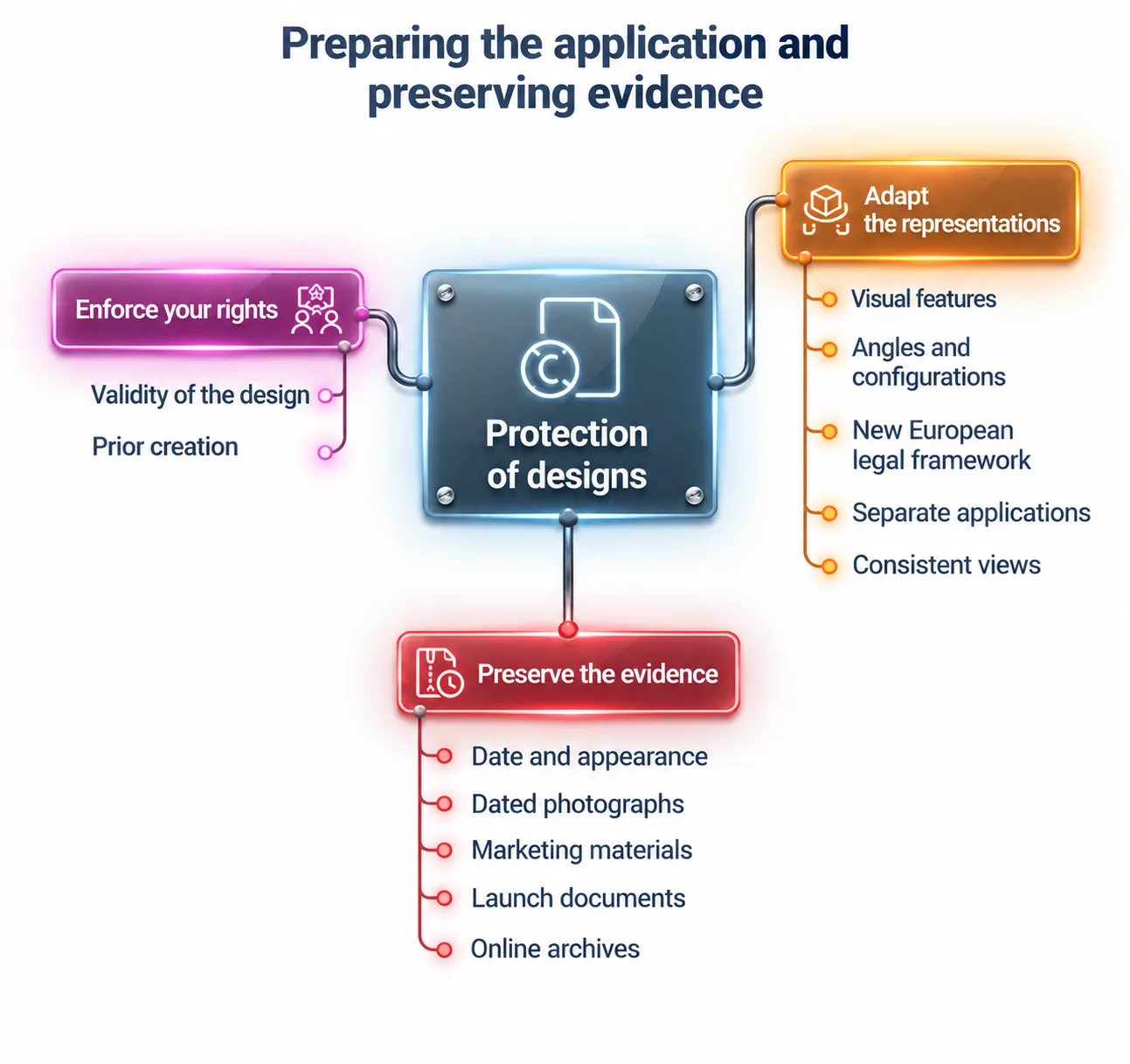
Tailoring representations to the features to be protected
The views accompanying an application for registration determine the appearance for which protection is sought.
It is therefore essential, from the filing stage, to identify the visual features that contribute to a product’s distinctive appearance.
Depending on the creation, it may be appropriate to show several angles or configurations of use, particularly where certain elements become visible only after the product is opened or manipulated.
Since 1 July 2026, the new EU framework has offered greater flexibility by removing the seven-view limit per design and allowing new forms of representation.
Businesses may also consider separate filings covering different aspects of the same product.
However, submitting more representations does not automatically guarantee broader protection. The views must remain consistent and clearly identify the features for which protection is sought.
Preserving evidence of disclosure
The SMEG case is a reminder that a business must be able to establish not only when an earlier creation was disclosed, but also what it looked like.
A catalogue showing only a closed product may establish that it was marketed without proving the appearance of its interior layout.
To anticipate such difficulties, it is advisable to preserve:
- dated photographs taken from several angles and showing different configurations;
- catalogues, brochures and advertising materials;
- product launch documents;
- archived webpages depicting the creations.
Such documentation may prove decisive when defending the validity of a design or relying on an earlier creation against a subsequent filing.
Conclusion
Decision R 2047/2025-3 of 19 June 2026 reiterates that the assessment of a design’s individual character must be based on the features actually disclosed and on their perception during the normal use of the product.
It highlights the importance of carefully preparing the representations filed and preserving comprehensive evidence of creations placed on the market.
For businesses, design protection should therefore be approached as a comprehensive strategy combining early filing preparation, documentation of creations and readiness for potential disputes.
Dreyfus Law Firm assists its clients in managing complex intellectual property cases, offering personalized advice and comprehensive operational support for the complete protection of intellectual property.
Nathalie Dreyfus, with the support of the entire Dreyfus team.
FAQ
How long does design protection last in the European Union?
A design registered with the EUIPO initially benefits from protection for five years from the filing date. Protection may be renewed in successive five-year periods, up to a maximum of 25 years.
Can a design be protected without registration?
EU law provides protection for unregistered designs for three years from the date they are first made available to the public within the European Union. This protection may, in particular, be relied upon against reproductions resulting from copying.
Can a design be filed after it has been placed on the market?
EU law provides a 12-month grace period allowing the designer or their successor in title to file a design after its first disclosure without that disclosure prejudicing its novelty or individual character, subject to the applicable conditions.
Can a design remain confidential after filing?
Applicants may request deferment of publication of their design for a maximum of 30 months. This mechanism allows the creation to remain temporarily confidential, particularly ahead of a commercial launch.
Does registration with the EUIPO provide international protection?
Registration with the EUIPO confers protection throughout the European Union but does not automatically extend to third countries. Protection in other territories requires consideration of national or international filings, including through the Hague System.
This publication is intended to provide general guidance and highlight certain legal issues. It is not intended to apply to specific circumstances or to constitute legal advice.