

AI in business: which obligations apply in 2026 and what changes under the AI Act from December 2?
Introduction
Drafting an advertisement, answering a customer or shortlisting job applications: artificial intelligence is now part of everyday business tasks. Its use may, however, expose confidential data, infringe a creator’s rights or lead to a discriminatory decision. The European regulation on artificial intelligence, known as the “AI Act”, addresses these risks by adapting obligations to the role of the business and the use of the tool.
The rules applicable to AI depend on how it is used: drafting an advertisement and selecting applicants do not carry the same risks. The business that uses the tool is called the “deployer”; the business that develops it or has it developed in order to place it on the market or put it into service under its own name, including for its own purposes, is the “provider”. Their obligations differ.
As December 2, 2026 approaches, the priority is to identify the changes that actually affect your business. This date marks, in particular, the end of a compliance period for certain providers of AI-generated content and the application of new prohibitions. It does not postpone the transparency rules that already apply, nor the obligations relating to personal data and intellectual property.
The AI Act timetable and the changes of December 2, 2026
The European Artificial Intelligence Regulation, known as the “AI Act” (Regulation (EU) 2024/1689), as amended by the AI component of the Digital Omnibus (Regulation (EU) 2026/1744), applies in stages:
| Deadline | Rules concerned | Consequences for the business |
| February 2, 2025 | Prohibited practices and AI literacy (Art. 4 and 5). | Rule out prohibited uses and help staff understand the tools and their limitations. |
| August 2, 2025 | Obligations of providers of general-purpose AI models, subject to transitional arrangements. | Check whether the business provides a model capable of performing several types of tasks, rather than merely using one. |
| August 2, 2026 | Transparency (Art. 50), with a targeted transition for technical marking. | Identify the interactions and content that must be disclosed to the public. For example, inform website users that the site’s chatbot is an AI, or state that an advertising video showing a real person was generated by AI. |
| December 2, 2026 | End of the Art. 50(2) transition for systems placed on the market before August 2, 2026. New prohibitions. | For the providers concerned, ensure that artificial content is technically detectable. Rule out the unlawful sexual or intimate uses covered by the regulation. |
| December 2, 2027 | High-risk regime for Annex III (including recruitment, credit, life and health insurance). | Prepare human oversight and traceability for the uses concerned, subject to transitional rules. |
| August 2, 2028 | High-risk rules for products listed in Annex I (including machinery and medical devices). | Anticipate the requirements applicable to systems meeting the criteria of Article 6(1). |
Source: European Commission timeline and Articles 111 and 113 of the AI Act, as amended.
These deadlines must be distinguished from the rules that already apply to all relevant projects, in particular the GDPR for personal data and intellectual property law.
To learn more about the obligations already in force, we invite you to read the article “How to manage AI risks in 2026?”.
What actually changes on December 2, 2026
For the providers concerned, this deadline requires artificial content to be made detectable in a machine-readable format. The extended period covers systems generating text, images, audio or video placed on the market before August 2, 2026. A business using these tools should ask its provider how this requirement is met. It is not, merely by using them, responsible for designing the technical solution.
What is technical marking? It means embedding in the generated file information that is invisible to the public but readable by software, indicating that the content was created or modified by AI. This information may take the form of metadata, i.e. a digital label attached to the file specifying, for example, the tool used and the date of creation. The C2PA standard, already used by several major tool developers, works this way. It may also take the form of an invisible watermark, embedded directly in the image, audio or video, which better withstands copying and cropping. Thanks to this marking, a social network or a verification tool can detect that an image is artificial, even if no notice appears on screen.
The new prohibitions cover, in particular, the use of AI to produce certain non-consensual sexual or intimate content depicting an identifiable person, as well as child sexual abuse material. In practice, a business that makes AI tools available to its employees must expressly prohibit these uses in its IT charter or internal AI use policy. For example, the charter may state that it is forbidden to use an image generator to create a nude or sexualised image of a colleague, a customer or any other real person, and set out the applicable disciplinary sanctions.
Obligations according to business uses of AI
Marketing and customer assistants: make AI identifiable
The transparency rules of Article 50 have already applied since August 2, 2026, subject to the targeted period described above. For a customer assistant, the provider must design the tool so that the person using it is informed that they are interacting with an AI, unless this is obvious. A business that installs it on its website must therefore check that this information appears clearly from the start of the conversation.
This information to the public should not be confused with the technical marking described above. Marking is invisible and intended for software, whereas information to the public is a visible notice intended for the people who see the content. It is required of any business that disseminates a “deepfake”, i.e. an image, audio or video created or modified by AI that appears real. For example, if your business publishes a video in which an executive appears to deliver a speech they never gave, it must state clearly, on screen or in the caption, that the video was generated by AI. For an evidently artistic, humorous or fictional work, this notice may be adapted so as not to spoil the work. AI-generated texts published to inform the public on matters of public interest, such as a news article, must also be disclosed, unless they have been reviewed by a person who takes editorial responsibility for them. To help businesses, the European Commission published on June 10, 2026 a Code of Practice on marking and labelling of AI-generated content, which notably proposes common icons to flag such content.
Disclosing AI is not enough, however, to make all content lawful. In France, Article 226-8 of the Criminal Code penalises, among other things, sharing without consent artificial content reproducing a person where its nature is neither obvious nor disclosed. For sexual content covered by Article 226-8-1, an “AI-generated” label does not make its dissemination lawful.
For more information, please read the Dreyfus article: “Who is responsible for the actions of autonomous AI agents?”
Personal data and recruitment: manage the information entrusted to AI
Entrusting CVs or a customer file to AI requires personal data to be protected. According to the CNIL’s recommendations, the purpose must be defined, the use legally justified and data limited to what is necessary. A CV contains, for example:
- a name,
- contact details,
- a photograph,
- a career history.
Sending them to a tool without checking its terms may lead to their retention or reuse by the provider beyond the recruitment process. If the processing is likely to result in a high risk to individuals, an impact assessment must evaluate these risks and provide for safeguards. It is also necessary to check individuals’ rights, providers’ commitments and transfers abroad.
The risk also concerns the decision taken on the basis of the output. A ranking may disadvantage certain applicants, for example if it reproduces biases related to age or career path. Automatically rejecting an application may fall under Article 22 of the GDPR, which strictly regulates fully automated decisions with significant effects on individuals. Provide for genuine human intervention, capable of understanding and reviewing the output, as well as information for applicants on how their data is processed.
Creations and copyright: check the content used and produced
Beyond personal data, the texts and images used by a business may belong to third parties. Training AI on texts or images may involve “text and data mining”: their automated analysis to extract information. Article L. 122-5-3 of the French Intellectual Property Code provides for an exception allowing certain reproductions needed for this analysis, in particular where access is lawful and rightholders have not objected (opt-out), for example through a machine-readable reservation, i.e. a technical signal enabling automated tools to detect that objection. Content available online is therefore not freely reusable. Before feeding a tool with catalogue photographs or articles, check the licences, access conditions and any rights reservations. This exception does not, on its own, authorise republishing the content analysed.
Once the tool has produced its output, another question arises: will the business be able to protect the resulting creation? A generated visual is not automatically protected by copyright. Keep intermediate versions and human creative choices, such as composition or retouching, to be able to demonstrate originality. Also check that the output does not reproduce a protected work or a third party’s sign before using it in a commercial campaign.
For more information, please read the Dreyfus article: “How can one secure or assign rights in a work created with the assistance of artificial intelligence?”
HR, credit and insurance: prepare for high-risk obligations
An AI system that screens applications, assesses a person’s creditworthiness or prices life or health insurance may be classified as high-risk. This classification reflects its potential consequences for access to employment, credit or insurance cover. It depends on the system’s precise function and on the criteria of the AI Act, not merely on the presence of AI in a piece of software.
The main obligations corresponding to these Annex III uses are scheduled for December 2, 2027, subject to transitional provisions. The deploying business must prepare for competent human oversight, use in accordance with the instructions and retention of the available logs, which record how the tool operates. Certain deployers, in particular for the credit and insurance uses covered by Article 27, will also have to assess the impact on fundamental rights. This assessment serves to identify the people exposed, the risks of discrimination and the measures to reduce them.
Contracts and evidence to prepare in case of litigation
Complying with the marking obligation does not, however, resolve the copyright question. It is not yet certain whether a model may be trained on protected works without their authors’ permission, and lawsuits are pending on this point. In March 2025, the Syndicat national de l’édition, the Société des gens de lettres and the Syndicat National des Auteurs et des Compositeurs announced proceedings against Meta over training on protected works.
In Case C-250/25, Like Company, the Advocate General delivered his Opinion on November 3, 2026. In his view, training a model is, in principle, covered by the text and data mining exception. However, reproducing press articles in a chatbot’s answers may infringe publishers’ rights. This Opinion is not binding on the Court, whose judgment is pending. For a business choosing a provider, these disputes suggest specifying in contracts who bears claims and legal fees, and within what limits.
In parallel, the CNIL may audit personal data processing. To prepare for an audit or a complaint, keep the contracts, instructions given to staff, checks carried out and the provider’s answers on marking. These documents will help explain the precautions actually taken by the business. The authority competent under the AI Act should be checked depending on the system and the applicable texts.
Funding and organising compliance without blocking projects
Compliance first requires understanding the uses the business wishes to develop. The Osez l’IA plan offers eligible SMEs and mid-sized companies a Data IA diagnostic, 40% co-funded, to identify and prioritise projects suited to their business. This technical and operational diagnostic does not replace a legal audit. Check the eligible expenses before concluding that your legal support will be funded.
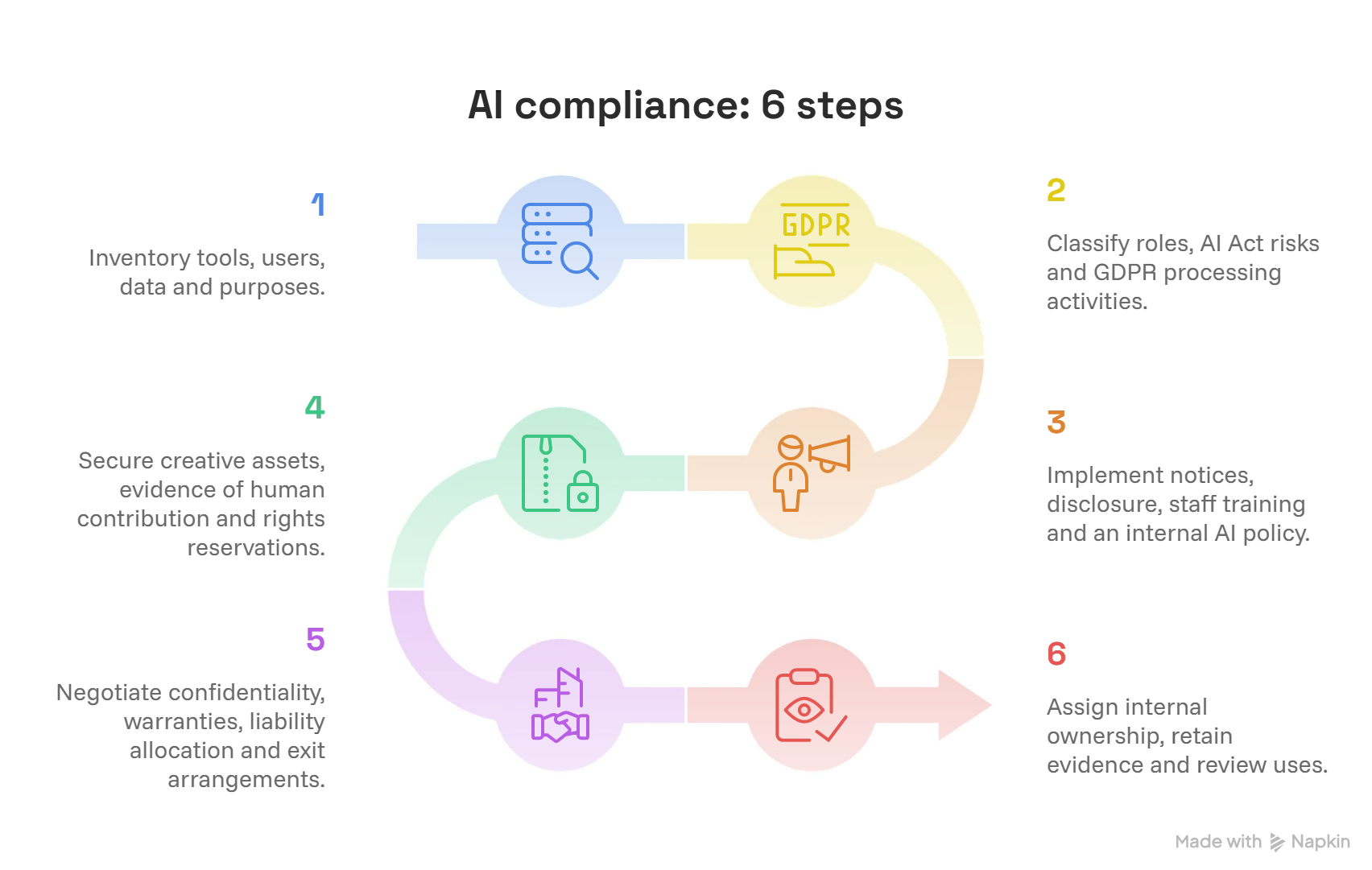
To prepare for the December deadline and the following stages, organise the work into six actions:
- List the tools, their users, the data entrusted and the objectives pursued.
- Determine your role for each tool, the risks of each use and the deadlines that actually apply.
- Check technical marking of the relevant content with the provider, inform the people concerned and train staff with clear instructions.
- Check the rights in the content entrusted to AI and in the outputs, keep evidence of human creative input and organise your rights reservations where necessary.
- Negotiate confidentiality, warranties, liability and the conditions for changing provider.
- Appoint internal owners, keep evidence and review uses regularly.
Conclusion
December 2, 2026 is not a general deadline for all AI projects. Businesses mainly need to determine whether they are affected by the end of the technical marking period and by the new prohibitions. The rules already applicable, in particular on transparency, personal data and intellectual property, continue to apply.
To move forward, ask your providers how their tools meet the applicable requirements, check the information given to the public and appoint the people responsible for monitoring uses. The later high-risk deadlines should be prepared now, without waiting to apply the GDPR. Dreyfus assists you with audits, contracts and the protection of your assets.
Dreyfus Law Firm assists its clients in managing complex intellectual property cases, offering personalized advice and comprehensive operational support for the complete protection of intellectual property.
Dreyfus & Associés works in partnership with a global network of attorneys specializing in Intellectual Property.
Nathalie Dreyfus with the support of the entire Dreyfus team
Q&A
Must the works council (CSE) be consulted before deploying AI?
In businesses with at least 50 employees, the social and economic committee (CSE) must, among other things, be informed and consulted prior to the introduction of new technologies, under Article L. 2312-8 of the French Labour Code. Review the project and its effects before implementing it.
Is an open-source model exempt from the AI Act?
No. A model available as open source does not automatically escape the regulation. Exemptions depend on its release conditions; certain transparency and copyright obligations remain.
Does using AI make it mandatory to appoint a DPO?
No. A data protection officer (DPO) is mandatory in the cases provided for by the GDPR, in particular certain monitoring of individuals or large-scale processing of sensitive data.
Does a provider established outside the EU escape the regulation?
No. The regulation may apply if the system is placed on the market in the EU or if its outputs are used there, under the conditions laid down. Being established abroad is not enough to exclude it.
Does cyber insurance cover an AI agent’s errors?
Not automatically. Check which events and activities are covered, the exclusions, the limits and infringements of third-party rights. Ask the insurer for written confirmation for the intended use.
This publication is intended to provide general guidance to the public and to highlight certain issues. It is not intended to apply to specific situations or to constitute legal advice.