

UDRP: how should the bad faith of a domain name investor be assessed? Lessons from the nexusmutual.com case
Introduction
Assessing bad faith in a UDRP proceeding can raise particular difficulties when the disputed domain name was acquired before registration of the trademark relied upon by the complainant. The <nexusmutual.com> case (Nexus Mutual Limited v. Mira Holdings, WIPO Case No. D2026-1863, August 18, 2026) is a striking example: a WIPO Administrative Panel, by a two-to-one majority, ordered the transfer of the domain name to a blockchain-based mutual cover provider, even though its trademark was registered only after a professional investor had acquired the domain name.
The outcome rests on two pillars: the recognition of unregistered trademark rights predating the acquisition of the domain name, and the application of the wilful blindness doctrine to an investor who could not have been unaware of its duty to search. The strongly worded dissent, however, highlights the limits of the UDRP Policy when a dispute raises domain name law questions that, in reality, belong before a court.
For more information on UDRP procedures, we invite you to consult our previously published article: “What is the UDRP? A Comprehensive Guide to Protecting Your Domain Names”.
Facts: an expired domain name bought at auction by an investor
The Complainant, Nexus Mutual Limited, has operated since 2018 a blockchain-based discretionary mutual specializing in cover for digital assets and smart contracts. It obtained registration of its UK trademark NEXUS MUTUAL only on May 9, 2025.
The domain name <nexusmutual.com>, previously held by an Australian credit union, expired and was acquired by Mira Holdings, an investor holding several thousand names, at an expired domain name auction on December 2, 2023, for USD 53,499. It was listed for sale at USD 250,000. The Complainant reportedly made an offer of USD 25,000 before filing the UDRP complaint; the investor, alleging that the Complainant had itself bid at the auction, requested a finding of Reverse Domain Name Hijacking.
The majority decision: bad faith grounded in wilful blindness
Unregistered rights predating the acquisition
The majority accepted that the NEXUS MUTUAL mark enjoyed a reputation and unregistered rights before December 2023, supported in particular by favorable articles published by CoinDesk in 2020 and 2021. This was decisive: under the WIPO Overview 3.1, bad faith is assessed at the date on which the respondent itself acquired the domain name, not its original creation date.
Historical Google searches: evidence admitted with caution
The Complainant filed a Google search limited to December 1, 2022 to December 1, 2023 and targeted at the United States, whose first three pages related almost exclusively to the Complainant. Notably, the Panel conducted its own research into how this tool works and found that it ranks results using Google’s current index, not a historical one. Such evidence is therefore not an exact record of what the investor would have seen in 2023; it nevertheless retains sufficient probative value in the absence of contrary evidence.
Regarding the preservation and evidentiary value of online content, we invite you to consult our article: “Can the Wayback Machine archives be relied upon as evidence on the Internet?”.
The professional investor’s duty to search
The majority of the Panel noted that the investor, already a party to nineteen prior UDRP cases, had previously been reminded of its duty to search by an earlier panel. Having paid four times more than in a previous acquisition for which it had conducted searches, it was likely to have checked the sign’s association with the Complainant. If it did not, it knowingly disregarded that risk: this is wilful blindness. The USD 250,000 asking price, while not in itself evidence of bad faith, was found likely to filter out any buyer other than the trademark owner. As the complaint succeeded, the request for a finding of Reverse Domain Name Hijacking was, logically, dismissed.
For further information regarding the requirement of registration and use in bad faith, please see our article: “How does the bad faith duplicate between registration and bad faith use?”.
The dissent: bad faith cannot be reconstructed after the fact
The dissenting panelist would have denied the complaint. He criticized the majority for not verifying whether sufficient acquired distinctiveness existed: the four articles relied upon, two of which came from specialist media, did not evidence actual commercial use of the mark. Above all, he considered that what is true today cannot be projected back to December 2023, since the investor most likely learned of the Complainant only when contacted in September 2025. In his view, the dispute raised a trademark issue beyond the scope of the UDRP, which only a court could resolve.
For further insight into the limits of the procedure, we invite you to consult our article: “Complex disputes are not meant to be resolved through the UDRP procedure: the case of a conflict between a manufacturer and a former distributor”.
Practical implications for trademark owners and investors
For trademark owners
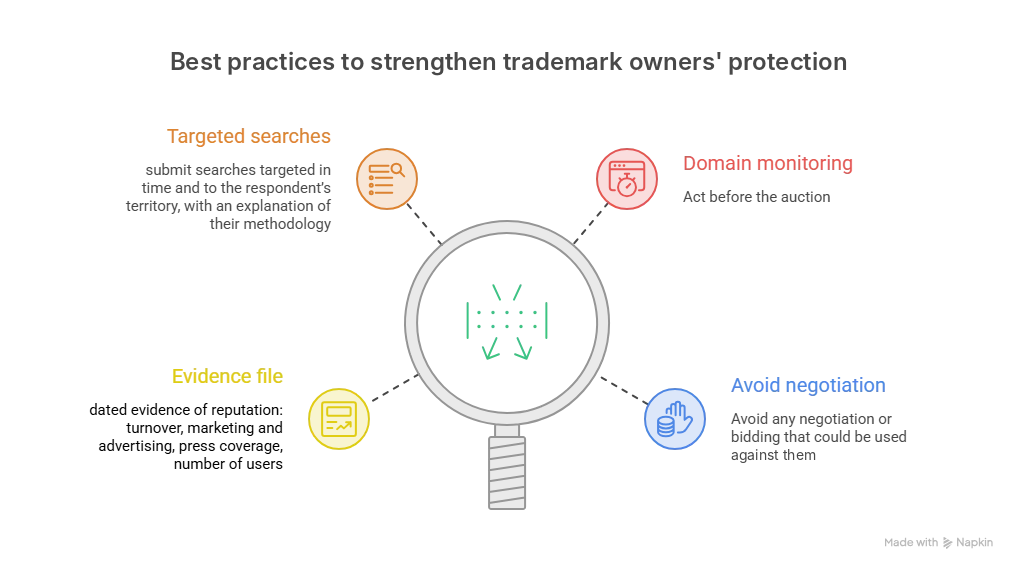
To strengthen the protection of their rights and maximize their chances of success in a UDRP proceeding, trademark owners should in particular:
- build a file of dated evidence of reputation: revenue, marketing, press coverage, user numbers,
- submit searches targeted by time and by the respondent’s territory, together with an explanation of their methodology,
- set up monitoring of expiring domain names so as to act before the auction,
- avoid any negotiation or bidding that could be turned against them.
For more on detecting abusive registrations, we invite you to consult our article: “Domain name monitoring: protecting your trademark against cybersquatting”.
For domain name investors
This decision is a reminder that acquiring domain names for investment purposes, while lawful in principle, does not exempt professionals from exercising particular vigilance with regard to third-party rights. In this context, several precautions should be taken:
- document and retain the clearance searches carried out before each acquisition,
- distinguish genuinely descriptive terms from combinations that look like a brand,
- bear in mind that an investor’s UDRP history may be held against it.
For a broader overview of domain name exploitation, we invite you to consult our article: “Domain names: how to value, leverage and anticipate legal risks”.
Conclusion
The <nexusmutual.com> case illustrates the difficulties involved in assessing bad faith where a domain name was acquired before registration of the trademark relied upon. The decision underlines the importance of evidencing unregistered trademark rights predating the acquisition, as well as the circumstances showing that the respondent was aware of those rights or wilfully disregarded their existence. For trademark owners, the lesson is clear: anticipate, document and coordinate UDRP strategy with potential litigation, with the guidance of an experienced UDRP lawyer and domain name dispute lawyer.
To stay informed of intellectual property developments, we invite you to subscribe to our newsletter and to follow us on social media.
Dreyfus & Associés assists its clients in managing complex intellectual property cases, offering personalized advice and comprehensive operational support for the complete protection of intellectual property.
Nathalie Dreyfus with the support of the entire Dreyfus team
Q&A
Can a UDRP decision be challenged in court?
A respondent that loses the proceeding has ten business days from the registrar’s notification of the decision to provide evidence that it has commenced a lawsuit before a competent court. The transfer is then stayed until the dispute is resolved or the action is withdrawn.
How much does a UDRP proceeding before WIPO cost?
The WIPO Arbitration and Mediation Center’s fees amount to USD 1,500 for one to five domain names decided by a single panelist, and USD 4,000 for a three-member panel. These amounts do not include counsel fees or the cost of gathering evidence.
What are the consequences of a Reverse Domain Name Hijacking finding?
A Reverse Domain Name Hijacking finding carries no financial penalty under the UDRP. It is published with the decision and may durably damage the complainant’s credibility, particularly in subsequent proceedings where its past conduct will be examined.
How can a trademark owner discreetly buy back a domain name held by an investor?
It is advisable to use an intermediary or a specialist broker so as not to reveal the trademark owner’s identity, and an escrow service to secure payment. Any negotiation should be conducted with a potential future proceeding in mind, as the exchanges may be submitted to a panel.
What steps should be anticipated when acquiring an expired domain name?
An expired domain name passes through several phases (grace period, redemption period, deletion) before returning to the market. Backorder services make it possible to take a position during this period, and monitoring the expiry dates of names matching one’s trademarks allows action before the auction opens.
This publication is intended for general public guidance and to highlight issues. It is not intended to apply to specific circumstances or to constitute legal advice.