

Introduction
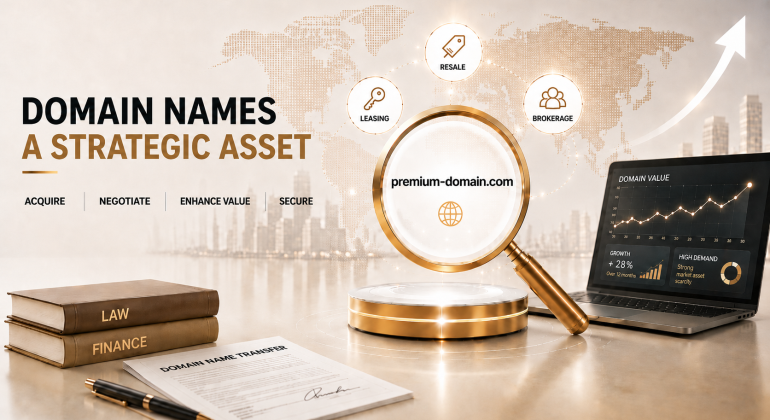
Over the past two decades, domain names have evolved into genuine intangible assets with autonomous economic value. The gradual saturation of the primary market has given rise to a structured, professional secondary market that is, for the best-informed actors, extremely lucrative. But how does domain name monetisation actually work? Which economic models exist? And which legal risks should be anticipated to secure these transactions?
From technical identifier to tradeable asset: understanding the value of a domain name
Originally, domain names were merely technical addresses designed to direct internet users to a website. It was the scarcity of available names, combined with the explosion of e-commerce, that triggered a profound transformation: certain domain names became rare and coveted assets, akin to plots of land in a commercial district.
1.1 Scarcity as a value driver
The primary market, direct registration through a registrar accredited by ICANN, can no longer meet the demand for short, generic and memorable names. With net registration growth of only 0.5% in 2024, the stock of attractive names is nearly exhausted. This structural scarcity stems from a fundamental property of the domain name system: a domain name is by nature unique. For example, there can be only one holder of the name « assurance.com »; this technical feature automatically lends a special value to appealing generic names. Uniqueness is the first determinant of value: a domain name built around a highly sought-after generic keyword concentrates a value that does not depend on its holder’s activity, but on its intrinsic ability to generate organic traffic and commercial visibility.
1.2 Financialisation: from use to investment
This dynamic of scarcity has led to the emergence of speculative investment practices: « domainers » build and manage portfolios in the same way as alternative-asset investors, buying at low prices, increasing value, and reselling at a profit. Landmark transactions, such as ai.com sold for USD 70 million in 2026, illustrate the phenomenon. These figures reveal the maturity of a market in which the valuation of intangible assets follows rigorous economic criteria.
Monetisation models: resale, leasing and passive exploitation
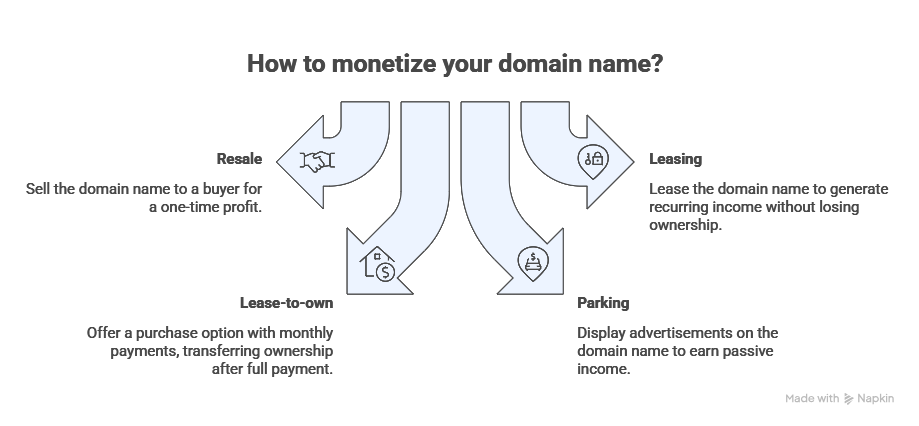
Domain name monetisation is not limited to resale. Several economic models coexist, offering strategies tailored to each holder’s profile.
2.1 Resale on the secondary market
This is the most straightforward model. The holder permanently transfers the domain name to a buyer, who becomes the new registrant. Around 144,700 transactions were recorded in 2024, for a total value exceeding USD 185 million. Resale can take place privately, through a specialised broker, or via auctions organised on dedicated platforms such as Sedo or Afternic. Pricing depends on multiple factors: extension, length, generic nature of the term, traffic history, and absence of pending disputes.
2.2 Leasing and lease-to-own
The leasing model allows the holder to collect recurring revenue without parting with the asset. The tenant obtains a limited, non-exclusive and non-transferable right of use for a fixed term, subject to the conditions set by the holder. This mechanism protects the owner while opening access to premium domain names for operators who cannot or do not wish to bear the immediate cost of acquisition.
Lease-to-own is a hybrid variant: the user pays monthly instalments credited against an agreed sale price, with legal ownership remaining with the seller until full payment. This structure, comparable to a financial lease, suits high-value assets that are difficult to finance up front.
2.3 Parking and passive monetisation of traffic
A domain name not actively exploited can still generate passive revenue through parking: the page displays contextual advertising links whose clicks produce revenue shared with the platform. The model works best when the name generates direct natural traffic, without going through a search engine. Active monitoring of the domain name remains advisable, even in this case: uncontrolled advertising use may at any time infringe a third party’s rights.
The market ecosystem: specialised platforms and intermediaries
The secondary market is structured around an intermediation ecosystem that, like financial markets, provides liquidity, price formation and transaction security.
3.1 Mass-market platforms
Actors such as Sedo, Afternic and GoDaddy Auctions form part of the secondary-market infrastructure. They combine several formats, auctions, fixed price or brokerage, and expose names to millions of potential buyers. Their compensation is based on commissions of 10% to 30% depending on the sales channel.
3.2 Specialised brokerage for high-value transactions
Above a certain threshold, transactions go through specialised brokers who appraise the asset, conduct negotiations and structure the contract. Their involvement is all the more valuable as the legal qualification of domain names remains uncertain, making contractual drafting decisive for the buyer’s security.
The legal framework: between contractual freedom and structural uncertainty
Domain name monetisation operates in a hybrid and uncertain legal environment. Neither property law, nor contract law, nor intellectual property law alone governs domain name transactions, which generates a legal insecurity that practitioners must learn to manage.
4.1 The uncertain legal qualification of domain names
Under French law, « .fr » domain names are governed by the Code des postes et des communications électroniques (CPCE), which entrusts management of the registry to AFNIC and frames registration conditions according to public-interest requirements. In this framework, registration confers a right of use, not a right of ownership. French administrative case law has nevertheless recognised a patrimonial dimension to this right of use, where it can be valued and assigned (Conseil d’État, 7 December 2016, no. 369814, Société eBay).
By contrast, « .com » domain names fall under a largely privatised system, governed by ICANN and the accreditation contracts of registrars. U.S. case law has, in some decisions, recognised domain names as intangible property subject to ownership (Kremen v. Cohen, 337 F.3d 1024, 9th Cir. 2003). This asymmetry of protection depending on the extension must be anticipated in any international monetisation strategy.
4.2 The absence of automatic legal warranties in transfers
Unlike the assignment of a registered trademark, which benefits from a precise legal regime including warranty against eviction and publicity enforceable against third parties : the transfer of a domain name does not automatically generate equivalent legal warranties. The transferee enjoys no presumption of title; it bears the entire risk linked to the anteriority of potential third-party claims, in particular those based on pre-existing trademark rights.
This is why contractual practice has developed compensatory mechanisms: representations and warranties on the quality of title (no pending litigation, no infringement of third-party rights), indemnification clauses, technical-cooperation obligations and escrow mechanisms allowing the release of funds to be conditional on the effective completion of the transfer.
4.3 Risks linked to UDRP proceedings and trademark infringement
A domain name may at any time be the subject of UDRP proceedings initiated by the holder of a prior trademark. Administered by WIPO or other providers accredited by ICANN, these proceedings can lead to the forced transfer of the name if the registrant’s bad faith is established, including after the transaction, exposing the buyer to loss of the asset. In the most serious situations, a trademark-infringement action may be brought in parallel, with significant financial and reputational consequences.
Securing a domain name transaction: essential precautions
Faced with these risks, rigorous due diligence is essential regardless of the transaction value. The following are the points of vigilance we recommend.
5.1 Verifying the quality of title before any acquisition
- Verify the registrant’s identity and its consistency with the seller.
- Search for prior trademarks on the INPI, the EUIPO and international databases (prior-art searches).
- Check the domain name’s history (Wayback Machine-type tools, spam records, parking history).
- Verify the absence of pending or recent UDRP proceedings via WIPO
5.2 Structuring the assignment contract with precision
Representations and warranties: the seller certifies that it is the legitimate registrant, that it has effective technical control of the name, and that no third-party claim is pending or foreseeable.
- Technical-cooperation obligations: provision of the EPP/Auth code, unlocking of the name with the registrar, assistance within the agreed timeframes.
- Escrow clause: funds are held by a trusted third party and released only after confirmation of the effective transfer.
- Indemnification clause: the seller undertakes to indemnify the buyer for any loss arising from infringement of a third-party right pre-existing the transaction.
Conclusion
Domain name monetisation has established itself as a structured economic reality, driven by the scarcity of available assets and the growing maturity of market actors. The central issue remains the legal security of transactions: verification of prior rights, suitable contractual structuring, escrow mechanisms, and post-acquisition monitoring. In this field, technical mastery and legal rigour are inseparable.
Dreyfus law firm assists its clients in managing complex intellectual property cases, offering personalized advice and comprehensive operational support for the complete protection of intellectual property.
Nathalie Dreyfus with the support of the entire Dreyfus team.
Q&A
1. What is a premium domain name and how is it valued?
A premium domain name is a short, generic and memorable term combined with a popular extension such as « .com ». Its value lies in inbound natural traffic, SEO potential and market comparables. It is advisable to have it appraised by an expert.
2. Can a domain name be seized or recorded as a balance-sheet asset?
Yes, French case law recognises the patrimonial dimension of the right of use attached to a domain name (Conseil d’État, 2016, ebay.fr), allowing it to be recorded on the balance sheet as an intangible asset (IAS 38). Its seizability remains, however, more uncertain under French law than under U.S. law, which allows in rem actions directly against the name.
3. How can a recently acquired domain name be protected from UDRP recovery?
Protection begins before acquisition: a prior-trademark search is essential. Once the name is acquired, it must be used in good faith, without risk of confusion with a third-party sign. If proceedings are commenced, the assistance of counsel specialised in domain name disputes from the cease-and-desist stage onwards is decisive.
4. What is the difference between assigning a domain name and assigning a trademark?
Assigning a trademark transfers an intellectual property right enforceable against third parties, with legal warranties. Assigning a domain name transfers only a contractual right of use, whose strength depends entirely on the contract. The two assets are complementary: a strategic domain name should always be backed by a corresponding trademark.
5. Can the parking of a domain name constitute trademark infringement?
Yes, if the name reproduces a prior trademark and the parking page displays advertisements in the same business sector. This may amount to use of the sign in the course of trade and ground an infringement action or UDRP proceedings. Prior verification of third-party rights is therefore essential before any parking.
The purpose of this publication is to provide general guidance to the public and to highlight certain issues. It is not intended to apply to particular situations or to constitute legal advice.