


Trademark holding companies and royalties: can a licence conceal an assignment?
Introduction
A holding company owns a group’s trademark and licenses it to its operating company. In return, the operating company pays annual royalties. But what happens when an option also provides for the future transfer of the trademark?
This situation raises an issue at the crossroads of trademark law, contract law and taxation: can a licence conceal an assignment whose price is simply spread over time?
In its opinion of March 19, 2026 (session No. 3, case No. 2026-02), the Abuse of Tax Law Committee ruled in favour of the tax authorities’ challenge to a structure combining a trademark licence, a put option and an escrow of the price.
This opinion encourages business leaders and groups to examine the economic reality of their intellectual property agreements.
Trademark licence and assignment: two transactions with different consequences
An essential legal distinction
A trademark is an intangible asset that its owner may use, assign or license.
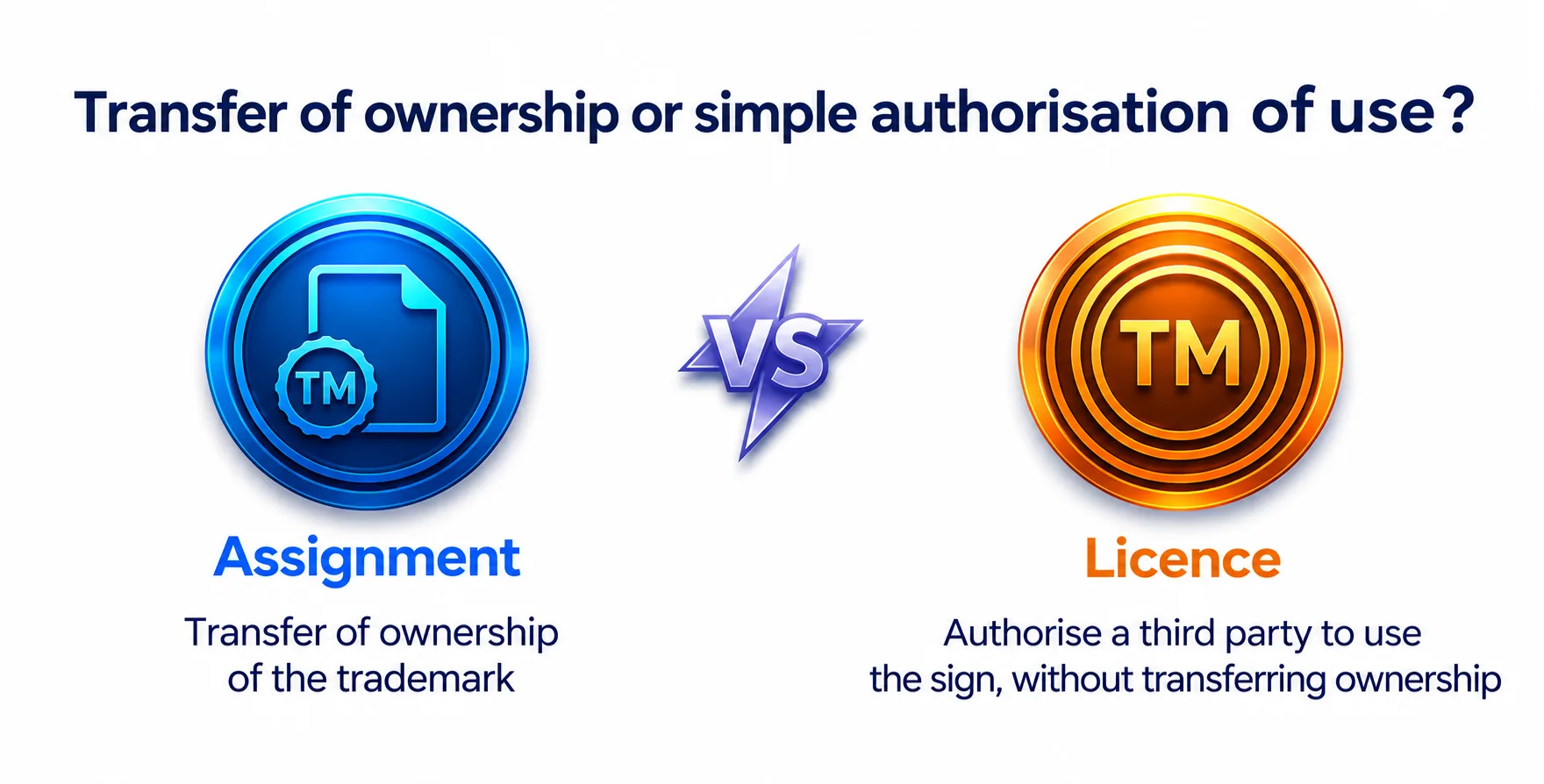
An assignment transfers ownership of the trademark to a purchaser. A licence authorises a third party to use the sign, under the conditions set out in the agreement, without transferring ownership.
Article L. 714-1 of the French Intellectual Property Code governs these transactions. A licence may be exclusive or non-exclusive and may cover specific territories, goods or services.
This distinction must, however, reflect the actual conditions of use: the title of the agreement is not enough to determine the nature of the transaction.
Different tax consequences
Royalties paid under a genuine licence may be deductible expenses for the licensee, subject to the applicable tax conditions. They are taxed in the hands of the licensor according to its tax regime.
By contrast, the purchase price of a trademark generally constitutes the cost of a capitalised intangible asset. Whether it can be amortised depends in particular on its foreseeable period of use.
For the assignor, the sale may generate a taxable capital gain, possibly subject to a specific regime.
Registration duties also vary depending on the nature of the transaction, particularly when a trademark is transferred together with a business (fonds de commerce).
This difference in tax treatment may lead the tax authorities to examine whether the royalties genuinely correspond to the use of a trademark or to the payment of its price in instalments.
The opinion of March 19, 2026: lessons from a deferred assignment
A licence combined with a put option
Case No. 2026-02 concerned a business owner who personally held a trademark used in a lubricants business.
When this business was sold to a Swiss group, several agreements were signed on the same day, October 31, 2014.
The owner notably granted the company being sold an exclusive licence for an initial term of twenty years, in return for an annual royalty of EUR 90,000 excluding VAT.
At the same time, a put option, exercisable until June 30, 2021, allowed him to sell the trademark and the related intellectual property rights for EUR 6 million, less the royalties paid until the option was exercised.
An escrow agreement secured payment of this price, which was deposited in full from the outset.
The assignment finally took place on June 24, 2021, for a price of EUR 5,422,500. The assignor then claimed the capital gain exemption under Article 151 septies of the French General Tax Code.
The indicators relied on by the Committee
The tax authorities considered that the agreements concealed a deferred assignment, the royalties being in reality instalments of the price.
The Committee noted in particular:
- the exclusive, irrevocable and transferable nature of the rights granted to the licensee,
- the licensee’s payment of the trademark maintenance costs,
- an annual amount of EUR 90,000 matching exactly the revenue threshold for the exemption, with no other economic justification,
- a put option whose timetable made it possible to meet the five-year activity requirement of this regime,
- the offsetting of the royalties against the sale price and the placing of the entire price in escrow from the outset.
The Committee considered that the sole purpose of the licence was to artificially bring the capital gain within the exemption regime of Article 151 septies of the French General Tax Code.
It found that the tax authorities were entitled to apply the abuse of law procedure under Article L. 64 of the French Tax Procedure Code. It also upheld the 80% penalty, as the owner had been the main instigator and main beneficiary of the acts in question.
The opinion is not a court judgment. It nevertheless illustrates the importance attached to the economic consistency of the agreements.
Which structures carry a tax risk?
The lessons of this case go beyond the situation of a business owner who owns his trademark.
Several structures may require particular attention:
- a holding company licensing a trademark to its subsidiary while providing for a promise to assign,
- a founder personally retaining a trademark before transferring it to the company,
- a long-term licence combined with a buy-back at a nominal price,
- a takeover transaction in which the seller temporarily retains the trademark while its future transfer is already organised.
These structures do not automatically constitute an abuse of law. The risk depends in particular on their objectives, on how the owner’s prerogatives are allocated and on the justification of the financial terms.
Since 2021, Article L. 64 A of the French Tax Procedure Code has also allowed the tax authorities to disregard acts whose main purpose, rather than sole purpose, is tax-driven.
In international groups, additional vigilance is required with regard to transfer pricing, in particular under Article 57 of the French General Tax Code.
How can a trademark licence be secured?
A genuine licence must reflect an operating relationship consistent with the licensor retaining ownership of the trademark.
Several points deserve particular attention.
- Allocation of responsibilities: the agreement should define the obligations relating to renewals, monitoring, enforcement of the trademark and quality control.
- Justification of royalties: their amount must be explainable on the basis of objective economic criteria, in particular the value of the trademark, the market concerned and the rights granted.
- Term and exit conditions: these must reflect a genuine contractual rationale, without artificially organising a transfer that has already been agreed.
- Purchase option: its existence alone is not enough to establish an abuse. However, where royalties are systematically offset against a price fixed in advance, an in-depth analysis becomes necessary.
Securing a licence therefore depends on consistency between the contractual provisions, the parties’ conduct and the economic objectives pursued.
Structuring a trademark holding company: best practices
Holding trademarks through a holding company may serve legitimate objectives: centralisation of assets, protection of assets, financing or preparation for a transfer.
To organise this structure effectively, several steps are recommended:
- value the trademarks when they are contributed or acquired,
- set economically justified royalties, taking market practice into account,
- draw up comprehensive agreements, specifying in particular the rights granted, the term, the territories and the termination conditions,
- carry out the necessary recordals with the relevant registers,
- keep the documents justifying the legal and economic choices.
In France, Article L. 714-7 of the French Intellectual Property Code makes transfers and changes to trademark rights enforceable against third parties only once they are recorded in the National Trademark Register.
An independent valuation is also useful to justify the value of the asset and the conditions under which it is made available.
Dreyfus & Associés assists companies with the valuation of their trademarks, the drafting and audit of licence and assignment agreements, and recordal formalities before the INPI, the EUIPO and WIPO.
This support is provided in coordination with tax lawyers and chartered accountants, in order to ensure the legal and economic consistency of the transactions.
Conclusion
The opinion of March 19, 2026 is a reminder that the distinction between a trademark licence and an assignment does not depend solely on how the agreement is drafted.
It rests on the reality of the rights granted, the financial terms and the objectives pursued.
For business leaders and groups, securing a trademark holding structure therefore requires documenting the value of the assets, justifying the royalties and ensuring the consistency of the agreements.
Dreyfus Law Firm assists its clients in managing complex intellectual property matters, offering personalised advice and comprehensive operational support for the full protection of intellectual property.
Nathalie Dreyfus, with the support of the entire Dreyfus team.
Q&A
Do trademark royalties qualify for the preferential tax regime for industrial property?
No. The reduced corporate income tax rate under Article 238 of the French General Tax Code applies in particular to patents, plant variety certificates and copyright-protected software. Trademarks are excluded, so the royalties they generate are taxed under the ordinary rules.
Must a trademark licence agreement be in writing?
Yes. Acts involving the transfer of a trademark or the grant of a right to use it must be recorded in writing, failing which they are void. A verbal agreement or informal exchanges therefore expose the parties to a challenge of their rights.
Can the licensee bring infringement proceedings against a third party?
Unless otherwise provided in the agreement, the licensee may only bring an infringement action with the trademark owner’s consent. An exclusive licensee may, however, take action if the owner, after formal notice, does not itself bring proceedings within an appropriate period.
Can the tax authorities be consulted before a structure is put in place?
Yes. The ruling procedure under Article L. 64 B of the French Tax Procedure Code allows a transaction to be submitted to the tax authorities before it is concluded. If no reply is received within six months, the authorities can no longer apply the abuse of law procedure to that transaction.
Can the licensee grant sub-licences?
The right to sub-license depends on the agreement. Without a clause expressly allowing it, a licence is generally regarded as granted in consideration of the licensee’s identity. It is therefore advisable to set out the conditions for sub-licensing, in particular the owner’s prior consent and quality control.
This publication is intended for general public guidance and to highlight issues. It is not intended to apply to specific circumstances or to constitute legal advice.