


Can a descriptive term be monopolised? What the L’ENTRECÔTE case changes for trademark protection
Introduction
Can a company obtain an exclusive right over a word in everyday language? In some sectors, trademarks directly reproduce the name of a product or a characteristic of the service offered. While such names are easily understood by consumers, their legal protection can prove difficult.
The judgment handed down by the Paris Judicial Court on June 19, 2026 in the L’ENTRECÔTE case (Docket No. 22/08095) illustrates this difficulty. The judges upheld the validity of an initially descriptive French trademark, owing to the distinctive character it had acquired through use in France. However, on a counterclaim, they partially invalidated the corresponding European Union trademark for restaurant services, as acquired distinctiveness had not been proven in Belgium.This decision serves as a reminder that a descriptive term can become a protected trademark when the public identifies it as designating a specific commercial origin. This must, however, be proven.
Can a descriptive term constitute a valid trademark?
Distinctive character, an essential requirement
Under trademark law, a sign must enable consumers to distinguish the goods or services of one company from those of its competitors. This capacity constitutes its distinctive character.
Article L. 711-2 of the French Intellectual Property Code notably excludes from registration signs consisting exclusively of indications that may serve to designate a characteristic of the goods or services concerned.
This rule aims to preserve freedom of trade: a company should not be able to appropriate the terms its competitors need to describe their own business.
Accordingly, the word “bakery” cannot normally be monopolised for bakery services. Its distinctive character could, however, be assessed differently for goods unrelated to that activity.
Distinctiveness acquired through use
An initially descriptive term may nevertheless become distinctive when prolonged use leads consumers to associate it with a specific company.
This mechanism, known as acquired distinctiveness through use, is expressly provided for in the last paragraph of Article L. 711-2 of the French Intellectual Property Code. It makes it possible to protect a sign that did not initially meet the distinctiveness requirements.
Such recognition is not automatic, however. European case law notably takes into account the duration and intensity of use, advertising investment, market share and consumer perception (ECJ, May 4, 1999, Windsurfing Chiemsee, C-108/97 and C-109/97).
The L’ENTRECÔTE case: protection acquired through use
A dispute between restaurant operators
The dispute was between, on one side, five companies operating the L’Entrecôte, Le Relais de Venise and Le Relais de l’Entrecôte restaurants (Entrecôte Gestion Tajpa, Le Relais de Venise, Le Relais de l’Entrecôte, Relais de l’Entrecôte SaintGermain and Relais de l’Entrecôte (Montparnasse)) and, on the other, the Spanish company Relais Groupe Europa and its director, who operate the “Relais de Paris” franchise.
Entrecôte Gestion Tajpa owned two word trademarks for L’ENTRECÔTE:
- French trademark No. 4124984, filed on October 10, 2014, and registered on April 29, 2016, covering services in Classes 35 and 43, including restaurant services (provision of food).
- European Union trademark No. 15437916, filed on May 13, 2016, and registered on August 30, 2016, covering the same services in Classes 35 and 43.
The claimants alleged that the defendants were using the sign “Entrecôte” to promote their restaurant services, in particular online and on social media, in circumstances likely to create confusion.
The defendants challenged their validity, arguing that the term simply designated a cut of beef served in restaurants.
In its judgment, the court indeed found that the term “entrecôte” was descriptive of restaurant services. Adding the article “L’” was not sufficient to give it inherent distinctive character.
Sufficient evidence to protect the French trademark
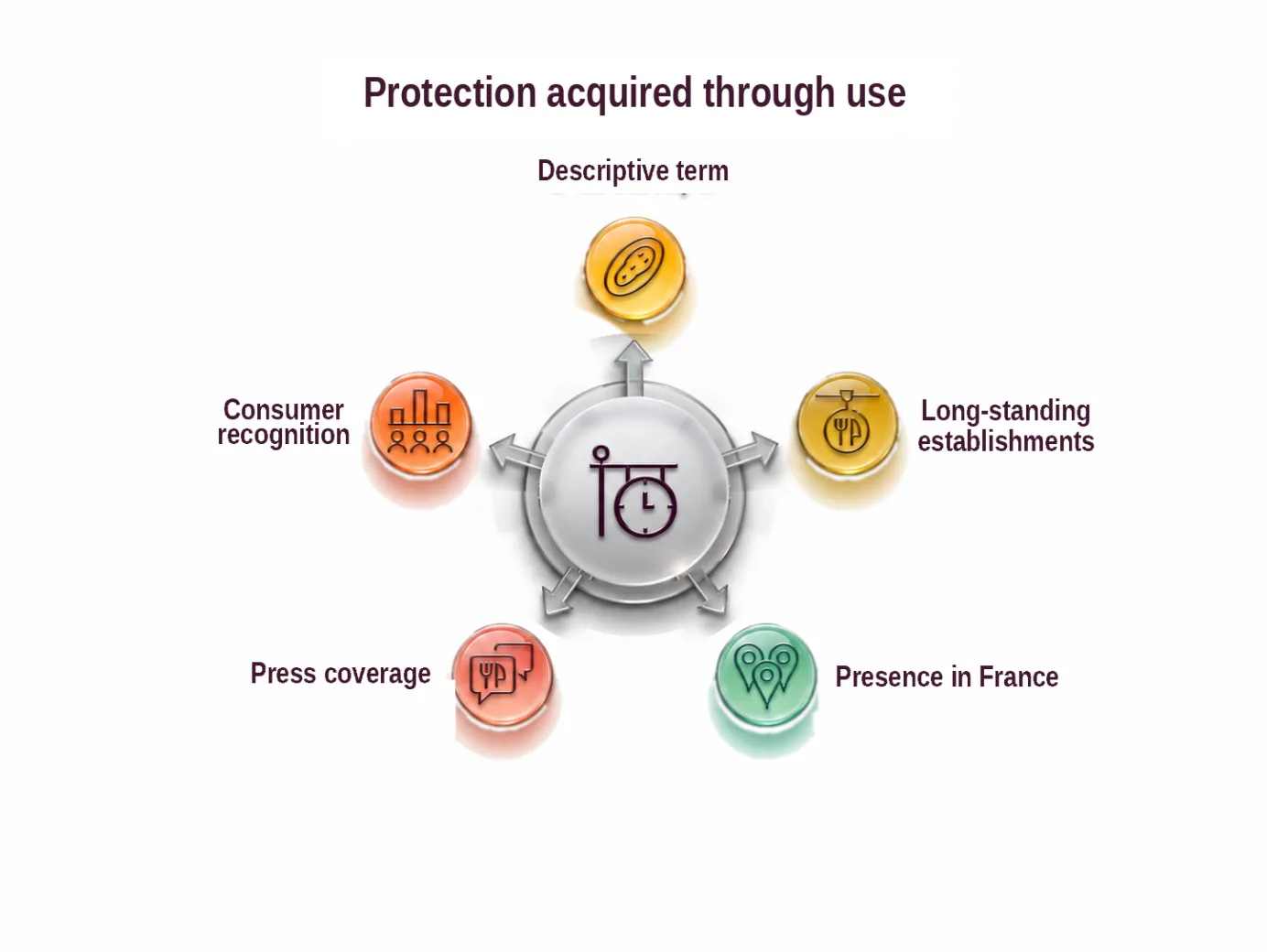
The court nevertheless held that the French trademark had acquired distinctive character through use.
The judges notably took into account:
- the long-standing nature of the restaurants, some of which have been operating since 1959,
- their presence in several French cities,
- numerous references in the press and in guides,
- consumer recognition of the sign.
This evidence showed that the term “L’Entrecôte” no longer referred solely to a dish, but also to a commercial origin.
The court considered that a consumer perception survey was not essential, as the other evidence was sufficiently convincing. This approach is consistent with European case law, under which acquired distinctiveness cannot be made conditional on a minimum percentage of recognition established by a survey (CJEU, , Oberbank, C-217/13 and C-218/13).
The French trademark was therefore upheld, despite its initially descriptive nature.
Why was the French trademark upheld, but not the EU trademark?
One of the main lessons of this decision concerns the difference between national and European protection.
The European Union trademark is unitary in character. A sign may be refused or invalidated even if it is descriptive in only part of the Union. Its owner must then prove that it has acquired distinctive character through use throughout the territories concerned.
This principle derives in particular from Article 7(2) and (3) and Article 59(2) of Regulation (EU) 2017/1001 and from European case law (CJEU, July, 25 2018, Nestlé, C-84/17 P).
In the L’ENTRECÔTE case, the term was understood by French-speaking consumers, notably in France and Belgium.
However, the evidence submitted mainly established its recognition in France, without showing that the French-speaking public in Belgium also identified it with a specific commercial origin.
The court therefore declared the EU trademark partially invalid for restaurant services in Class 43, while upholding the French trademark.
This outcome highlights that a trademark that is well established on the French market does not necessarily enjoy equivalent protection at European level.
Protection that does not prohibit all competing uses
The distinction between descriptive use and use as a trademark
The validity of a trademark does not mean that its owner can prohibit all use of the protected term.
Trademark law distinguishes between using a sign to identify the commercial origin of a service and using it to describe a product. Article L. 713-6 of the French Intellectual Property Code thus allows third parties to use, in accordance with honest practices in industrial or commercial matters, indications concerning the kind, quality or other characteristics of their goods or services.
In the L’ENTRECÔTE case, the court found that certain uses of the term on the defendants’ website and social media presented their restaurant services in a manner likely to create confusion with the French trademark.
These uses were held to constitute trademark infringement.
On the other hand, the court specified that the use of the terms “Entrecôte” or “Formule entrecôte” remained permitted in restaurant menus to designate the dishes offered.
Sanctions tied to the circumstances of the dispute
The court also found misleading commercial practices, in particular due to presentations likely to suggest a history or family heritage comparable to that of the claimants’ restaurants.
It prohibited certain uses of the terms “Entrecôte” and “Formule entrecôte” outside menus and awarded interim payments on account of the compensation for infringement and unfair competition.
The claims based on parasitism (free-riding) were, however, dismissed, as no individualised economic value resulting from specific investments had been demonstrated.The decision therefore does not create an absolute monopoly over the word “entrecôte”. It sanctions specific uses, assessed in light of their context and the likelihood of confusion.
How can the protection of a descriptive trademark be secured?
For companies, this case highlights the importance of anticipating distinctiveness issues as early as the choice of sign.
Several precautions can be taken:
- Favour an inherently distinctive trademark, in order to limit the risk of refusal or invalidation.
- Keep evidence of use: advertising, press articles, commercial data and dated documents.
- Document public perception, in particular through surveys where necessary.
- Adapt protection to the territories concerned, particularly for a European Union trademark.
- Monitor competing uses, distinguishing legitimate descriptive uses from those creating confusion.
An appropriate strategy thus makes it possible to strengthen the protection of the sign while respecting the limits imposed by trademark law.
Conclusion
L’ENTRECÔTE case is a reminder that a descriptive term is not necessarily excluded from all protection.
When a sign acquires, through use, the capacity to identify a specific commercial origin, it can benefit from effective protection. This protection nevertheless remains limited by the available evidence, the territories concerned and the conditions under which competitors use the sign.
For companies, the challenge is therefore to build a distinctive trademark, keep evidence of its recognition and adapt their protection strategy to their markets.
Dreyfus Law Firm assists its clients in managing complex intellectual property cases, offering personalized advice and comprehensive operational support for the complete protection of intellectual property.
Dreyfus Law Firm works in partnership with a global network of attorneys specializing in Intellectual Property.
Nathalie Dreyfus, with the support of the entire Dreyfus team.
Q&A
Can a surname be used as a trademark for a commercial activity?
A surname can be registered as a trademark provided it meets the legal requirements for protection, in particular distinctive character.
Can a trademark become generic over time?
An initially distinctive trademark may gradually become the common name in the trade for a product or service. Where this results from the acts or inactivity of its owner, the owner is exposed to a revocation action (Article L. 714-6 of the French Intellectual Property Code). It is therefore important to monitor how the trademark is used and to regularly remind the public of its function as an indicator of commercial origin.
Can a descriptive trademark be protected by copyright?
Copyright protection is subject to different conditions from trademark law. A logo or graphic creation incorporating a descriptive term may be protected if it is original.
Can a trademark refused registration be filed again?
A refusal of registration does not necessarily prevent the same sign from being filed again. A new filing may be considered in particular if circumstances have changed or if new evidence makes it possible to establish its distinctive character. The grounds for the initial refusal should nevertheless be reviewed in order to adapt the filing strategy.
Can a trademark be filed in several languages to protect the same name?
A company may consider filing different language versions of a trademark in order to strengthen its protection internationally. However, each sign must meet the applicable validity requirements, in particular as regards distinctiveness. It is also necessary to take into account how consumers in the relevant markets understand the terms.
This publication is intended for general public guidance and to highlight issues. It is not intended to apply to specific circumstances or to constitute legal advice.