

Do you own what you create with AI? The CSPLA report sets out the method to find out and prove it
Introduction
Advertising visuals, logos, texts, digital interfaces: businesses now produce a great deal of content using generative artificial intelligence. But can they really claim exclusive rights over these creations and prevent competitors from reproducing them?
On 16 July 2026, the French Higher Council for Literary and Artistic Property (Conseil supérieur de la propriété littéraire et artistique, CSPLA) published a report on the status of artificial intelligence outputs, presented at its plenary session of 9 July 2026. Without proposing any change to the law, the report establishes a method for determining when an AI-assisted creation may be protected by copyright and how its originality can be demonstrated.
Hybrid creation or synthetic production: what copyright protection?
The CSPLA report distinguishes between outputs according to the extent of human involvement.
A hybrid production results from collaboration between a person and an AI system, in which the human retains an active role. Where human creative choices are reflected in the final result and give it sufficient originality, it becomes a hybrid creation and may be protected by copyright under the usual conditions.
By contrast, a synthetic production is generated without decisive human creative input. According to the CSPLA, it falls into the public domain as soon as it is generated and gives rise to no copyright or moral rights in the output as such.
This distinction does not call into question the traditional originality criteria. European case law requires an intellectual creation of the author’s own, reflecting free and creative choices (ECJ, 16 July 2009, Infopaq International, C-5/08 and CJEU, 1 December 2011, Painer, C-145/10).
Using an AI tool therefore does not automatically prevent protection. On the other hand, simply asking a machine to produce content is not enough to become its author.
For businesses, this distinction means identifying precisely the creations over which they can actually claim exclusive rights.
The CSPLA method for identifying human creative input
The report’s main practical contribution is an analytical grid for identifying human involvement at three stages of the creative process.
Before generation: designing and directing
Originality may arise as early as the design stage, in particular where a person defines precise aesthetic choices, a specific composition or a sufficiently individualised artistic direction.
A detailed prompt may help demonstrate this, but its length does not guarantee the originality of the result. Generic instructions, on the contrary, indicate a lack of creative input.
During generation: selecting and transforming
Human involvement may also result from successive iterations that genuinely steer the creation.
For example, an art director who gradually changes the composition, colours and visual elements of a campaign may exercise identifiable creative direction.
Conversely, multiplying generations without any real expressive choice is not enough.
After generation: reworking the result
Finally, substantial creative input may take place after generation, in particular through original retouching or by integrating the content into a whole that is itself original. Using the first result obtained, without any modification, rules out protection.
A single one of these three stages may be sufficient, provided the human choices are reflected in the final creation.
The report also proposes two assessment criteria: the visibility of the human contribution in the result and its personal nature. If any user could obtain an equivalent result without making any particular creative choice, protection would be difficult to justify.
It is therefore not a matter of measuring a percentage of human contribution: the originality threshold is either met or not.
How can the originality of a creation made with AI be proven?
Copyright protection arises without any formality, by the mere fact of creation, provided the legal conditions are met (Article L. 111-1 of the French Intellectual Property Code). In the event of a dispute, however, originality must be demonstrated.
A distinction must be drawn between the presumption of authorship under Article L. 113-1 of the French Intellectual Property Code and proof of originality, which is not presumed.
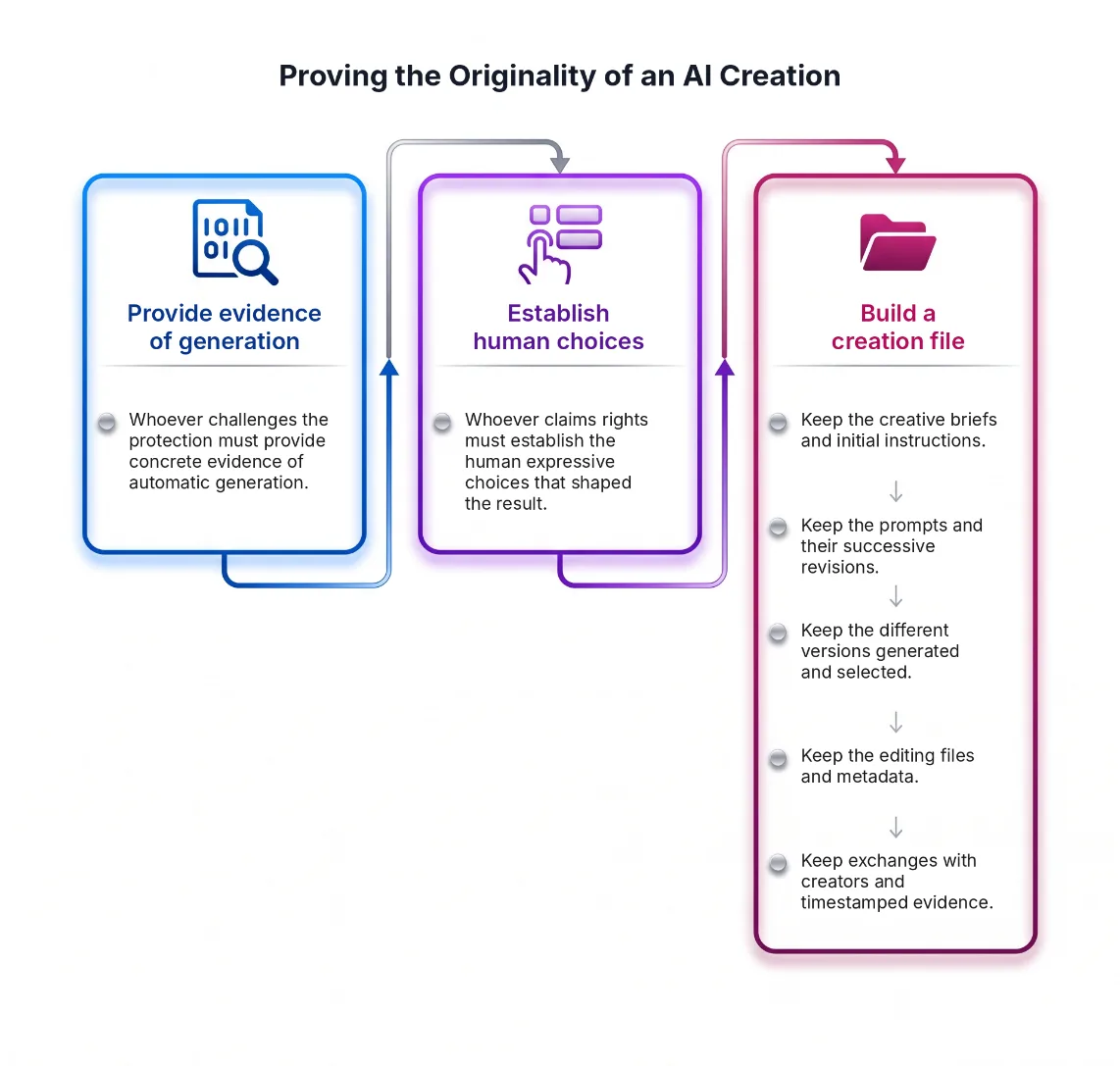
The CSPLA proposes a two-step approach to evidence: the party challenging protection should first provide concrete indications of automatic generation, and the party claiming rights should then establish the human expressive choices that shaped the result.
This proposal is an analytical method, not a new statutory rule of evidence.
To anticipate disputes, businesses should keep:
- creative briefs and initial instructions,
- prompts and their successive changes,
- the various versions generated and selected,
- editing files and metadata,
- exchanges with creators and time-stamped evidence.
The marking of AI-generated content, in particular under Article 50 of the EU Artificial Intelligence Act, is not in itself sufficient to conclude that there is no protection. It indicates the artificial origin of the content, without necessarily excluding a human creative contribution.
Building a creation file is therefore becoming an essential reflex for strategic assets.
Protecting synthetic productions through other rights
Where an output is entirely synthetic, the CSPLA rules out the creation of a special copyright or a sui generis right. It also recommends against artificially extending neighbouring rights to content without human creation. The idea of a paying public domain remains, for its part, forward-looking.
The absence of copyright does not, however, mean that a business has no means of protection.
A logo, mascot, jingle or interface generated by AI may, depending on its characteristics, benefit from other mechanisms:
- trademark law, in particular for figurative, sound or motion signs, provided they are distinctive,
- designs, where the conditions of novelty and individual character are met,
- trade secrets, for confidential information meeting the legal requirements,
- contracts, to govern uses and partners’ obligations.
These mechanisms do not create copyright in the synthetic output. They nevertheless make it possible to protect certain economic interests linked to its exploitation.
An audit of AI-generated assets thus helps identify the additional filings required.
How can AI-generated imitations be tackled?
The report also examines the reverse situation: where an AI reproduces the creative universe of a business or an artist.
Infringement may be established where the generated content recognisably reproduces original expressive elements of a pre-existing work, provided actual derivation is shown.
The difficulty concerns in particular content produced “in the style of” certain brands or creators.
The CSPLA distinguishes styles corresponding to a technique or an artistic movement, which remain free, from the “signature style”, characterised by identifiable expressive elements. The latter notion may cover, in particular, a recognisable character or creative universe.
A mere resemblance to an aesthetic atmosphere is therefore not necessarily enough to establish infringement.
Where the conditions for copyright are not met, an action for parasitism (free-riding), a form of unfair competition under Article 1240 of the French Civil Code, may be considered. It requires in particular showing an individualised economic value and a third party’s intention to ride on its coattails in order to take undue advantage of it, even in the absence of direct competition. The report notably cites the example of a voice imitated by a deepfake for commercial purposes.
For trademark owners, the strategy consists in identifying the genuinely protectable elements of their visual identity, monitoring imitations and selecting the appropriate legal basis.
Securing business contracts and practices
The CSPLA method encourages businesses to review their relationships with communication agencies, freelancers and AI tool providers.
Contracts should in particular specify the identity of the creators, the conditions for using AI, documentation obligations, warranties relating to third-party rights and the terms for assigning the rights that actually exist.
An assignment clause cannot, however, create copyright in an output that is not protectable.
It is also advisable to train teams to keep records of the creative steps and to set up an internal validation procedure for strategic content.
Conclusion
The CSPLA report does not create new rights over artificial intelligence outputs. It provides a method for determining whether a creation made with AI may be protected by copyright.
For businesses, three reflexes are becoming essential: identifying human creative choices, keeping the evidence needed to demonstrate them and seeking complementary protection where copyright does not apply.
Dreyfus Law Firm assists its clients in managing complex intellectual property matters, offering personalised advice and comprehensive operational support for the full protection of intellectual property.
Nathalie Dreyfus, with the support of the entire Dreyfus team.
Q&A
Does a company automatically own the rights in creations made with AI by its employees?
No. Under French law, an employment contract does not in itself transfer copyright to the employer, except in specific cases such as software or collective works. Where an employee produces a protectable hybrid creation, a written and sufficiently precise assignment is therefore still required for the company to exploit it securely.
Do the AI tool’s terms of use affect the rights?
Yes. AI providers’ terms and conditions may allocate rights in generated content, restrict certain commercial uses or allow the provider to reuse the data entered. They do not create copyright where none exists, but they should be checked before any strategic use of content.
Can protected works be used to train an AI system?
Directive (EU) 2019/790 allows text and data mining of lawfully accessible works, unless rights holders have expressly reserved their rights in an appropriate manner. The EU Artificial Intelligence Act also requires providers of general-purpose AI models to respect these reservations and to publish a summary of the content used for training.
Is an AI-generated creation protected in the same way abroad?
No, approaches vary. In the United States, the Copyright Office and the courts require human authorship for protection. The United Kingdom has historically provided a specific regime for computer-generated works, whose removal is under consideration. An international strategy must therefore take into account the law of each country of exploitation.
Does the use of AI have to be declared when filing a trademark or a design?
At present, intellectual property offices do not require applicants to declare the use of AI when filing a trademark or a design. The sign or appearance filed must, however, meet the usual conditions for protection, in particular distinctiveness for a trademark, and novelty and individual character for a design.
This publication is intended for general public guidance and to highlight issues. It is not intended to apply to specific circumstances or to constitute legal advice.