News

How does the French Digital Republic Act regulate the operation of online platforms?

Introduction

The French Digital Republic Act of October 7, 2016 laid the foundation for a structured regulatory framework governing online platforms in France. It introduced transparency, fairness and accountability obligations designed to rebalance the relationship between platforms, professionals and users.

In an ecosystem now largely shaped by the GDPR and the Digital Services Act (DSA), these obligations must be reassessed and updated. In this article, we offer a comprehensive analysis of the actual scope of the statutory provisions: first, what the law truly provides for, and then how those provisions fit into a legal landscape that has been profoundly reshaped since 2016.

Core obligations imposed on online platforms

Legal definition of online platforms

The Digital Republic Act introduced a precise definition of online platforms, formerly codified in the old Article L.111-7 I of the French Consumer Code. Services were considered platforms when they professionally offered, whether for remuneration or not, an online communication service to the public based on:

  • The ranking or referencing of content, goods or services;
  • The facilitation of interactions between several parties for the purpose of a transaction.

This definition covered a broad range of services: comparison tools, marketplaces, directories, search engines, social networks and intermediation services.

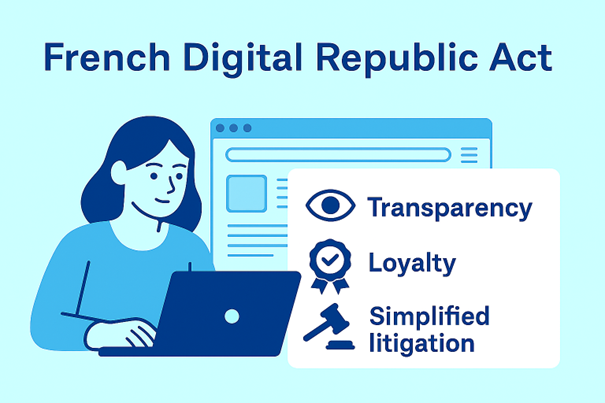
Its purpose was clear: to acknowledge the significant influence of these operators and to establish a protective framework built on three core principles, transparency, fairness and responsibility.

Article L.111-7 I of the Consumer Code was revoked in 2022. The applicable definition is now the one set out in the Digital Services Act, which qualifies an online platform as any intermediary service that stores and makes information accessible to the public at the request of users.

Differentiation between operators

The law distinguishes between:

  • Online platform operators, subject to general transparency rules;
  • Influencer platforms or hyperscale operators, now primarily regulated at the EU level by the DSA.

This structure enables obligations to be calibrated according to the platform’s economic influence.

Strengthened transparency and fairness requirements

Enhanced information obligations

Article L.111-7 of the French Consumer Code requires platforms to inform users of the criteria determining the ranking of content or offers. This information must be clear, intelligible and easily accessible.

This obligation, innovative in 2016, anticipated today’s concerns regarding algorithmic manipulation and the transparency of recommendation systems.

Disclosure of contractual relationships

Platforms must also indicate whether the advertiser or seller is acting as a professional, a consumer, or an uncertified reseller.

This enables users to determine whether consumer protection provided by law applies.

Identification of sponsored content

The law requires clearly identifiable disclosures when content has been paid for or promoted.
These provisions foreshadowed today’s standards set by:

  • The ARPP (French Autorité de régulation professionnelle de la publicité) for influencers,
  • The DSA for digital services,
  • Established case law on hidden advertising.

Increased accountability of digital actors

Reporting mechanisms

Platforms must provide a user-friendly mechanism enabling individuals to report illegal content, including: counterfeiting, hate speech, privacy violations, fraud, and other unlawful activities.

This obligation strengthens the notice-and-takedown regime established by the French Law on confidence in the digital economy (LCEN) of June 21, 2004 by requiring faster action.

Communication of pre-contractual information

When a platform connects professionals, sellers or service providers with consumers, it must provide a space enabling them to communicate the pre-contractual information required under Articles L.221-5 and L.221-6 of the French Consumer Code.

Fair information on online reviews

Since the French Decree of September 29, 2017, adopted to clarify the Digital Republic Act, platforms displaying reviews must disclose:

  • Their moderation methods,
  • Any financial consideration,
  • Their verification methodology.

These obligations aim to reduce fake reviews, a major concern for both the DGCCRF and French courts.

Interactions with European regulations

Compatibility with the GDPR

The Digital Republic Act paved the way for enhanced personal data protection, now fully governed by the GDPR.

Platforms must ensure:

The Act has been largely absorbed by this EU framework while retaining its additional economic transparency requirements.

Complementarity with the Digital Services Act

The DSA, applicable since 2024, has established a comprehensive EU-wide regime for platforms. The DSA notably imposes increased responsibility on platforms regarding the moderation of illegal or harmful content. They must implement mechanisms to detect and remove such content, failing which they may face sanctions.

French Digital Republic Act remains relevant, particularly for:

  • Economic fairness obligations,
  • Online review regulation,
  • Consumer information duties.

Oversight and sanctions

The competent authorities include: the DGCCRF, CNIL, Arcom, and civil and criminal courts.
Sanctions can include fines, corrective measures, and even temporary bans on operations.

Practical considerations for professionals

Businesses operating a platform must now navigate several layers of regulation: the Digital Republic Act, LCEN, GDPR, DSA and the French Consumer Code.
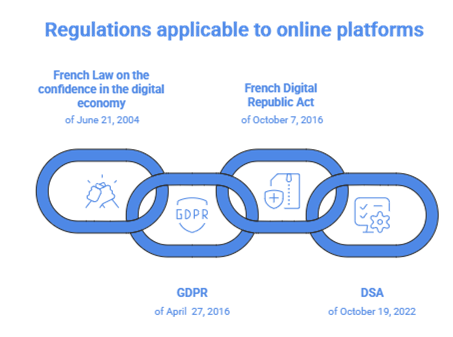
regulation plateform

To ensure robust compliance, platforms must:

  • Map national and EU obligations,
  • Document ranking criteria,
  • Enhance algorithmic transparency,
  • Structure moderation procedures,
  • Anticipate regulatory requests,
  • Update their terms of use, privacy policies and notices.

Conclusion

The Digital Republic Act remains a fundamental component of the French regulatory framework for online platforms. It establishes an environment based on transparency, responsibility and user protection, now reinforced by the GDPR and the Digital Services Act. Businesses must adopt an integrated approach combining legal compliance, algorithmic governance and consumer protection to secure their digital operations.

Dreyfus & Associés assists its clients in managing complex intellectual property cases, offering personalized advice and comprehensive operational support for the complete protection of intellectual property.

Dreyfus & Associés works in partnership with a global network of attorneys specializing in Intellectual Property.

Nathalie Dreyfus with the support of the entire Dreyfus team

FAQ

1.Can a platform be held liable for content posted by a user?
Yes. A platform becomes liable if it fails to remove manifestly illegal content promptly after being informed of it.

2.Can a user challenge a platform’s decision to remove content?
Yes. Platforms must provide an internal complaint mechanism allowing users to contest removal or delisting decisions. Under the DSA, this mechanism must be accessible and include human review.

3.Can French law require a platform to disclose the identity of a user who posted illegal content?
Yes, but only under strict conditions. Disclosure can only be ordered by a judicial authority when there is evidence of illegal activity.

4.Must a platform located outside the EU comply with French law when targeting French users?
Yes. If it targets the French or EU market, it remains subject to local legislation.

5. What best practices should online platform operators adopt?
Platform operators should implement a comprehensive compliance strategy that integrates both national and European legal requirements. This includes documenting ranking criteria, strengthening transparency in commercial practices, structuring content moderation procedures, ensuring the reliability of online reviews, and regularly updating terms of use, privacy policies and mandatory disclosures.

This publication is intended to provide general guidance to the public and highlight certain issues. It is not intended to apply to specific situations or constitute legal advice.


Read More

UDRP/URS: Guide to the 10 Best Practices for a Successful Proceeding

Introduction

The UDRP (Uniform Domain Name Dispute Resolution Policy) and the URS (Uniform Rapid Suspension System) are two essential extrajudicial mechanisms for effectively combating cybersquatting and abusive domain name registrations. Administered under the auspices of ICANN, these procedures provide trademark owners with a fast and targeted means of enforcing their rights globally, without resorting to lengthy and costly court actions.

However, the success of any action largely depends on the strategic choice of the arbitration and mediation center. Each institution has its own specific features in terms of procedural rules, timelines, costs, and the quality of its decisions. Given this diversity, it is essential to adopt a methodical approach, based on objective criteria and a careful analysis of your needs.

In this article, we share 10 key tips to help you make this crucial decision and optimise the protection of your digital assets.

Legal framework of UDRP and URS proceedings

Tip 1 : Determine whether your dispute requires a UDRP or a URS

Before initiating any action, it is essential to assess the nature of the infringement. UDRP is appropriate where the objective is the transfer or permanent deletion of the domain name, for instance, in cases of clear cybersquatting. URS, which is faster and less expensive, is limited to temporary suspension and applies only to new gTLDs. A strategic review of the facts, the commercial risk, and long-term objectives will ensure that you choose the most appropriate procedure and avoid wasting time on an unsuitable path.

Tip 2 : Review the Supplemental Rules of the selected center

Each accredited center applies the baseline rules defined by ICANN but adds “Supplemental Rules” that can influence the process. These set deadlines for filing, evidence formats, accepted languages, and proof requirements. A thorough review before filing allows you to anticipate constraints and prepare a compliant case file, reducing the risk of dismissal for procedural defects.

Choosing based on the disputed domain name

Tip 3 : Check the policy applicable to the domain extension

Not all extensions fall under UDRP or URS. Certain ccTLDs voluntarily adopt UDRP (e.g., .tv, .me), while URS applies only to new gTLDs such as .shop, .app, or .paris. Before starting a procedure, confirm the applicability of the rules with the registry of the extension. This is critical to avoid initiating an inapplicable action, which could waste costs and delay enforcement.

Tip 4 : Select a center adapted to the language and time zone

The language of the proceedings directly impacts speed and cost. Choosing a center that operates in your language, or in the registration agreement’s language, avoids high translation costs and reduces the risk of errors. Time zone alignment is also important, as it facilitates communication with panelists and administrative staff particularly for urgent exchanges or submission of additional evidence under tight deadlines.

Assessing costs, timelines, and procedural rules

Tip 5 : Balance budget, urgency, and expected outcome

Costs and timelines vary significantly. URS generally costs between USD 300 and 500 and can conclude in under 20 days, but only provides suspension. UDRP, which is more expensive (often several thousand euros), takes an average of 60–75 days and results in a transfer or permanent deletion. Your choice should be guided by whether you prioritise speed or the permanence of the remedy.

Tip 6 : Anticipate technical and administrative constraints

Some centers require specific electronic formats, online filing tools, or strict file size and format rules. Others still require physical submission of signed documents. Failing to anticipate these requirements can lead to delays or even dismissal of the complaint. Preparing for these in advance ensures smooth procedural progress.

Service quality and legal expertise

Tip 7 : Choose a center with a rich and consistent body of case law

Centers such as WIPO have extensive decision databases and research tools that consolidate international case law. This consistency is invaluable for predicting the likely outcome of a case and crafting a strong argument. A center with few precedents offers less predictability in decision-making trends.

Tip 8 : Opt for a center offering flexibility and adaptability

Some disputes require procedural flexibility, such as extensions of deadlines, acceptance of late-filed evidence, or hearings in an additional language. A center capable of tailoring its process to the complexity of your case can greatly improve your chances of success, especially in multi-respondent or cross-border matters.

Other decisive factors

Tip 9 : Consider the reputation and experience of the center

A center’s reputation is often tied to the quality of its panelists and the consistency of its rulings. An experienced center inspires trust among the parties and can also facilitate enforcement of decisions by registrars and registries. This institutional credibility is a key factor in legal security.

Tip 10 : Assess additional services and avenues for appeal

Some centers provide added value through technical assistance, practical guides, or an appeal mechanism in case of an adverse decision. Such features can be decisive, particularly under URS where an appeal process exists. Evaluating these advantages ensures you select a center offering more than just case management.

Conclusion

Selecting the right arbitration and mediation center for UDRP/URS proceedings is a strategic decision that must account for the nature of the dispute, the domain extension, timelines, costs, language, and the institution’s experience and reputation. Applying these ten tips will maximise your chances of success and secure the protection of your digital assets.

chose udrp procedure

Dreyfus & associés assists clients at every stage of these proceedings, backed by its recognised expertise in Internet and domain name litigation.

Nathalie Dreyfus with the support of the entire Dreyfus team.


FAQ


What is the difference between UDRP and URS ?

UDRP allows transfer or permanent deletion; URS provides only temporary suspension.

How do I know if my domain name is eligible for URS ?

URS applies only to new gTLDs approved by ICANN.

Which center should I choose to maximise my chances of success ?

Select a center with a rich case law history and recognised decision consistency, such as WIPO.

Do costs vary from one center to another ?

Yes, each center sets its own fees and terms.

Can an URS decision be appealed ?

Yes, some centers provide an internal appeal mechanism.

Read More

Can a semi-figurative trademark used without its logo constitute genuine use? Key lessons from the “Fuette / Fusette” case law

Introduction: a landmark dispute

In its decision of February 16, 2016, delivered by the Commercial Chamber of the Cour de cassation, the dispute opposed Le Fournil, the owner of the French semi-figurative trademarkla fuettela fuette nb” designating bread and bakery services and used as a trade name and shop sign, to the company Coup de Pâtes, which marketed a pre-baked bread product called “Fusette.” Claiming that this designation infringed its trademark rights, Le Fournil brought an action for trademark infringement.. In response, Coup de Pâtes sought the revocation of the trademark for lack of genuine use.

The Paris Tribunal de grande instance, upheld by the Paris Court of Appeal declared the revocation of the “La Fuette” trademark. However, the Cour de cassation overturned that decision, providing important clarifications regarding the requirement of genuine use of a trademark. The following article examines this ruling and outlines the practical lessons to be drawn for managing and protecting a trademark.

The legal framework: Article L. 714-5 of the French Intellectual Property Code and the notion of genuine use

Article L. 714-5 of the French Intellectual Property Code provides that the owner of a trademark may be subject to revocation if the trademark has not been put to genuine use for an uninterrupted period of five years, unless there are proper reasons.

Genuine use implies that the use is real, public, and in line with the essential function of the trademark: to guarantee the commercial origin of the goods or services. Evidence may be submitted by any means, provided that it reflects authentic and sufficiently significant commercial exploitation, rather than merely token use.

pillars genuine use

The system also includes a specific rule: use resumed within the three months preceding the filing of a revocation action can only be taken into account if it occurred before the owner became aware of the action or its imminence. This often-overlooked rule plays a decisive role in assessing whether genuine use has been proven.

All these elements show that the assessment of genuine use is highly contextual, depending both on the nature of the goods or services and on the concrete conditions under which the trademark is exploited. These are precisely the aspects on which the decision analysed here offers valuable guidance.

Detailed analysis of the February 16, 2016 ruling of the Cour de cassation

In its judgment of October 11, 2012, the Paris Tribunal de grande instance, followed by the Paris Court of Appeal in its decision of January 17, 2014,revoked the “La Fuette” trademark on the grounds that its use was not genuine: the trademark was neither affixed to the bread nor used with its figurative logo, and the evidence provided (receipts, bags, display panels) merely reflected the bakery’s activity rather than genuine trademark use.

The courts also held that using the verbal element alone altered the distinctiveness of the registered sign. Lastly, certain evidence of use was disregarded because they were dated after the three-month period prior to the revocation action, without verifying whether the trademark holder was aware of that action.

In its judgment of February 16, 2016 (No. 14-15.144), the Commercial Chamber of the Cour de cassation overturned and cancelled the decision of the Paris Court of Appeal.

The need for a complete and coherent body of evidence

The Cour de cassation criticised the lower courts for adopting an excessively restrictive approach to evidence of use.

Since the trademark could not physically be affixed to bread produced in a bakery, it was incumbent upon the Court of Appeal to take into account all relevant supports on which the trademark could also be used: bread bags, labels, advertising materials, the store sign, and invoices linked to the products sold, rather than relying solely on the absence of affixing on the product itself.

The Court reaffirmed that genuine use must be assessed globally, on the basis of a set of converging indicators, rather than a single isolated element.

Use of the verbal element alone: an acceptable modified form of use

Another key aspect of the ruling concerns the use of the term “La Fuette” without its figurative component “ la fuette.”

The Cour de cassation held that Court of Appeal should have determined whether the verbal element constituted the dominant and distinctive component of the semi-figurative trademark. If so, the use of the verbal element alone could be sufficient to demonstrate genuine use, provided that such use does not alter the distinctive character of the registered trademark.

This reasoning is consistent with established European case law, including the landmark Sabel judgment of 11 November 1997 (ECJ, C-251/95), which holds that a “global assessment must be based on the overall impression conveyed by the trademarks, taking into account their distinctive and dominant elements. The perception of the average consumer plays a decisive role, and the consumer normally perceives a trademark as a whole rather than analysing its individual details.”

Considering evidence within the critical three-month period

The ruling also recalls that resumed use within the three months prior to the revocation action can preserve the trademark, but only if the proprietor had not yet become aware of the impending action.

The Court of Appeal had rejected some evidence simply because it was dated after this period. The Cour de cassation held that this was legally incorrect: before excluding such evidence, the appellate judges should have verified whether Le Fournil was aware of the revocation action at the relevant time.

Practical implications for trademark owners

This decision highlights several essential points for effective portfolio management:

  • Semi-figurative trademarks must be used on all supports adapted to the nature of the product, even where the product itself cannot bear the trademark.
  • Evidence of use may consist of a wide variety of documents: receipts, display materials, commercial documentation, packaging, digital and traditional communications.
  • Using only the verbal element may be sufficient where it is the dominant component of the trademark.
  • Timing is critical: any threat of revocation must be anticipated so that a documented and timely resumption of use can be secured.

For more detailed guidance on assessing the genuine use of a trademark, please refer to our previously published article on the subject.

Strategic recommendations

In light of this case law, trademark owners should adopt a rigorous and proactive approach to documenting use. Systematic and dated retention of all materials demonstrating commercial exploitation (packaging, display items, advertising, digital content, invoices) remains essential.

From the moment the trademark is filed, identifying its dominant distinctive element helps guide how the trademark should be used and ensures consistency between the registered sign and its actual use.

If commercial exploitation becomes limited, a documented and timely resumption of use should be organised to avoid revocation. Evidence should always rely on a consistent and converging set of documents rather than a single isolated document.

Finally, when actual use differs from the registered sign, filing complementary variants may be an effective way to secure long-term protection.

Conclusion

The decision of February 16, 2016 adopts a pragmatic approach: genuine use must be assessed in light of commercial reality and the constraints inherent to the product. It also confirms that using only the verbal element of a semi-figurative trademark can amount to genuine use when that verbal element is the dominant component of the sign.

This decision is therefore a key reference for owners of semi-figurative trademarks, particularly where the nature of the product does not allow the sign to be affixed directly. It encourages trademark owners to document use rigorously, make systematic use of all available supports, and develop a proactive and structured evidentiary strategy.


Q&A

1. What is genuine use of a trademark?

It is the real and effective use of the trademark in the course of trade, enabling it to fulfil its essential function of identifying the commercial origin of goods or services.

2. Can a trademark be preserved if the owner proves that the lack of use is due to “proper reasons” under Article L. 714-5?

Yes. Article L. 714-5 explicitly provides that revocation cannot be ordered if non-use is justified by proper reasons. Case law interprets this narrowly: the obstacles must be beyond the owner’s control, directly linked to the trademark, and must objectively prevent its exploitation. Force majeure, administrative bans, pending litigation, or insurmountable regulatory barriers may be accepted; economic or strategic choices are not.

3. How can evidence of use be effectively secured?

The owner should systematically retain dated materials showing commercial use, regularly document actual exploitation, analyse the trademark’s structure to identify its dominant element, and, where necessary, file variants corresponding to the forms actually used.

4. Is use of a modernised version of a trademark (new design, updated typography) considered genuine use?

Yes, provided that the modernisation does not alter the distinctive character of the registered sign. Updated versions, such as changes in typography, simplified graphics, refined styling, are generally acceptable as long as the dominant element remains recognisable. A thorough redesign may, however, break the continuity of use.

5. Can digital use (website, social media) constitute evidence of use?

Yes. Digital materials showing visible and commercially meaningful use of the trademark can be accepted as part of a broader body of evidence demonstrating genuine use

Read More

France: Jane Birkin defends her trademark against Hermès

Recently alerted by the cruel practices endured by crocodiles during their slaughter for the production of the famous Birkin bags from the Hermès fashion house, the singer Jane Birkin informed Hermès about her intention to rename the crocodile-skin handbag bearing her name. The singer no longer wishes her name to be associated with such practices.

The Birkin bag, created in the early 1980s following a meeting between the singer and Jean-Louis Dumas, the chief executive of Hermès at that time is, however, one of the leading bags from the Hermès fashion house since its inception date.

Alongside arousing the curiosity of fans of the luxury brand Hermès, this news has also piqued the interest of lawyers. Indeed, in the face of such news, the question that arises is whether Jane Birkin can legally rename the crocodile-skin bag.

The fact of renaming a designer bag bearing the name of a star is not an isolated practice since there is a myriad of bags bearing the name of their muse. To cite only the most famous, it is noteworthy to mention the following designer handbags namely: So Kelly from Hermès as a tribute to Grace Kelly, Jackie from Gucci, Lady Dior, or B. Bardot from Lancel.

Since these names are associated with handbags, i.e. with goods, they were obviously registered as trademarks. This is the case, for example, for the name Birkin, filed and registered both as a French and international trademark by HERMES INTERNATIONAL since 1997 and the “So Kelly”, filed in 2009. The same holds true for the “Jackie” handbag, which refers to Jackie Kennedy and was filed by the Italian company GUCCIO GUCCI in 2008.

The practice of registering a surname as a trademark has been upheld by legislation and the French courts for a long time.

The surname is a personality right which is inalienable and indefeasible. Yet Article L.711-1, paragraph 2 a) of the French Intellectual Property Code provides that surnames can be registered as a trademark. Moreover, since the 1985 case of Bordas (Cass. Com. March 12, 1985, No. 84-17163), it is settled law that there can be an agreement to the effect of the commercial use of a surname.

Subsequently, the cour de cassation specified the conditions under which a surname could be registered as a trademark. In a judgment datedMay 6, 2003 (Cass. Com. No. 00-18192) the cour de cassation held that a founding partner who has agreed to the inclusion of his name in the company name must also expressly waive his ownership rights and allow the company to register the said surname as a trademark. In other words, the use of the surname of a third party is limited to what has been expressly authorized by the name holder.

Thereafter, the cour de cassation intervened in the Inès de la Fressange case regarding the use of her surname as a trademark by the fashion company bearing her name. After being dismissed from the company, the fashion designer had sought to recover the rights affiliated with her name by invoking the potentially misleading nature of the trademark on the basis of Article L. 714-6 b) of the Intellectual Property Code. She claimed that consumers would be misled into believing that they were buying clothes designed by her. But this was not the stance taken by the cour de cassation which, on the basis of Article 1628 of the Civil Code and the implied warranty against eviction principle, dismissed the designer’s claim (Cass. Com. January 31, 2006, N ° 05-10116).

A few months later, the Court of Justice of the European Union also faced a similar question in the Elizabeth Emanuel case (ECJ March 30, 2006. Aff . C-259 /04. Elizabeth Florence Emanuel v Continental Shelf). The issue in that case concerned the sale by the designer Elizabeth Emanuelof her fashion company bearing her name and the assets attached thereto, including the ELIZABETH EMANUEL trademark. However, following the sale, the fashion designer filed a claim for the revocation of rights against the trademark which was transferred accordingly, deeming that, just as was the case with Madame de la Fressange, the public was confused since she was no longer the designer of the clothes marketed under the trademark.

The Court held that the ELIZABETH EMANUEL trademark was not, in itself, likely to mislead the public as to the origin of the clothes. But the Court opined that it is for the national court to verify whether there is, on behalf of the company holding the trademark, an intention to make the consumer believe that the designer is still involved in the design of clothes. This would thus be tantamount to fraudulent tactics likely to make the company liable.

In the present case, since Jane Birkin is not associated with the design of the handbag, she cannot rely on this approach for the crocodile-skin handbag to be renamed.

It therefore remains to be seen whether the intention to rename the Birkin crocodile-skin handbag can materialize to the extent that the surname of the singer, registered as a trademark, could be considered as part of the assets of the Hermès company. The outcome of this case shall enlighten us.

Furthermore, on 11 September last, the saddler welcomed in a press release that Jane Birkin seemed to be satisfied by the measures adopted by the Hermès house following the controversy appeared this summer.

Can Jane Birkin legally prohibit Hermès from using her name?

Yes. Jane Birkin can oppose the use of her name if it harms her image or was used without her express consent. Under French law, a family name is protected by privacy rights and potentially by trademark law, if registered.

What are the criteria to protect your name as a trademark?

To defend your name, you must demonstrate its notoriety, commercial use, and the risk of confusion or harm to your reputation. This is especially relevant for public figures and celebrities.

Does Hermès have to rename the Birkin bag?

Not necessarily. If Hermès originally obtained consent or the name has become a standalone brand, the use may be legally justified. However, legal opposition from Jane Birkin could force the company to reconsider its use.

Read More

Can retail services be protected as trademarks in Class 35?

Introduction

The Court of Justice of the European Union (CJEU) has provided an essential clarification: retail services, when properly defined, can be protected as services falling under Class 35 of the Nice Classification. This recognition applies not only to the sale of goods but also to the sale of services, thereby expanding the scope of trademark protection for businesses operating in hybrid commercial environments. Understanding the legal framework, the conditions of admissibility, and the practical implications is crucial for any company wishing to secure its brand.

The legal framework of retail services in Class 35

Trademark law in the European Union was harmonised by Directive 2008/95/EC, later replaced by Directive (EU) 2015/2436. Class 35 of the Nice Classification covers services such as advertising, business management, and retail trade.

The long-debated question was whether the act of commercialising goods or services constituted an autonomous service eligible for trademark protection. The CJEU answered positively, provided that applications respect the requirement of clarity and precision set out in EU law.

The conditions of admissibility for retail services

To be accepted in Class 35, retail services must:

  • Specify the types of goods or services concerned (cosmetics, clothing, financial services, etc.);
  • Be presented as an activity distinct from the goods themselves;
  • Be drafted so that authorities and competitors can clearly understand the scope of protection claimed.

protection trademark 35

This requirement stems directly from the IP Translator judgment (CJEU, C-307/10), which imposes a precise and unequivocal wording of trademark specifications.

The Netto Marken-Discount ruling: scope and practical implications

In this case (10 july 2014 C-420/13), the CJEU confirmed that retail services cover both goods and services. These activities therefore fall within Class 35, as long as their wording is sufficiently precise.

Practical implication: a trademark registration can now protect both the physical sale of goods (e.g., supermarkets, fashion stores) and the sale of intangible services (e.g., online travel agencies, financial service platforms).

This reinforces the ability of brand owners to act against third parties seeking to exploit a trademark in a distribution context.

The boundary between goods and services in retail

The ruling clarifies a previously delicate distinction. Traditionally, goods fell within Classes 1 to 34, while services belonged to Classes 35 to 45. By recognising the retail of services, the CJEU acknowledges the evolution of commerce, where companies often act as both producers and service providers.

Example: a telecom operator markets mobile phones (goods) but also mobile subscription plans (services). Trademark protection must reflect this dual reality.

Jurisprudential developments in 2025

Since the 2014 ruling, EUIPO practice has evolved. In 2025, case law confirms that:

  • Specifications such as “retail services for pharmaceutical preparations” are admissible;
  • Overly broad wording such as “all retail services” is refused;
  • Courts require that evidence of use specifically relates to retail services, pursuant to Article 18 EUTMR.

The General Court has recently emphasised that these services must demonstrate a separate economic value to justify protection.

Practical guidance for trademark applicants

To optimise protection, businesses should:

  • Seek advice from industrial property specialists;
  • Draft specific descriptions of retail services;
  • Prepare evidence of use in advance;
  • Anticipate international divergences, as some jurisdictions (United States, China) do not recognise retail services in the same way.

An integrated strategy is therefore essential to avoid gaps in brand protection.

Conclusion

The recognition of retail services in Class 35 represents a significant step forward for trademark protection. The CJEU’s approach reflects commercial developments and provides businesses with an effective tool to secure their activities, both for goods and for services.

Dreyfus Law firm assists its clients in managing complex intellectual property cases, offering personalized advice and comprehensive operational support for the complete protection of intellectual property.

Dreyfus Law firm is partnered with a global network of lawyers specializing in intellectual property.

Nathalie Dreyfus with the assistance of the entire Dreyfus team.


FAQ

1. Does the CJEU recognise retail services as protectable in Class 35?
Yes, provided they are defined with clarity and precision.

2. Does this protection cover only goods?
No, it also extends to intangible services.

3. What details must the application include?
It must specify the types of goods or services concerned.

4. What is the risk of overly broad or vague wording?
The application may be refused for lack of precision.

5. What is the practical importance of the Netto Marken-Discount ruling?
It broadens trademark protection to new forms of commerce.

Read More

Does the reputation of a trademark suffice to create a likelihood of confusion? The Ballon d’Or / Golden Balls case

Introduction

The dispute between Éditions P. Amaury, holders of the iconic “BALLON D’OR” trademark, and the British company Golden Balls Ltd, applicant for the “GOLDEN BALLS” trademark, sharply illustrates the complexity of assessing the likelihood of confusion within the European Union. By confronting two signs that differ linguistically yet are conceptually close, the various rulings highlight the limits of protection afforded to a well-known trademark when its intrinsic distinctiveness remains weak.

The origin of the dispute: confusion or linguistic coincidence?

The dispute began when Golden Balls Ltd sought to register the trademark “GOLDEN BALLS as an EU trademark for goods and services partially identical or similar to those covered by the earlier trademark “BALLON D’OR”.

Les Éditions P. Amaury opposed the registration on two main grounds:

The General Court’s 2013 rulings: dissimilarity prevails

In its initial judgments in 2013 (T-437/11 and T-448/11), ), the EU General Court ruled in favour of Golden Balls Ltd, an outcome that initially surprised many intellectual property specialists. The judges found that the signs were visually and phonetically dissimilar. The signs differed notably in their language. Even if a conceptual similarity could be identified, it was deemed insufficient to create a likelihood of confusion in the mind of the average EU consumer. Consequently, the application for “GOLDEN BALLS” was provisionally accepted.

The ECJ’s historic correction in 2014: fame must be assessed

The French publisher appealed. In 2014, the Court of Justice of the European Union (ECJ) handed down a landmark decision, overturning the 2013 judgments of the General Court. The ECJ held that the General Court had failed to adequately examine the ground based on damage to fame, thereby committing an error of law.

The ECJ further clarified that even a low degree of similarity between two signs may be sufficient to establish a link in the mind of the relevant public, provided that the earlier trademark enjoys a high degree of distinctiveness and fame.

Following this decision, the case underwent a long and complex procedural journey, marked by several intermediate decisions issued by the EUIPO Opposition Division and Boards of Appeal, including a   decision in 2016 (R 1962/2015‑1), before being referred back to the General Court.

In 2018, the General Court handed down its judgment in a confirming the fame of the “BALLON D’OR” trademark while adopting a nuanced stance on whether a sufficiently close link existed between the signs to justify a finding of unfair advantage.

Specifically, the Court clarified that Article 8(5) of Regulation (EU) 2017/1001 protects a well-known trademark only if the public establishes a link between the signs and if the use of the contested sign takes unfair advantage of or is detrimental to the fame of the earlier trademark. The “GOLDEN BALLS” trademark thus remained valid for classes of goods and services considered too far removed from the sporting field to give rise to unfair advantage.

The unexpected turning point: partial revocation of the “BALLON D’OR” trademark for lack of genuine use

A few years later, Golden Balls Ltd initiated revocation proceedings against the BALLON D’OR mark for non-use, under  Article 58(1)(a) EUTMR.

In its judgment of July 2022 ((T-478/21), the General Court issued a nuanced decision redefining the scope of protection of the “BALLON D’OR trademark.

While the Court accepted that the “organisation of sporting competitions and award ceremonies” constituted sufficient proof of use for the broader category of “entertainment services”, it upheld partial revocation for numerous other goods and services (such as printed matter, films, and telecommunications).

The evidence provided failed to demonstrate use of the trademark for each specific subcategory claimed during the preceding five-year period.

To learn more about assessing genuine use of a trademark for all classes of goods and services for which it is registered, please see our previously published article.

summary ballon dorProving genuine use of a trademark: evidence and best practices

To establish genuine use of a trademark, various forms of evidence may be submitted, such as:

  • Invoices, purchase orders, or delivery note;
  • Catalogues, brochures, and packaging displaying the trademark;
  • Print and digital advertisements;
  • Dated and archived website screenshots;
  • Market studies and opinion surveys demonstrating the fame
  • Contracts or licence agreements with third parties using the trademark.

Each item must be dated and correspond precisely to the goods and services covered by the registration. Use limited to only part of the designated goods or services may result in partial revocation.

Moreover, use must be uninterrupted or duly justified if interrupted. Sporadic or symbolic use is insufficient; the evidence must show an actual commercial presence, not merely internal use.

Conclusion

The Ballon d’Or vs Golden Ball dispute serves as a crucial reminder for trademark owners: fame is a powerful asset in trademark litigation, but it does not exempt the owner from the fundamental duty to prove genuine use for all registered goods and services.

A lack of proof, even for seemingly secondary classes, may result in partial revocation, thereby reducing the overall scope of trademark protection.

It is therefore recommended to engage an IP law firm or trademark attorney both upstream, to craft a precise and relevant specification of goods and services aligned with actual or intended use, and downstream, to evaluate risk, identify relevant evidence, and implement a robust use strategy that preserves the integrity of trademark rights.

Dreyfus & Associés assists its clients in managing complex intellectual property cases, offering personalized advice and comprehensive operational support for the complete protection of intellectual property.

Dreyfus & Associés works in partnership with a global network of attorneys specializing in Intellectual Property.

Nathalie Dreyfus with the support of the entire Dreyfus team

Q&A


1.What is revocation for non-use of a trademark?
Under Article 58(1)(a) EUTMR, a registered trademark may be revoked if its proprietor fails to prove genuine use of the trademark for the goods and services claimed during an uninterrupted period of five years. Revocation may be partial if use is shown only for certain goods or services.

2.What is the key takeaway from the Ballon d’Or / Golden Balls decision for owners of well-known trademarks?
The main lesson is to meticulously document genuine use for each product and service designated in the registration, particularly during the first five years following registration, to avoid subsequent revocation.

Can use in a single EU Member State preserve an EU trademark?
Ye, if that use produces commercial effects within the internal market, taking into account the economic context

4.What happens after revocation for non-use?
Once revoked, the trademark is deemed never to have produced effects from the date set by the decision. It retroactively loses protection for the relevant goods and services. The proprietor can no longer rely on exclusive rights, oppose similar trademarks, or prevent third-party use. The trademark may then be re-registered by another party, provided this does not create a likelihood of confusion with still-valid prior rights.

5.What practical steps help prevent revocation and preserve a trademark’s evidentiary strength?
It is essential to:

  • actively monitor the trademark’s use and archive evidence (invoices, ads, publications, screenshots, etc.);
  • periodically renew communication campaigns linked to the trademark;
  • audit the portfolio to detect inactive registrations;
  • restrict filings to goods and services genuinely used, thus avoiding vulnerabilities in non-use challenges.

This publication is intended to provide general guidance to the public and to highlight certain issues. It is not designed to apply to specific situations, nor does it constitute legal advice.

Read More

New Domain Name Extensions and the UDRP : an overview of the current landscape and strategies

Introduction

Since the launch of ICANN’s New gTLD Program in 2012, the domain name landscape has undergone a profound transformation. This initiative has enabled the introduction of hundreds of new thematic, geographic, and sector-specific extensions (.shop, .paris, .app, .law, etc.), offering businesses enhanced opportunities for online positioning. However, this diversification has also brought increased risks of cybersquatting and brand infringement, compelling rights holders to adapt their protection strategies.

The Uniform Domain-Name Dispute-Resolution Policy (UDRP) remains the central, globally recognised mechanism for resolving disputes over domain names registered in bad faith, whether they involve legacy extensions (.com, .net) or the new gTLDs. Today, the UDRP must address a rising volume of disputes and increasingly varied contexts, requiring more tailored approaches.

This article provides a comprehensive overview of developments since the landmark Canyon.bike case in 2014, examines recent trends in UDRP disputes involving new extensions, and outlines strategic recommendations for trademark owners in 2025.


Context and scope of the UDRP for new extensions

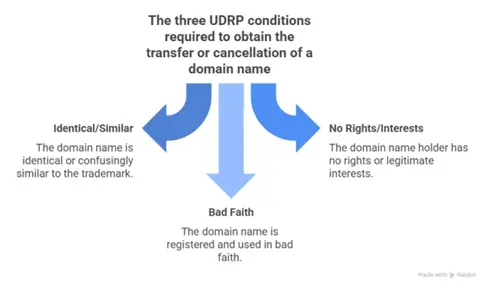
Adopted by ICANN in 1999, the UDRP applies to all generic top-level domains (gTLDs), whether they are legacy extensions or part of the New gTLD Program. It allows a trademark owner to obtain the transfer or cancellation of a domain name where three cumulative conditions are met:

  • The domain name is identical or confusingly similar to the trademark;
  • The domain name holder has no rights or legitimate interests in respect of the domain name;
  • The domain name has been registered and is being used in bad faith.

This framework applies to all new extensions, thereby ensuring legal consistency on a global scale.

three udrp conditions

Evolution of new extensions since 2014

Growth and diversification of gTLDs

Since 2014, the number of available extensions has increased dramatically, now exceeding 1,200 delegated gTLDs. These fall into several categories:

  • Thematic extensions (.shop, .tech, .app) targeting specific industries;
  • Geographic extensions (.paris, .london) highlighting local presence;
  • Community or specialised extensions (.law, .bank), often subject to strict eligibility requirements.

Trends and most-used extensions

Some new extensions have quickly gained prominence due to their universal appeal and marketing potential, such as .xyz, .online, and .shop. These have also become prime targets for cybersquatters, necessitating enhanced monitoring measures.


Case law and landmark decisions

The Canyon.bike case (2014)

This decision remains the first known UDRP case involving a new extension. It confirmed that the extension itself does not influence the assessment of similarity between the trademark and the domain name: the decisive element is the string to the left of the dot.

Recent jurisprudential developments

Since 2014, numerous cases have involved new extensions. UDRP panels apply the same criteria to recent gTLDs as to legacy ones, while considering the specific context of certain extensions, particularly when the extension reinforces the association with the trademark’s industry sector. Decisions also show heightened vigilance toward multiple registrations across different extensions targeting the same brand.


Issues and strategies for trademark owners

Monitoring and anticipation

The proliferation of extensions makes it essential to implement automated and targeted monitoring of trademark terms across all relevant extensions.

Selecting the appropriate procedures

Depending on the case, several options are available:

  • UDRP: to obtain permanent transfer or cancellation;
  • URS (Uniform Rapid Suspension): for clear-cut cases of cybersquatting, enabling swift suspension;
  • Local procedures: such as Syreli for .fr, when the domain name falls under a ccTLD.

Building strong cases

The success of a complaint hinges on demonstrating all three UDRP criteria with clear, tangible evidence of the trademark’s reputation and the respondent’s bad faith (e.g., multiple registrations, deceptive use, redirection to competitor websites).


Conclusion

New extensions offer businesses unprecedented opportunities for online visibility but also open new fronts for rights infringements. The UDRP remains as relevant and effective as ever, provided it is integrated into a comprehensive strategy combining monitoring, rapid action, and careful selection of dispute resolution procedures.


Dreyfus & Associés assists clients in protecting and defending their rights across all extensions, in partnership with a global network of intellectual property law specialists.


Nathalie Dreyfus, with the support of the entire Dreyfus team


FAQ

What is a new gTLD?

A generic top-level domain introduced after 2012, such as .shop, .paris, or .app, expanding the range of available domain name choices.

Does the UDRP apply to new extensions?

Yes. It covers all ICANN-approved gTLDs, whether legacy or new.

Should all extensions be monitored?

It is advisable to target the extensions most relevant to your sector and market to optimise monitoring costs and effectiveness.

Can multiple domain names be challenged in a single procedure?

Yes, if they are registered to the same holder and circumstances justify joint action.

How can a respondent’s bad faith be proven?

Through evidence such as the trademark’s reputation, redirection to a competitor’s site, or offering the domain for sale at an excessive price.

Read More

New gTLDs: the National Arbitration Forum (NAF), first arbitration center chosen for the administration of the Uniform Rapid Suspension (URS)

Introduction

The expansion of new generic top-level domains (gTLDs) has revolutionized how businesses and individuals create unique digital identities. As a result, intellectual property holders face significant challenges in protecting their trademarks from cybersquatting. To address these concerns, the Uniform Rapid Suspension (URS) system was introduced, offering a fast and cost-effective way to resolve domain name conflicts. The National Arbitration Forum (NAF) was chosen in 2013 as the primary center to administer this procedure, playing a critical role in protecting trademarks in the digital world. Today, the Asian Domain Name Dispute Resolution Center (ADNDRC) is also responsible for some URS procedures, but its use is more marginal.

What is the Uniform Rapid Suspension (URS)?

The URS is a domain name dispute resolution procedure, introduced by the ICANN, designed to offer a quick and cost-effective solution for trademark holders seeking to suspend domain names that infringe upon their rights and are identical or confusingly similar to their registered trademarks. Unlike other dispute resolution mechanisms like the Uniform Domain Name Dispute Resolution Policy (UDRP), which may lead to the transfer of the disputed domain name, the URS only provides for the suspension of the domain name in question. The suspended domain name remains registered in the name of the defendant but is deactivated, can no longer be used or transferred, and the suspension lasts until the domain name expires.

The role of the National Arbitration Forum (NAF)

Founded in 1986, the NAF is one of the world’s leading providers of alternative dispute resolution services. Chosen by ICANN (Internet Corporation for Assigned Names and Numbers) in 2013 to manage the URS procedure, it is responsible for handling disputes related to new gTLDs (namely .online, .site, etc.), complementing the UDRP, which remains applicable for traditional gTLDs (e.g., .com, .net, .org).

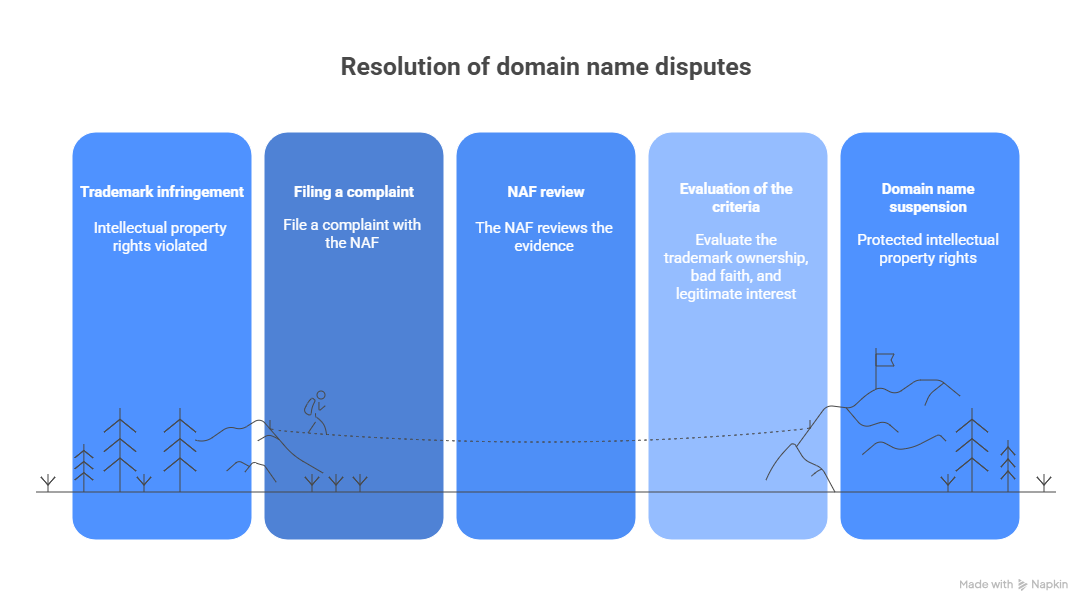
Trademark holders who believe their intellectual property rights are being violated can file a complaint with the NAF.

The NAF reviews the complaint and the evidence provided by both parties, considering, among other things:

  • Trademark ownership: The complainant holds a valid, registered trademark that is identical or similar to the disputed domain name.
  • Bad faith registration: The domain name was registered or is being used in bad faith, typically indicated by the intent to exploit the reputation of the trademark holder.
  • Lack of legitimate interest or right to the domain.

If these criteria are met, the NAF will suspend the domain name for the remaining term of its registration. Although temporary, the suspension may be extended for an additional year.

disputes resolution names

The benefits of the URS for trademark holders

The URS, administered by the NAF, offers several benefits to trademark holders seeking to quickly and efficiently resolve cybersquatting issues:

  • Speed and efficiency: The URS procedure is designed to be fast, with most cases resolved within 48 hours to 14 calendar days. This is particularly important when the infringement causes immediate harm (e.g., consumers are misled into thinking they are interacting with an official site or purchasing counterfeit products).
  • Cost-effectiveness: Legal procedures and the UDRP can be expensive and time-consuming, especially for companies with limited resources. The URS provides a solution with reduced fees and streamlined administrative management.
  • Temporary suspension: The URS allows for the temporary suspension of the disputed domain name, enabling the trademark holder to resolve the issue quickly and mitigate any reputational damage associated with the domain.

The NAF arbitration process

The NAF arbitrators are experts in domain name law and intellectual property. By offering a quick and affordable alternative to traditional litigation, the NAF ensures that trademark holders are not left without recourse in the face of cybersquatting and other malicious actors.

Conclusion

The URS, administered by the NAF, is a vital tool for trademark holders, allowing them to quickly and efficiently resolve domain name conflicts related to cybersquatting. The NAF is positioned as a key player in the protection of intellectual property rights online, and its role continues to grow, as new domain extensions are introduced. By providing trademark holders with an effective solution, the NAF ensures critical protection for online assets.

Dreyfus & Associés assists its clients in managing complex intellectual property cases, offering personalized advice and comprehensive operational support for the complete protection of intellectual property.

Dreyfus & Associés works in partnership with a global network of specialized intellectual property lawyers.

Nathalie Dreyfus with the support of the entire Dreyfus team.

FAQ

1. What types of cases can be handled by the URS?
The URS is designed to resolve conflicts where a domain name has been registered in bad faith, with the intent to exploit the reputation of an existing trademark. Typical cases include domain names that are identical or confusingly similar to registered trademarks.

2. Why procedure should be chosen between URS and UDRP ?
The URS and UDRP are both domain name dispute resolution mechanisms, but they differ in their goals and procedures. The URS only allows for the suspension of the domain name, while the UDRP may result in the transfer of the domain name to the trademark holder. The choice between the two depends on the trademark holder’s strategy. (For more information, refer to this article).

3. What evidence is required to initiate a URS procedure ?
To initiate a URS procedure, the complainant must prove that they own a valid, registered trademark, that the domain name is identical or similar to the trademark, and that the domain name was registered in bad faith. Evidence such as screenshots of the disputed domain’s website, copies of the trademark registration, or evidence of the intent to harm the trademark may be required.

4. What happens if a domain is suspended via the URS ?
If a domain is suspended through the URS, it will no longer be accessible to the public for the duration of its registration, but the domain holder does not necessarily lose ownership.

5. What remedies are available to a cybersquatter if its domain name is suspended under the URS?
If a cybersquatter believes the suspension of their domain is unjustified, they can challenge the decision through the appeal process provided by the URS. They will need to provide evidence demonstrating that they have a legitimate right to the domain, such as proof of commercial use of the domain or prior rights to the term.

This publication is intended for general public guidance and to highlight issues. It is not intended to apply to specific circumstances or to constitute legal advice. 
Read More

Singapore 2011 : Icann launches the new gTLDs

On 20 June 2011 at the Singapore conference, Icann’s Board of Directors voted at a large majority in favour of the launch of the new gTLDs. After heated exchanges between government representatives the day before, and in spite of persistent disagreements, the Board decided to move forward and approve the current Applicant Guidebook.  The Board nevertheless indicated that modifications would be made in the forthcoming weeks and months.

The principal stumbling blocks related to the protection of trade marks during the Sunrise periods and to concerns raised by the competition authorities in the EU and the US in relation to the separation of the duties of the Registry (organisation in charge of the management of the extensions) and of the Registrar (company in charge of selling the domain names). The measures contested are the following:

– Obligation to provide proof for marks to be protected during the Sunrise periods (TLD launch period)  and under the Uniform Rapid Suspension System (the URS), an expedited procedure for resolving disputes in clear-cut cases of cyber-squatting. It should be noted that all registered trade marks may be recorded in the Trademark Clearinghouse, without it being necessary to provide proof of use;

– End of vertical integation (separation of registry and registrar functions), whereby one company will be able to propose both services under certain conditions.

New gTLDs: the dates to be retained

12 January 2012: launch of the application submission period

12 April 2012: end of the application submission period

End of April 2012: publication of applications

November 2012: publication of the first results of the initial evaluations

What strategies should brand owners adopt?

The programme is now launched and it is necessary for trade mark owners to take a position quickly on the possibility of applying for an extension such as .brand or .company.

Indeed, the application submission period commences in less than 7 months and will only last 3 months.

The decision making processes and work involved in preparing the applications will necessarily take time.  It is therefore advisable for brand owners to start examining the opportunity of applying for such an extension straightaway.

What about the future?

Icann has specified that the next cycle of applications will only be launched once the majority of applications from the first cycle have been processed and the stability of the DNS has been verified to ensure that it is not compromised by the new extensions granted.  Depending on the number of applications submitted during the first cycle (expected to total between several hundreds to several thousands), it is probable that the next cycle will not be launched for several years.


Click here to download the pdf version of this document
Read More

The low down on .xxx domain names: what strategy should trade mark owners adopt?

On 31 March 2011, Icann and ICM Registry entered into a registry agreement in relation to the top level domain (TLD) .xxx, putting an end to a saga which has lasted several years. Initially accepted by Icann in 2004, at the same time as a number of other TLDs, Icann went back on its position further to pressure by the US government and rejected the application made by ICM Registry. After several years of negotiations and against the opinion of a number of countries, Icann finally accepted the creation of a domain for the adult entertainment industry.

What are the applicable rules? What public is the .xxx TLD intended for?

The .xxx TLD falls within the category of sponsored TLDs (sTLD), i.e. domain names intended for a specific community. The novelty of sTLDs is that the relevant registries verifies that prospective registrants belong to the given community. Such sTLDs also include .aero, .asia, .cat, .coop, .edu, .gov, .int, .jobs, .mil, .mobi, .museum, .tel, .travel.

As the sTLD .xxx is contested for moral reasons, a new form of organisation has been put in place to manage this TLD. ICM Registry has been designated as registry operator and its role is to ensure the proper technical management of the extension. Furthermore, the International Foundation for Online Responsibility (IFFOR), a non-profit making organisation, has been appointed with a specific mandate of ensuring, in particular, that the rules on the organisation of the Registry are complied with, including the registration rules. IFFOR is financed directly by a tax on registrations and renewals of.xxx domain names.

The rules governing the registration of .xxx TLDs are set out in the registry agreement entered into with Icann. These rules specify that the registration of domain names in a .xxx TLD is limited to members of the sponsored community, i.e. individuals or entities which provide online sexually orientated adult entertainment, their representatives, and providers of goods or services to entities or individuals in this industry. The definition of adult entertainment is rather vague, but the range of individuals and entities entitled to register a name as a .xxx TLD will be relatively broad. It should however be noted that individuals or companies not operating in, or related to, this sector of activity will not be authorised to register names as .xxx TLDs.

These rules can only be amended by renegotiating the Registry Agreement with Icann.

What are the rules for the registration of a .xxx extension?

The rules for the registration and use of .xxx domain names are subject to a strict framework. They include the following requirements:

– verification that the prospective registrant is eligible to register a. xxx domain name;

– the identity of all prospective registrants must be authenticated;

– all registrants must label their sites using an IFFOR approved label; and

– all registrants must consent to the monitoring of their sites.

The registrants of .xxx domains must undertake:

– not to publish any child pornography;

– not to infringe third party rights (including trade marks or first names and last names);

– not to engage in any malicious conduct; and

– to comply with IFFOR’s Best Practices Guidelines.

Although anonymous registrations will be authorised, this can only be done by pre-approved proxy service providers and once the identity of the registrant has been verified. If the whois data is incorrect this can lead to the cancellation of the domain name. In case of repeated violaions, the registrant can be disqualified from maintaining existing or registering future .xxx domain names.

Details on the sunrise period

The launch of the.xxx domain name will commence by a double sunrise period of 30 days. This sunrise period is intended to allow members of the adult entertainment industry, which have already registered domain names in other extensions (for example, .com, or .net) to secure their domain names in the .xxx TLD (sunrise A) and to allow intellectual property right owners which do not consider themselves to be part of the pornographic community to block the registration of their earlier rights as .xxx domain names (sunrise B). Registration will then be made available to other members of the adult entertainment industry.

Sunrise period A will allow domain name holders in the adult entertainment industry to register their domain names as .xxx TLDs. In case of dispute between several registrants for an identical name, the allocation of the name will be made on the basis of a closed auction between the registrants.

Sunrise period B is intended to allow right holders to declare their trade marks in order to block the registration of such trade marks as .xxx domain names. If a prospective registrant tries to register a domain name reproducing a trade mark recorded with ICM Registry, both the registrant and the right holder will receive a notification. The right holder will then been provided with the opportunity to file so-called STOP proceedings (Start Up Trademark Opposition Proceeding) before ICM Registry, allowing it to notify the registrant of its rights. The registrant will nevertheless be able to continue the registration procedure and will be allocated the domain name if it satisfies the conditions for the registration of a .xxx domain name.

These defensive registrations will be available to trade mark holders. In support of such applications, it will be necessary to provide copies of the registration certificates for the trade marks. ICM Registry may also request other documents as decided on a case by case basis upon examination of the applications.

Even prior to the sunrise period, trade mark owners, which are not members of the adult entertainment industry can already start preparing for the introduction of the .xxx extension by pre-blocking their trade marks with ICM Registry.

Such pre-blocking consists of submitting a term corresponding to a trade mark, a first name or surname or a domain name registered in another extension to ICM Registry to request the “pre-ordering” of this term. This pre-order can be made directly by the right holder or by its representative.

The blocking of domain names further to such “pre-orders” is not automatic. ICM Registry has a full discretion to accept or refuse such pre-orders. No fees are payable for pre-reservations.

If the pre-order is accepted by ICM Registry, this does not mean that the term has been blocked. However, if the pre-order is accepted, the right holder will receive prior notice from ICM Registry of all official deadlines and of the availability of the trade mark requested, in other words if other pre-orders for the registration of the trade mark in question as a .xxx extension have been received. The notification issued by the Registry should also include further information on the supporting documents to provided in order to secure the blocking of the trade mark during the sunrise B period.

What rules have been put into place for dispute resolution?

Three dispute resolution procedures have been put into place:

– the UDRP procedure will apply to active registrations made by right holders in the adult entertainment industry;

– a specific procedure, the CEDRP, will apply to blocking registration (which are by their very nature not used) for right holders which are not members of the adult entertainment industry. The implementing rules for this procedure have not yet been determined; and

– an expedited cancellation procedure (48 hours) for domain names which are obvious examples of cybersquatting (for example, registration of well-known trade marks as domain a domain name where it is quite clear that the registrant was not acting in good faith).

What policy should right holders adopt?

Extensive communication campaigns have been launched by several registrars aimed at inciting trade mark holders to register their rights during the sunrise B period. However, these campaigns which appear to verge on domain slamming should be taken with precaution and it is necessary for right holders to be aware of the limits of the measures made available to them in view of the forthcoming launch of the .xxx domain name:

– blocking registrations are not yet available, and only pre-reservations are currently possible;

– the registration of a trade mark will not enable the holder to block a disputed domain name, but will trigger a procedure pursuant to which the registrant is notified of this trade mark; and

– right holders in the adult entertainment industry will have priority over other right holders.

In these conditions, it is advisable for right holders to conduct a benefit-cost analysis of applying for a blocking registration during this sunrise B period. Indeed, this option would appear to be comparable to an improved watch services for trade marks among .xxx domain names. In this respect, the means of defence remain similar to those applicable to other extensions.

We would be delighted to assist you in putting in place a strategy for protecting your trade marks in anticipation of the launch of the .xxx extension. The watch services proposed by our firm will be extended to .xxx TLDs.

Click here to download the pdf version of this document
Read More