

Introduction
The “Made in France” label has become a major strategic lever for companies seeking to enhance their trademark image. At a time when consumers prioritize traceability, quality, and economic sovereignty, product origin has become a decisive purchasing criterion.
However, behind this marketing argument lies a complex legal framework, often misunderstood, exposing companies to significant risks in cases of misuse.
We analyze here the applicable rules, conditions of use, legal risks, and best practices to secure the use of this claim.
Understanding the legal definition of “Made in France”
An undefined notion governed by customs law
Contrary to common belief, the term “Made in France” is not defined by a single legal provision. It is based on the rules of non-preferential origin set out in the European Union Customs Code.
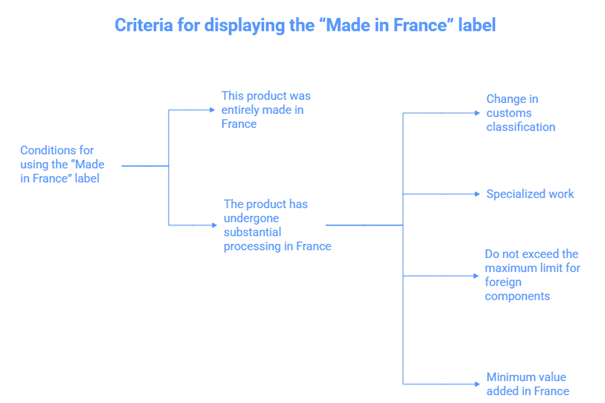
To use this designation, the manufacturer must demonstrate that the product meets one of the following criteria:
• Wholly obtained in France: all components originate from France and all stages of production take place there;
• Substantial transformation in France: where the product is not entirely French, it must undergo its last significant transformation in France, resulting either in a new product or a key manufacturing stage giving it its essential characteristics.
The concept of substantial transformation is assessed through several alternative criteria:
• Change in tariff classification: the finished product falls under a different customs code than its components;
• Specific processing: key operations (e.g., weaving or full garment manufacturing in textiles) confer French origin;
• Maximum threshold of foreign components: limits on non-French inputs in the final product;
• Minimum value added in France: a significant portion of the ex-works price is generated domestically (e.g., 45% for certain industrial goods).
A key distinction: food products vs manufactured goods
The legal framework varies significantly depending on the type of product.
For food products, certain origin labeling requirements apply within a strict European regulatory framework designed to ensure traceability and food safety. This serves a primary objective of consumer protection, particularly in matters of public health and fair information.
By contrast, for manufactured goods, the use of the “Made in France” label remains optional. It falls within the principle of freedom of trade, subject to consumer law rules on misleading commercial practices. In the absence of full EU harmonization, companies retain flexibility but also bear increased responsibility regarding the accuracy of origin claims.
What legal obligations apply to products?
Compliance with consumer law: a duty of fairness
The use of “Made in France” constitutes a commercial claim and is therefore subject to provisions of the French Consumer Code on misleading practices.
A company incurs liability where:
• the information is inaccurate or ambiguous;
• it is likely to mislead consumers;
• it creates an unjustified competitive advantage.
In this context, expressions such as “designed in France,” “French design,” “French craftsmanship,” or “French trademark” must be used with caution. These claims may be considered misleading if they suggest French manufacturing when this is not the case. Clear and precise communication is therefore essential.
DGCCRF controls and risks of misuse
The DGCCRF plays a central role in verifying the accuracy of origin claims. It has extensive powers enabling it to request supporting documentation, carry out on-site inspections, and sanction any non-compliant practices.
In the event of irregularities, companies may be subject to administrative fines, withdrawal of products from the market, as well as significant reputational damage.
More broadly, the misuse of the “Made in France” claim constitutes a major legal risk. It may result in:
• proceedings for misleading commercial practices;
• civil liability for unfair competition or competitive harm;
• criminal sanctions in the most serious cases.
The consequences are not limited to legal exposure. From a strategic perspective, such misuse may lead to:
• A loss of consumer trust,
• Negative media coverage (bad buzz),
• A lasting deterioration of trademark image.
How to prove the French origin of a product?
The burden of proof lies with the company
Any company using the “Made in France” claim must be able to objectively substantiate it. Evidence may include:
• Technical manufacturing documentation;
• Supplier invoices;
• Component traceability;
• Detailed industrial processes.
It is essential to maintain a clear, structured, and accessible file in case of inspection. This documentation enhances transparency and strengthens trademark credibility.
The value of a Binding Origin Information (RCO)
To secure their position, companies may request a Binding Origin Information (BOI) decision from customs authorities. This mechanism provides an official and legally binding determination of a product’s origin under non-preferential rules.
The BOI offers several advantages:
• it provides strong evidentiary value;
• it ensures legal certainty regarding the use of the claim;
• it helps mitigate litigation risks.
In practice, obtaining a BOI is part of a proactive compliance strategy, particularly relevant for complex or international supply chains.
Conclusion
The “Made in France” label represents a significant competitive advantage, provided its legal implications are fully understood. Its use requires rigor, transparency, and proactive risk management under both customs and consumer law.
A compliant approach relies on precise supply chain analysis, robust documentation, and clear communication to avoid misleading practices and preserve the long-term credibility of both the company and its trademark.
Dreyfus & Associés assists its clients in managing complex intellectual property cases, offering personalized advice and comprehensive operational support for the complete protection of intellectual property.
Nathalie Dreyfus with the support of the entire Dreyfus team
Q&A
1. Is “Made in France” mandatory?
No, except for certain food products. For manufactured goods, it is optional.
2. What is a substantial transformation?
It is the final stage of production that significantly alters the product.
3. Can a product be “Made in France” if raw materials are imported?
Yes, if the main transformation occurs in France.
4. Is there an official label?
There are several private or semi-public labels (e.g., Origine France Garantie).
5. What is the difference between “Made in France” and “Origine France Garantie”?
The latter is based on stricter specifications and certification.
This publication is intended to provide general guidance and highlight certain issues. It is not intended to apply to specific situations or constitute legal advice.