


Introduction
Competition for new generic top-level domains has reopened, but the auctions have not yet begun. ICANN’s 2026 application window—the first since 2012— closed on August 12, 2026.
Operating a new gTLD, particularly a .brand, involves administering a registry, controlling a namespace and complying with technical, financial, contractual and abuse-mitigation obligations. An application should therefore be treated as a long-term intellectual property and digital governance project.
The 2026 round revives competition for new gTLDs
Following the 2012 application round, which generated 1,930 applications, ICANN opened a new application window for generic top-level domains in 2026. This window closed on August 12, 2026, with more than 1,600 primary applications submitted. The next milestone will be “Reveal Day”, scheduled for mid-October, when the applied-for strings, the identities of the applicants and any potential contention situations between applications will notably be made public.
This new round therefore brings back to the forefront the question of whether companies should consider having their own extension. Beyond trademark protection, a “.brand” can indeed constitute a genuine tool for controlling and managing a company’s digital identity.
A .brand can create a closed namespace in which the company alone determines which second-level domains may be registered. It may strengthen the authenticity of official websites and reduce dependence on open extensions. It does not, however, provide an automatic Google ranking advantage: new gTLDs are generally treated in the same manner as other generic extensions.
Occurrence of string contention
String contention occurs when separate applicants seek identical gTLDs, variants of one another or strings that are visually, aurally or semantically similar. Contention may be direct, where applications immediately conflict, or indirect, where one application connects several otherwise separate applications within a broader contention set.
Initial contention sets involving identical strings will be published on Reveal Day. They may subsequently change following singular-plural notifications, String Similarity Evaluation or a likehood of confusion. A proper clearance exercise must therefore cover translations, transliterations, linguistic variants and phonetic similarities – not merely exact textual matches.
New mechanisms for avoiding contention
Applicants may designate a replacement string when submitting their application. During the 14-day period following Reveal Day, an applicant may permanently replace its initial string with that alternative. The change is irreversible and does not guarantee that the replacement will avoid later contention.
Subject to specific requirements, a .brand applicant may also amend its string by adding a term appearing in the goods or services covered by its registered trademark. This mechanism makes an early audit of the applicant’s trademark portfolio essential: an unduly narrow specification may restrict the alternatives available if contention arises.
Concerning the resolution of new contention, an eligible community application, that is, an application submitted on behalf of a clearly identified and structured community, may participate in Community Priority Evaluation. If it meets the applicable criteria, it may receive priority over competing applications. Where several community applicants prevail, or no application obtains priority, an ICANN auction may still be required.
Private contention resolution is now prohibited
The most significant departure from the practices that followed the 2012 round is the prohibition of private resolution arrangements. The 2026 Applicant Guidebook prohibits private auctions, joint ventures and other arrangements designed to resolve contention outside ICANN’s procedures.
From Reveal Day, applicants within the same contention set are generally prohibited from communicating about their applications, strategies, compensated withdrawals or any proposed sharing of the string. A voluntary withdrawal remains possible, but it must not result from a prohibited negotiation.
This rule fundamentally changes financial planning. An applicant can no longer rely on a confidential settlement under which it receives compensation for withdrawing or agrees to share the future operation of the string. Its economic ceiling, fallback options and operational rationale must be determined before the application is filed.
How will an ICANN auction work?
The auction of last resort will use an ascending-clock, second-price method:
- the price increases through successive rounds;
- applicants progressively leave the auction;
- the final remaining participant wins the string;
the successful applicant pays the second-highest bid. 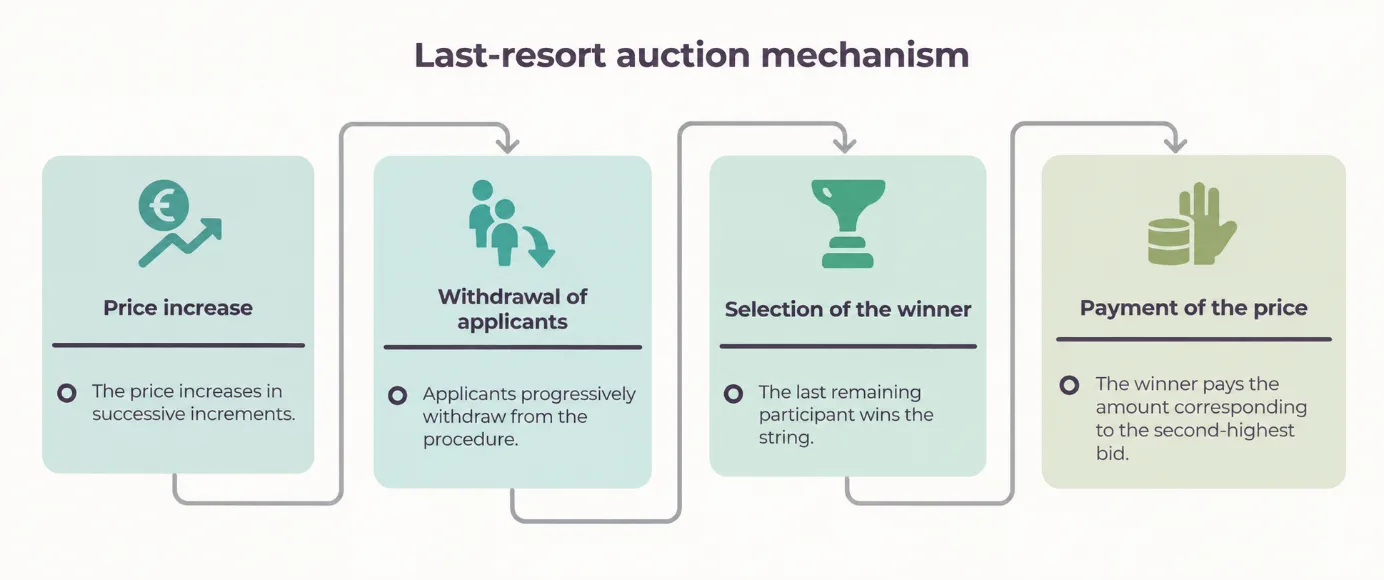
An indirect contention auction may leave more than one application able to proceed towards delegation.
Applicants qualifying for the Applicant Support Program may receive a bid credit of up to 35%, capped at USD 1.75 million per application. The credit is progressively reduced when the winning price exceeds USD 5 million and falls to zero above USD 9 million.
The outcome and use of the proceeds from the 2012 auctions
Sixteen auctions of last resort generated approximately USD 225 million.
ICANN has established a global Grant Program funded by the net proceeds of the 2012 auctions. Its first cycle made USD 10 million available. In 2026, the ICANN Board also authorized aggregate funding of up to USD 9.9 million from those proceeds to support as many as 75 eligible applicants participating in the new round.
The experience of the previous round also demonstrates that the winning bid is only one part of the total investment. Registry operation, contractual compliance, cybersecurity, abuse prevention and user adoption must all be incorporated into the business case.
How should trademark owners prepare for Reveal Day?
Reveal Day will make it possible to identify the applied-for strings, the applicants and the first contention situations. Trademark owners should therefore implement targeted monitoring covering not only identical trademarks, but also variants, translations, transliterations and similar signs.
For companies that have filed an application, a rapid response will be essential: where a replacement string has been designated, they will have fourteen days after Reveal Day to decide whether to activate it.
It is therefore advisable to anticipate now which strings should be monitored, the potential risks involved and the internal decision-making process, so as to be able to react immediately once the applications are published.
Conclusion
The new gTLD application round opened by ICANN in 2026 marks the return of global competition for scarce digital assets. Effective decision-making requires coordination between intellectual property, brand strategy, finance, cybersecurity and registry operations.
Dreyfus Law Firm assists its clients in managing complex intellectual property cases, offering personalized advice and comprehensive operational support for the complete protection of intellectual property.
Nathalie Dreyfus with the support of the entire Dreyfus team
Q&A
How much does a new gTLD application cost in 2026?
The standard evaluation fee is USD 227,000 per application. Applicants must also budget for technical, legal, operational and possible auction costs.
Can a trademark owner object to a new gTLD that infringes its rights?
Yes. A Legal Rights Objection may be filed where a rights holder considers that an applied-for string infringes its existing legal rights. This procedure is separate from application comments.
What are the main grounds for objecting to a new gTLD application?
The Applicant Guidebook provides four grounds: String Confusion, Legal Rights, Limited Public Interest and Community objections.Can applicants reach a private settlement?
No. Private auctions, compensated withdrawal agreements and other private contention-resolution arrangements are prohibited under the 2026 Applicant Guidebook.
Does a .brand automatically improve search rankings?
No. Google treats new gTLDs in broadly the same manner as other generic extensions. Their principal value lies in control of the namespace, brand consistency and the identification of official services.
This publication is intended for general public guidance and to highlight issues. It is not intended to apply to specific circumstances or to constitute legal advice.