

Introduction
The development of tools to combat cybersquatting, in particular DPML (Domains Protected Marks List) and MPML (Mind + Machines’ Protected Marks List) mechanisms, is a significant shift in online trademark protection. In the face of the proliferation of generic top-level domains (gTLDs) and the industrialisation of fraudulent domain name registrations, reactive litigation alone is no longer sufficient.
The key issue is no longer how to recover an infringing domain name, but how to prevent its registration altogether. In this context, preventive blocking mechanisms represent a decisive strategic opportunity for trademark owners.
A digital environment conducive to large-scale cybersquatting
The expansion of generic top-level domains (new gTLDs), initiated under the ICANN framework, has profoundly transformed the digital environment for rights holders. Whereas monitoring efforts were historically focused on a limited number of strategic extensions such as .com, .net or .fr, the landscape now includes hundreds of thematic and sector-specific extensions.
This fragmentation has created particularly favourable conditions for cybersquatting. Practices have become more diversified and sophisticated, including mass speculative registrations following public announcements, targeted typosquatting, exploitation of SEO vulnerabilities, phishing campaigns and identity theft schemes.
In such an environment, relying solely on post-infringement remedies often results in a continuous and costly defensive effort.
For more information about online infringements, please see our previously published article.
Structural limitations of traditional anti-cybersquatting procedures
Trademark owners traditionally rely on mechanisms such as the UDRP (Uniform Domain Name Dispute Resolution Policy), the URS (Uniform Rapid Suspension System) or national court actions. While these tools remain essential, they are fundamentally curative in nature.
Each procedure requires evidence of bad faith, prior rights and a likelihood of confusion. They involve legal costs, procedural timelines and internal resource allocation. Most importantly, they intervene only after the infringement has occurred, sometimes after reputational damage has already been inflicted.
As the number of extensions increases, the cumulative cost of individual enforcement actions may become disproportionate. The strategic challenge is therefore to shift from a reactive to a preventive approach.
DPML : a large-scale preventive blocking tool
The DPML (Domains Protected Marks List) is based on a straightforward but powerful principle : preventing the registration of a domain name corresponding to a trademark across a portfolio of extensions operated by a specific registry.
Available to trademark owners whose marks are recorded in the Trademark Clearinghouse (TMCH), the mechanism does not grant ownership of the domain names but blocks their registration by third parties. It operates as a preventive neutralisation tool.
The strategic value of DPML lies in its multiplier effect. Instead of defensively registering a trademark across each relevant extension, the owner activates a single mechanism covering an entire portfolio of extensions. This approach rationalises overall costs and simplifies administrative management.
For highly exposed or international trademarks, DPML offers a proportionate response to industrial-scale cybersquatting risks.
MPML : a blocking tool specific to the Minds + Machines registry
The MPML (Mind + Machines’ Protected Marks List) is a blocking service implemented by the Minds + Machines (MMX) registry.
Inspired by the DPML model, it enables trademark owners whose marks are :
• registered,
• composed of at least three characters, and
• validated with the TMCH (Trademark Clearinghouse),
to obtain an identical match block, and, depending on the options available, an extended block, across the domain name extensions operated by Minds + Machines.
Unlike a standalone multi-registry mutualization system, the MPML applies exclusively to the portfolio of TLDs operated by this registry (for example: .law, .fashion, etc.).
Certain domain names may be excluded from the mechanism (in particular names reserved or blocked at the ICANN level). The duration and specific terms of the block vary in accordance with the applicable registry conditions.
The MPML therefore follows a logic comparable to that of the DPML : a preventive tool, linked to a specific registry, designed to optimize protection across its portfolio of extensions.
An economic and reputational opportunity for trademark owners
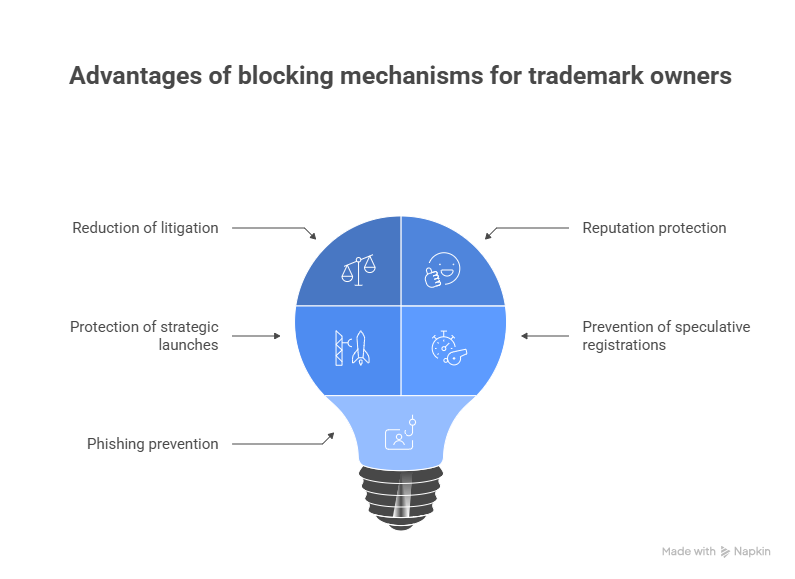
The benefits of blocking mechanisms go beyond reducing litigation. They directly contribute to reputational protection and the safeguarding of strategic launches.
The period preceding the public announcement of a new product or trademark is particularly sensitive. Speculative registrations frequently occur within hours of an official communication. Activating a blocking mechanism beforehand can effectively prevent such opportunistic behaviour.
A recurring scenario involves technology or financial companies targeted by phishing campaigns using domain names identical to or closely resembling their trademarks. Preventive blocking significantly reduces the vectors available for impersonation.
DPML and MPML therefore form part of a broader digital risk management strategy.
Conclusion
DPML and MPML now represent a major strategic opportunity for trademark owners seeking to anticipate cybersquatting risks. When implemented within a coordinated domain name management policy, these mechanisms strengthen the resilience of intangible asset portfolios and enhance corporate digital credibility.
Dreyfus & Associés supports its clients in managing complex intellectual property matters by providing tailored advice and comprehensive operational support for the full protection of intellectual property rights.
Nathalie Dreyfus, with the support of the entire Dreyfus team.
Q&A
1. Does DPML completely prevent any use of a trademark in a domain name ?
No. DPML blocks the exact match of the protected sign within the covered extensions but does not automatically neutralise complex combinations or additional descriptive terms. Complementary monitoring remains necessary.
2. Can a DPML block be lifted if the trademark owner wishes to use the domain name ?
Yes. The trademark owner may generally override the block in order to register and use the relevant domain name, subject to the registry’s applicable conditions. This flexibility allows strategic adjustments.
3. Do DPML and MPML cover country-code extensions such as .fr, .de or .cn ?
No. These mechanisms primarily apply to certain generic top-level domains (gTLDs). Country-code domains are governed by specific national registry policies and require a dedicated strategy.
4. Can an unregistered trademark benefit from DPML protection ?
Access to blocking mechanisms requires a registered trademark validated through the Trademark Clearinghouse, excluding unregistered or purely commercial designations.
5. Does implementing DPML eliminate the need for domain name monitoring ?
No. While blocking significantly reduces risk, it does not replace active monitoring, particularly for extensions not covered or for variants outside the scope of the blocking mechanism.
This publication is intended for general public guidance and to highlight issues. It is not intended to apply to specific circumstances or to constitute legal advice.