

Introduction
The entry into force of the digital publishing contract in France constitutes a structural reform of copyright law as applied to the book industry. By formally incorporating digital exploitation into the intellectual property Code, the French legislature put an end to persistent legal and contractual uncertainty and rebalanced the relationship between authors and publishers.
Digital publishing can no longer be treated as a mere technical extension of print publishing. It is now governed by an autonomous, demanding and strictly regulated legal framework. This evolution raises practical questions: What new obligations do publishers face? How is digital remuneration calculated? Under what circumstances may an author recover their digital rights?
A reform integrated into the French Intellectual Property Code
The ordinance of November 12, 2014 formally integrated digital exploitation into the statutory regime governing publishing agreements. Articles L.132-1 et seq. of the French Intellectual Property Code establish a fundamental principle: digital exploitation must be expressly provided for and precisely regulated.
This clarification put an end to overly broad clauses providing for the transfer of rights “on all media now known or unknown.” Such wording is no longer sufficient to secure the lawful exploitation of works in digital form.
Publishing agreements must now distinguish between print and digital modes of exploitation while ensuring overall economic consistency. This requirement directly addresses a recurring question raised by authors: may a publisher exploit a work in digital format without a specific clause? The answer is clearly no.
Digital exploitation: an autonomous and regulated obligation
One of the reform’s major contributions is the extension of the obligation of continuous and permanent exploitation to digital formats. A publisher cannot rely on mere passive availability. It must ensure effective distribution, genuine accessibility and consistent promotion of the work across digital platforms.
This obligation implies active conduct. The work must remain available to the public under normal commercial conditions. Prolonged unavailability or total absence of promotional efforts may constitute a contractual breach.
Transparency is the second cornerstone of the system. Royalty statements must clearly distinguish between print and digital sales. Authors must be able to identify download volumes, generated revenues and the calculation basis for their remuneration. This annual reporting obligation restores informational balance in a technological environment often characterized by opacity.
Author remuneration in the digital environment
The guiding principle remains proportional remuneration. In the digital sphere, this rule is particularly significant given the multiplicity of technical intermediaries involved in distribution.
Authors’ royalties are calculated on revenues derived from digital exploitation, in accordance with contractual provisions that must be precisely defined. Although digital platforms have reshaped the value chain, they have not altered contractual responsibility. The publisher remains the author’s primary contractual counterpart.
It is the publisher’s responsibility to ensure financial traceability and to avoid ambiguity regarding the royalty calculation basis. In practice, negotiations frequently focus on whether royalties are calculated on the retail price, the publisher’s net receipts, or the actual revenues received after platform commissions.
Termination, reversion of rights and corrective mechanisms
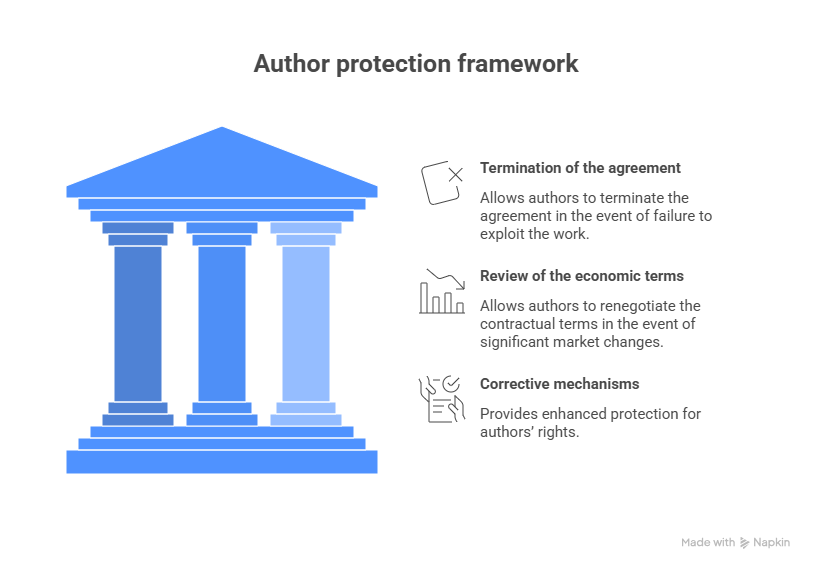
The entry into force of the digital publishing contract introduced reinforced protective mechanisms. In the event of failure to comply with the obligation of continuous and permanent exploitation, the author may formally notify the publisher to remedy the breach. If the publisher fails to comply within the prescribed period, termination may be declared.
This procedure serves as a critical safeguard, preventing publishers from retaining digital rights without genuine intent to exploit them.
The reform also provides for mechanisms allowing the re-examination of economic conditions. Where market developments substantially alter the contractual balance, renegotiation may be requested. This reflects an adaptation of copyright law to technological and commercial evolution.
The entry into force of the digital publishing contract extends beyond a technical adjustment. It reshapes contractual governance within the book industry.
For publishers, it requires rigorous legal structuring and transparent accounting practices. Any drafting imprecision may result in litigation or loss of exploitation rights.
For authors, it strengthens control over the digital dissemination of their works. They are entitled to demand effective exploitation, detailed reporting and remuneration consistent with statutory principles.
In a context where ebooks coexist with audiobooks, subscription models and international platforms, contractual security has become a central component of publishing strategy.
Conclusion
The entry into force of the digital publishing contract in France represents a decisive step in adapting intellectual property law to contemporary uses. It imposes transparency, effective exploitation and economic balance.
This new legal framework enhances author protection while professionalizing publishing practices. It calls for heightened vigilance in drafting and negotiating publishing agreements.
Dreyfus & Associés assists its clients in managing complex intellectual property matters by providing tailored advice and comprehensive operational support for the full protection of intellectual property rights.
Nathalie Dreyfus with the support of the entire Dreyfus team.
FAQ
1. Must a digital publishing contract include a specific digital clause?
Yes. Since the 2014 reform, digital exploitation must be expressly provided for and governed by distinct contractual provisions. A general clause is no longer sufficient to secure the transfer of digital rights.
2. What does the obligation of continuous and permanent exploitation mean in digital publishing?
The publisher must ensure effective and ongoing digital availability of the work. Merely listing the work online without active distribution or promotion may constitute a contractual breach.
3. How are royalties calculated for an ebook?
Royalties are generally based on a percentage of revenues derived from digital exploitation. The contract must clearly define the calculation basis to prevent ambiguity or disputes.
4. Does an old clause covering “all media now known or unknown” include digital formats?
Not necessarily. Current legal standards require precise identification of transferred rights. Overly broad clauses may be challenged if digital exploitation is not specifically detailed.
5. Under what circumstances may an author recover their digital rights?
An author may seek termination of its publishing contract in the event of failure to ensure continuous exploitation or other serious contractual breaches. After formal notice and absence of remedy, digital rights may revert to the author.
This publication is intended for general public guidance and to highlight issues. It is not intended to apply to specific circumstances or to constitute legal advice.