

Introduction
Trademark protection in Sint Maarten represents a strategic issue for companies seeking to secure their intangible assets in the Caribbean. As an autonomous country within the Kingdom of the Netherlands since 2010, Sint Maarten has its own trademark protection system, which is distinct from the Benelux system and does not fall within the territorial scope of the European Union trademark.
Therefore, a rigorous approach is essential for effective trademark protection in Sint Maarten in order to avoid any legal vulnerability or fraudulent exploitation.
What is the legal framework for trademark protection in Sint Maarten?
Since its institutional reform, Sint Maarten has established its own legislation governing trademark rights. Unlike the European Netherlands, trademark protection is not administered by the Benelux Office for Intellectual Property (BOIP). The applicable legal framework is local in nature, although it is strongly influenced by Dutch and European legal standards.
Since January 1, 2015, trademark applications may be filed electronically via the technical infrastructure administered by the BOIP, while legal decisions remain under the authority of the Bureau Intellectuele Eigendom of Sint Maarten (BIE SXM).
This system ensures the existence of a secure electronic register, a modernized filing procedure and efficient administrative management. However, it is important to emphasize that neither a Benelux trademark nor a European Union trademark produces automatic legal effects in Sint Maarten.
How to file a trademark in Sint Maarten?
Before filing a trademark application, conducting a prior art search is essential to identify potential conflicts with existing registered trademarks, locally used trade names, domain names registered under the “.sx” extension, or well-known signs.
Trademark applications are filed online via the platform operated in cooperation with the BOIP.
The application must include the following elements:
• accurate identification of the applicant
• representation of the sign to be protected
• designation of the goods and services according to the Nice Classification
• payment of the official filing fees
The office conducts both a formal and substantive examination, verifying in particular the distinctiveness of the sign and its compliance with legal requirements.
After publication, an opposition period is opened, allowing holders of prior rights to take action. If there is no opposition or refusal to grant the trademark by the office, registration is granted and the trademark is protected.
What rights does a registered trademark confer in Sint Maarten?
Trademark registration grants the owner an exclusive right of use within the territory for the goods and services designated.
This exclusive right enables the trademark owner to prohibit:
• the use of an identical sign for identical goods or services
• the use of an identical or similar sign for identical or similar goods or services where there is a likelihood of confusion in the mind of the relevant public
• the use of a sign that takes unfair advantage of, or is detrimental to, the distinctive character or reputation of the trademark
Protection extends to commercial, advertising, and digital uses. It covers shop signs, promotional materials, online platforms, and similar domain names, particularly those using the “.sx” extension.
Trademark owners may also take action against the use of identical or similar signs for related goods or services when a likelihood of confusion is established.
In the event of infringement, the first step generally consists of sending a cease-and-desist letter requesting voluntary cessation of the unlawful use.
If the infringement persists, legal proceedings may be initiated before the competent courts of Sint Maarten in order to obtain:
• cessation of the infringing acts
• compensation for damages
• and, where appropriate, interim or injunctive relief
Active monitoring of new trademark applications is essential to identify potential conflicts at an early stage. Monitoring “.sx” domain names, local marketplaces, and digital advertising uses is also particularly important in a highly digitalized market.
How to manage trademark disputes and enforcement in Sint Maarten?
The legal framework applicable in Sint Maarten provides several mechanisms for challenging the registration or use of a trademark that infringes prior rights.
An opposition may be based on:
• a prior registered trademark
• a protected trade name
• or any other recognized intellectual property right
The assessment of likelihood of confusion relies on a global analysis that considers the similarity of the signs, the proximity of the goods or services involved, and the perception of the relevant public.
In cases of counterfeiting, the courts of Sint Maarten have jurisdiction to hear the dispute. The principles applied in trademark matters are largely inspired by Dutch and European trademark jurisprudence.
Interaction with international trademark protection
Trademark protection in Sint Maarten must be considered within an international protection strategy.
Neither a European Union trademark nor a Benelux trademark produces direct legal effects in this territory.
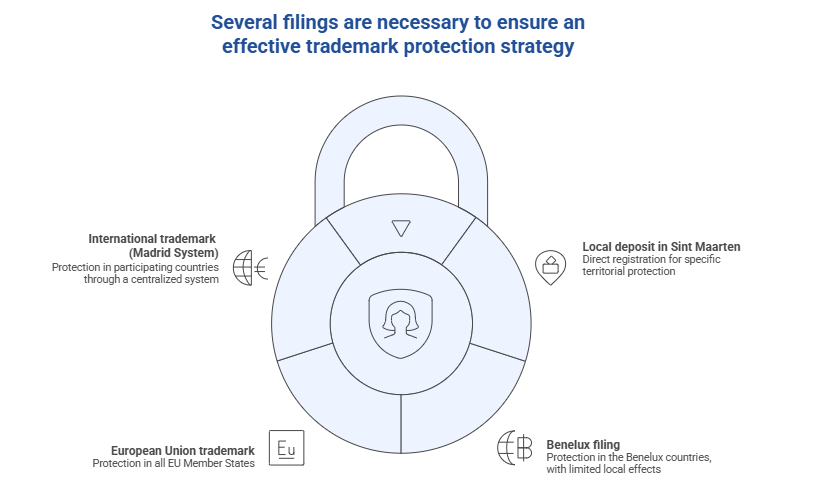
Companies operating in the Caribbean region or internationally should therefore structure a coherent trademark portfolio that may include, depending on their needs:
• a local trademark filing in Sint Maarten
• a Benelux trademark
• a European Union trademark
• and, where appropriate, an international registration through the Madrid System
Such a strategy ensures consistent territorial coverage and reduces the risk of opportunistic trademark registrations in jurisdictions not covered by the main trademark portfolio.

Conclusion
Trademark protection in Sint Maarten relies on an autonomous legal system that requires a specific local filing, as neither European nor Benelux trademarks apply automatically.
Businesses must therefore adopt a proactive strategy in order to prevent conflicts, preserve the economic value of their trademarks, and secure their commercial investments in the Caribbean region.
A coordinated approach combining trademark filings, monitoring, and enforcement mechanisms remains the key to achieving effective and sustainable protection.
Dreyfus & Associés assists clients in managing complex intellectual property matters, providing tailored advice and comprehensive operational support for the full protection of intellectual property rights.
Dreyfus & Associés works in partnership with a global network of intellectual property attorneys.
Nathalie Dreyfus, with the support of the entire Dreyfus team.
Q&A
How long does it take to register a trademark in Sint Maarten?
The processing of a trademark application by the Director of the Sint Maarten Intellectual Property Office takes approximately four months. During this period, the office examines the application to verify compliance with legal and administrative requirements. Once the procedure is completed and no objections arise, the office issues a certificate of registration confirming the trademark owner’s rights.
What is the duration of trademark protection in Sint Maarten?
A registered trademark in Sint Maarten is protected for a period of ten years from the filing date. This protection may be renewed indefinitely for successive ten-year periods, subject to payment of the applicable renewal fees.
Must a trademark be used in Sint Maarten?
Yes. As in many jurisdictions, a registered trademark may be subject to revocation if it is not genuinely used for an extended period. Effective use of the trademark is therefore essential to maintain the validity of the rights.
Can a trademark be protected in Sint Maarten through the Madrid international system?
Yes. Companies with an international protection strategy may use the Madrid System administered by the World Intellectual Property Organization (WIPO). This mechanism allows applicants to file a single international application and designate multiple territories, including Sint Maarten.
Is it necessary to appoint a local representative when filing a trademark in Sint Maarten?
Depending on the applicant’s situation, representation by an intellectual property attorney or specialized lawyer is strongly recommended, particularly when the trademark owner is not established in Sint Maarten. Appointing a representative helps ensure compliance with local legal requirements, optimizes the drafting of the goods and services specification, and anticipates potential objections or oppositions.
This publication is intended to provide general information and highlight certain legal issues. It is not intended to apply to specific situations and should not be construed as legal advice.