


Introduction
The decision rendered on April 12, 2016 by the Paris Court of Appeal in the dispute between the “Le Petit Marseillais” and “Le P’tit Zef” trademarks constitutes a landmark ruling in the field of trademark protection in the cosmetics and hygiene sector. By confirming the distinctiveness of the earlier trademark and sanctioning the imitation embodied by the later trademark, the Court reaffirmed a rigorous approach to addressing parasitic appropriation strategies.
Beyond the specific dispute, this decision illustrates how French courts currently assess the economic value of trademarks, the construction of a coherent commercial identity, and the protection of intangible investments. It forms part of an evolving body of case law aimed at ensuring enhanced legal certainty for rights holders.
Assessment of the validity of the trademark “Le Petit Marseillais”
The company CILAG GmbH International, owner of the trademark “Le Petit Marseillais” , registered in Class 3 for soaps and cosmetic products, initiated counterfeit proceedings against Sir Philippe LE HIR, owner of the trademark “Le P’tit Zef” . In response, the latter sought to invalidate the earlier trademark on the ground that it was deceptive in character.
In the present case, the owner of the “Le P’tit Zef” trademark attempted to justify its position by arguing that the “Le Petit Marseillais” trademark was liable to mislead the public, by suggesting that the products were genuine Marseille soap, whereas this was allegedly not the case. Article L.711-3 of the French Intellectual Property Code provides that a sign may not be adopted as a trademark if it is likely to mislead the public, in particular as to the nature, quality, or geographical origin of the goods or services.
The Court of appeal recalled that the term “Marseille soap,” although deeply embedded in the collective imagination, does not constitute a protected geographical indication but rather refers to a traditional manufacturing method. This conclusion was supported in particular by a Wikipedia page submitted as evidence, according to which Marseille soap is defined by its production process rather than by an exclusive geographical origin. This interpretation is consistent with the regulatory framework overseen by the DGCCRF (branch of the French Ministry of the Economy).
The Court therefore inferred that, in the mind of the average reasonably attentive consumer, the name “Le Petit Marseillais” does not necessarily designate a product manufactured in Marseille or Provence. Instead, it refers to an evocative brand embedded in a recognizable marketing universe, reinforced by the figurative element depicting a child in maritime attire on the product packaging.
This analysis led the court to dismiss the argument alleging that the sign was deceptive and, consequently, to reject the counterclaim for invalidity brought in response, thereby confirming the validity of the “Le Petit Marseillais” trademark as a protectable distinctive sign.
Assessment of the infringing nature of the trademark “Le P’tit Zef”
Once the validity of the earlier trademark had been confirmed, the Court proceeded to analyze the likelihood of confusion between “Le Petit Marseillais” and “Le P’tit Zef,” in light of the products designated, all falling within Class 3.
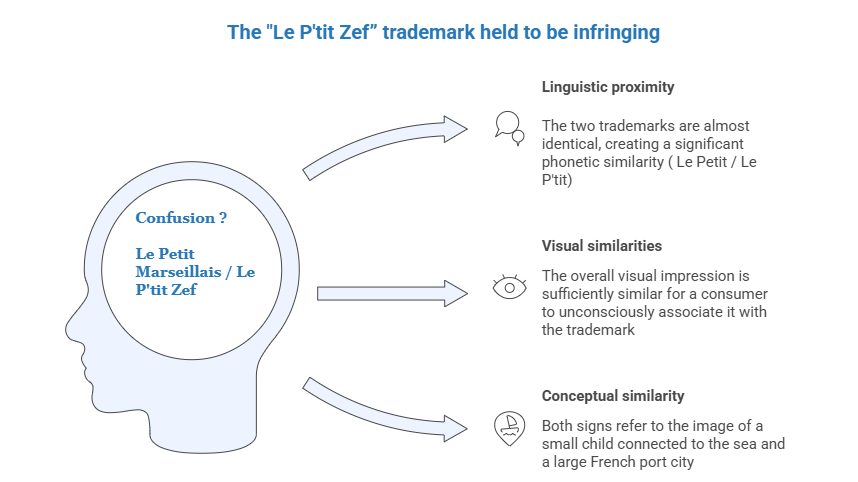
The Court of Appeal first noted that the signs share a strong linguistic similarity in their structure, the initial element of both trademarks being almost identical (“Le Petit” / “Le P’tit”). Although the terms “Marseillais” and “Zef” differ visually and phonetically, this distinction is not sufficient to rule out any likelihood of confusion.
From a conceptual standpoint, the judges considered that both signs refer to comparable images, namely that of a child associated with a major French port city, Marseille for the earlier trademark and Brest for “Le P’tit Zef.” This interpretation led the Court to conclude that the public might perceive “Le P’tit Zef” as a regional variation or thematic extension closely associated with the earlier trademark.
The Court also took into account the figurative elements displayed on the packaging, which showed comparable visual configurations, thereby reinforcing the impression of association between the two trademarks.
This overall assessment led the judges to find the existence of a likelihood of confusion and association and, consequently, to characterize the use of the trademark “Le P’tit Zef” as an infringement of the trademark “Le Petit Marseillais”
Practical and strategic lessons for trademark owners
The decision of April 12, 2016 confirms, first, that a trademark referring to a region or a traditional product, in this case, Marseille soap, is not, per se, liable to mislead the public, provided that an overall assessment of the elements perceived by consumers, including figurative components, clearly identifies the true origin of the goods and rules out any false geographical representation.
Second, the assessment of likelihood of confusion extends beyond purely verbal elements. The ruling illustrates that a judge’s global analysis include conceptual and figurative elements relating to the visual representation of the signs, thereby strengthening the protection afforded to a strong trademark when a competitor adopts a similar graphic or conceptual universe.
Conclusion
The judgment of April 12, 2016 rendered by the Court of Appeal of Paris confirms that the “Le Petit Marseillais” trademark, registered in Class 3, is not misleading within the meaning of Article L.711-3 of the French Intellectual Property Code, even though it evokes a reputed traditional manufacturing method.
This decision validates a contextual reading of consumer behavior and of the perception of signs as a whole. It also demonstrates that the overall comparability of trademarks may suffice to establish infringement when a competitor develops a similar brand, both visually and conceptually.
Dreyfus & Associés assists its clients in managing complex intellectual property cases, offering personalized advice and comprehensive operational support for the complete protection of intellectual property.
Nathalie Dreyfus with the support of the entire Dreyfus team
FAQ
1. Can a trademark evoke a geographical origin without being considered misleading?
Yes. A trademark may refer to a region or territory provided that this reference does not lead consumers to believe, incorrectly, that the products actually originate from that place. In this case, the Court held that “Le Petit Marseillais” referred to a marketing universe rather than to a geographical guarantee.
2. Is the actual place of manufacture decisive in assessing trademark validity?
Not systematically. The place of manufacture becomes legally relevant only if the trademark explicitly suggests a protected or certified origin. In the absence of an official geographical indication, a mere discrepancy between the evocation of the sign and the actual production site is insufficient to establish deception.
3. Is the mere use of different terms sufficient to exclude a likelihood of confusion?
No. The presence of different terms does not, in itself, exclude the likelihood of confusion. Judges assess the sign as a whole, including its structure, rhythm, positioning, and overall impact. In this case, despite the differences between “Marseille” and “Zef,” the overall similarity was decisive.
4. Do packaging and commercial presentation influence legal analysis of counterfeiting?
Yes. Courts take into account the overall presentation of products, including graphic elements, colors, illustrations, and visual identity. When these elements reinforce the proximity between two brands, they may contribute to a finding of imitation.
5. What risks does a company face when adopting a trademark too close to that of an established competitor?
It may face counterfeit proceedings resulting in a prohibition on use, withdrawal of products from the market, payment of damages, and, in some cases, destruction of infringing materials. It may also suffer lasting commercial harm due to loss of credibility.
This publication is intended to provide general guidance and to highlight certain issues. It is not intended to address specific situations nor to constitute legal advice.