

Introduction
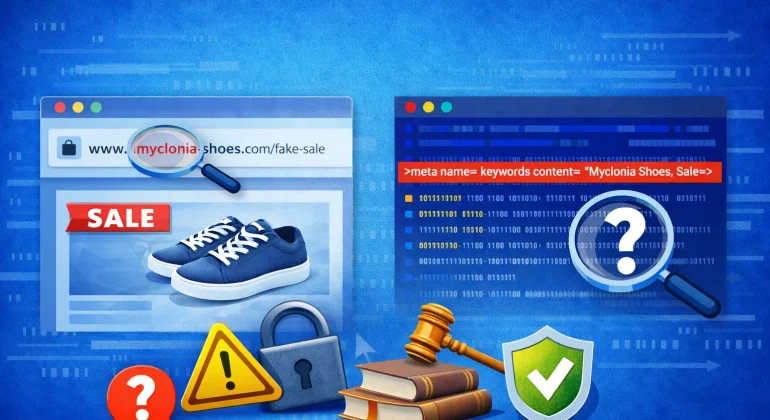
The reproduction of a trademark in a URL or in the source code of a website raises recurring legal issues for companies confronted with unauthorized digital uses of their distinctive signs.
At a time when online visibility conditions access to the market, such practices directly call into question trademark law, as well as the boundaries between infringement, search engine optimization, lawful technical uses and unfair competition.
The central question appears simple at first glance: does the insertion of a trademark into a URL, an HTML tag or a website’s source code automatically constitute trademark infringement? In practice, the answer is nuanced. It requires a detailed legal analysis of the nature of the use, its economic context and its concrete effects on the relevant public.
Legal qualification of the reproduction of a trademark in a URL
Under both French law and European Union law, trademark infringement requires that several cumulative conditions be met. The trademark must be used in the course of trade, in relation to identical or similar goods or services, and such use must be liable to adversely affect one of the functions of the trademark, foremost among them its essential function of indicating the commercial origin of goods or services.
The analysis is therefore not limited to the mere material reproduction of the sign, but focuses on its economic role and the effect it produces on the perception of the relevant public.
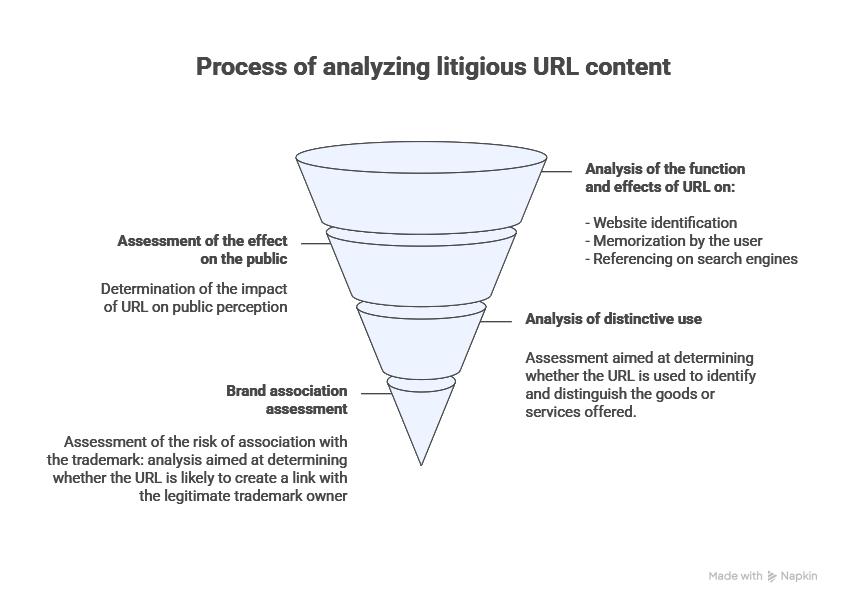
In this context, the presence of a trademark in a URL must be assessed in light of its function and its effects. A URL is not a neutral or purely technical element; it contributes to the identification of the website, its memorability for internet users, and its indexing and ranking by search engines. As such, it constitutes a vector of commercial visibility, the effects of which may be comparable to those of a domain name or a sign displayed directly on a webpage.
Where a trademark is incorporated into the URL of a website offering goods or services, such reproduction may be characterized as use in a distinctive capacity, particularly where it seeks to capture qualified traffic or to create, in the mind of the public, an association with the legitimate trademark owner. In this respect, the URL forms part of the overall commercial presentation of the website and contributes to shaping the perception of the reasonably well-informed and reasonably observant internet user.
This approach has been upheld by case law, notably in a judgment of January 29, 2016. In Un Amour de Tapis v. Westwing (Paris Court of First Instance, 3rd Chamber, 3rd Section, 29 January 2016, No. 14/06691), the court found trademark infringement on the basis of the unauthorized use of a trademark in the URL of a private sales website in the context of a one-off commercial operation. The court held that such reproduction was likely to create a risk of confusion as to the origin of the goods offered and to give the impression of the existence of a link, endorsement or participation by the trademark owner in the operation at issue.
The decisive impact of URLs on organic search rankings
The use of a trademark in the source code of a website presents a specific and significant feature. Although such use is invisible to the end user, it plays a decisive role in organic search rankings and in the way search engines identify, classify and promote a website’s content.
The source code therefore directly contributes to the visibility of an offer on the market.
The insertion of a trademark into strategic elements such as title tags, meta descriptions, HTML headings or alt attributes may constitute use in the course of trade where it is intended to improve the website’s positioning for searches associated with that trademark. Such use cannot be regarded as purely technical where it pursues an objective of attracting traffic and influencing the behavior of internet users.
Case law now consistently recognizes that the invisible nature of the use does not, in itself, preclude a finding of trademark infringement. In its judgments of March 23, 2010 (CJEU, March 23, 2010, joined cases C-236/08 to C-238/08), the European Union Court of Justice held that the assessment must focus on the effects produced on the economic behavior of internet users, in particular through the results displayed by search engines.
Where the use of a trademark in the source code enables the capture of qualified traffic, diverts the attention of internet users or creates an undue association with the legitimate trademark owner, an infringement of the functions of the trademark may be established, irrespective of the sign’s direct visibility on the page consulted.
The criteria applied to establish trademark infringement
In order to assess whether trademark infringement has occurred, courts carry out an overall assessment of the circumstances of the case.
The first criterion consists in determining whether the trademark is used as a distinctive sign in the URL, that is, as an indicator of commercial origin, rather than as a purely descriptive, informational or strictly necessary reference. The targeted and repeated insertion of the trademark into strategic elements such as the URL or certain component of the source code tends to reveal use as a trademark where it contributes to attracting the public and promoting the offer.
The likelihood of confusion remains a central criterion. It is assessed on a concrete basis, taking into account in particular the full or near-full reproduction of the trademark, the identity or similarity of the goods or services offered, as well as the overall presentation of the website and its digital environment. Taken together, these factors may lead internet users to mistakenly believe that there is an economic, organizational or contractual link with the trademark owner.
Beyond the likelihood of confusion, courts also take into consideration harm to the other functions of the trademark. Unauthorized use may adversely affect its advertising function by unduly exploiting its power of attraction, its investment function by weakening the efforts made by the owner to enhance the value of the sign, or its communication function. Such impairments may be sufficient to establish counterfeiting, even in the absence of immediate confusion.
Lawful uses and the boundary with unfair competition
Not every reproduction of a trademark in a digital environment is necessarily unlawful. Certain uses may be permitted where they are strictly necessary, proportionate and devoid of any distinctive character, in particular for descriptive, informational or fair comparative purposes.
That boundary, however, is a narrow one. Where the use goes beyond what is necessary to inform the public and tends to unduly capture customers or to take unfair advantage of the trademark’s reputation, the risk of a finding of infringement re-emerges.
In practice, where the strict conditions for trademark infringement are not fully met, the conduct at issue may nevertheless fall within the scope of unfair competition or parasitism, particularly where it reveals an intent to capitalize on the reputation of an established operator or to divert its online traffic.
Conclusion
The reproduction of a trademark in a URL or in the source code of a website cannot be only reduced to a purely technical use. Where it influences the visibility of the website, its organic search ranking and the economic behavior of internet users, it may constitute a use in the course of trade that adversely affects the functions of the trademark.
The assessment must remain concrete and based on the actual effects of the use. Regardless of whether the sign is visible or invisible to the user, URLs and source code fully form part of a website’s commercial presentation and may, as such, give rise to a finding of trademark infringement.
Dreyfus & Associés assists its clients in managing complex intellectual property cases, offering personalized advice and comprehensive operational support for the complete protection of intellectual property.
Nathalie Dreyfus with the support of the entire Dreyfus team.
Q&A
Is it necessary to prove fraudulent intent in order to establish trademark infringement?
No. Trademark infringement is an objective form of liability. While intent may be relevant to the assessment of damages or the measures ordered, it is not a condition for establishing infringement.
Can the use of a competitor’s trademark in a URL be justified by comparative SEO practices?
Very rarely. Lawful comparative practices require information that is fair, objective and proportionate. In practice, the insertion of a trademark into a URL is difficult to justify under these standards.
Is the use of a trademark in a URL for purely internal (back-office) purposes risky?
In principle, no, provided that the URL is neither indexed nor accessible to the public.
Is an action based on unfair competition preferable where the use is described as “technical”?
It may offer greater flexibility in certain situations, particularly where the qualification of trademark infringement is uncertain. Both legal grounds may, however, be relied upon in a complementary manner.
Is the use of a trademark in a URL by an authorized distributor lawful?
This depends on the contractual framework and the conditions of use. In the absence of express authorization, excessive or misleading use may go beyond the distributor’s rights.
Do well-known trademarks benefit from enhanced protection in this context?
Yes. Harm to the investment function or the reputation of the trademark may be established even in the absence of a likelihood of confusion, thereby facilitating enforcement actions.
The purpose of this publication is to provide general guidance to the public and to highlight certain issues. It is not intended to apply to particular situations or to constitute legal advice.