

Introduction
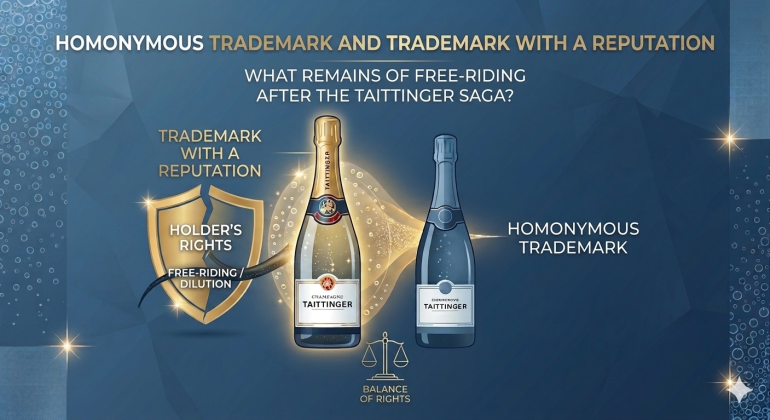
Can a homonymous trademark legitimately coexist with a trademark with a reputation bearing a well-known surname? The answer has evolved considerably since the landmark ruling of the French Court of Cassation of July 10, 2018 (No. 16-23.694). The second judgment rendered in the same proceedings on June 22, 2022 (No. 20-19.025), the reform introduced by Ordinance No. 2019-1169, and a series of recent decisions (Castelbajac, Tour de France, Fauré Le Page) have substantially reshaped the contours of this area of litigation. Both trademark owners and entrepreneurs whose surname coincides with an established trademark must now reconsider the applicable analytical framework
The dual threat facing the homonymous trademark: the analytical framework established by the Taittinger saga
Where a surname coincides with a pre-existing trademark with a reputation, the use of that name in the course of trade opens two distinct, yet frequently cumulative, avenues of litigation:
- Infringement of a trademark with a reputation, now governed by Article L. 713-3 of the French Intellectual Property Code (IPC);
- Action for parasitism under Article 1240 of the Civil Code.
The ruling of July 10, 2018 established a reference methodology: due cause operates only as a post-characterisation defence, the two questions being assessed sequentially and not concurrently.
Background: the Taittinger proceedings
One of the heirs of the Taittinger family had participated in the sale of shares in the family company, proprietor of the TAITTINGER champagne trademark. The share transfer agreement dated July 21, 2005 contained a personal warranty against eviction prohibiting the transferors from making use of the Taittinger name in connection with competing products. Following her dismissal in 2006, the individual concerned filed the trademark Virginie T in respect of, inter alia, champagne, and registered several domain names incorporating her surname. Taittinger CCVC brought proceedings against her on three cumulative grounds:
- Breach of the warranty against eviction;
- Infringement of a trademark with a reputation;
- Parasitism.
The 2022 Taittinger epilogue: recognition of the legitimate use of a patronymic name
Ruling on remand following the 2018 decision, the Paris Court of Appeal (March 3, 2020, No. 18/28501) dismissed the claims of Taittinger CCVC. The court held that the references to the surname were intended to recall Mme Taittinger’s professional career and family background, attesting to her expertise, and that the communication strategy did not establish, in the mind of the reasonably well-informed consumer, any link between the trademarks Virginie T and Taittinger.
On a further appeal, the Court of Cassation (June 22, 2022, No. 20-19.025) upheld that reasoning: Mme Taittinger’s use of her surname was legitimate inasmuch as it sought to evoke her family and professional history, her acquired expertise, and to differentiate the Virginie T products from those of the Taittinger house. The reputation of a trademark does not preclude the legitimate use of a sign as a surname, provided three cumulative conditions are met: good faith, the purpose of evoking a professional career and family heritage, and the absence of any strategy creating a link in the public’s mind with the trademark with a reputation.
This ruling confirms the qualified and conditional primacy of personality rights attached to a name over the exclusive rights conferred by a trademark, where the use remains honest and factual.
The new legal regime for reputed trademarks following the 2019 ordinance
Ordinance No. 2019-1169 of November 13, 2019 brought about a structural transformation. The former Article L. 713-5 IPC, upon which the 2018 ruling was based, was repealed. Infringement of a trademark with a reputation now falls under Article L. 713-3 IPC and constitutes an act of trademark infringement, no longer a tort under general civil liability rules. The available sanctions, procedural remedies and search-and-seizure procedures are considerably strengthened as a result.
The cumulative conditions for establishing infringement
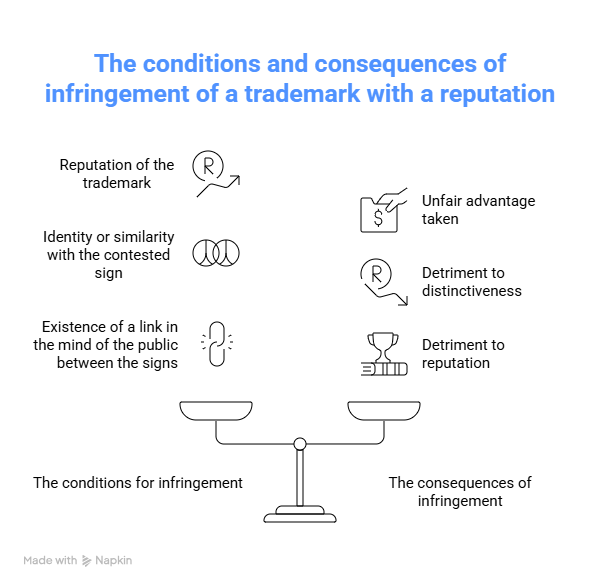
The trademark owner must demonstrate:
- The reputation of the trademark among a significant portion of the relevant public, a concept developed by the CJEU in General Motors v Yplon (C-375/97);
- The identity or similarity of the contested sign;
- The link established in the mind of the relevant public between the contested sign and the trademark invoked.
A likelihood of confusion is not required.
Once those conditions are satisfied, it is necessary to characterise unfair advantage taken of, or detriment caused to, the distinctive character (dilution) or the reputation (tarnishment) of the trademark. Evidence may be adduced by any means, and prior registration with the INPI or the EUIPO constitutes the indispensable foundation for any such action.
Article L. 713-6 IPC: the statutory exception for surnames
The 2019 reform also enshrined, in Article L. 713-6 IPC, an express exception: “A trademark shall not entitle its proprietor to prohibit a third party from using, in the course of trade, in accordance with honest practices in industrial or commercial matters, his or her family name or address where that third party is a natural person.” This provision gives direct statutory grounding to the solution developed by the Taittinger case law.
Due cause: a post-characterisation defence
The two-stage methodology established in 2018 remains fully applicable in light of Directive (EU) 2015/2436. The CJEU ruling in Leidseplein Beheer v Red Bull (C-65/12) clarifies that due cause encompasses the subjective interests of the third party, which ultimately enabled Mme Taittinger to prevail in 2022. This defence may only be assessed once infringement has been established: it has no bearing on the characterisation of the unfair advantage taken.
The post-2022 case law landscape: Castelbajac, Tour de France, Fauré Le Page
The Castelbajac case (Cass. com., February 28, 2024; CJEU, December 18, 2025, C-168/24)
In the Castelbajac case, the dispute concerned a patronymic trademark designating fashion products, which had been assigned to a company. Following that assignment, the question was whether the use of the trademark could become deceptive where the public was likely to believe that the creator was still involved in the design of the products, although this was no longer the case.
By a judgment of February 28, 2024, the Cour de cassation referred this question to the CJEU. In substance, it asked whether a patronymic trademark could be revoked for acquired deceptiveness where its use, after the assignment, misled the public as to the creator’s actual involvement.
In its judgment of December 18, 2025, the CJEU answered in the affirmative. It confirmed that a patronymic trademark may be revoked where its use suggests that the creator is still behind the style or design of the products, although this is no longer true.
The Tour de France Case (Cass. com., March 19, 2025, No. 23-18.728)
The Court of Cassation, in its decision of March 19, 2025, gave express recognition to the concept of exceptional reputation, which affords protection extending beyond the public concerned by the designated goods and services. The degree of reputation must be taken into account in assessing the link in the public’s mind, even in the absence of similarity between the goods or services.
The Fauré Le Page Case (CJEU, March 26, 2026, C-412/24)
In a judgment of March 26, 2026, the Court of Justice held that a trademark may be deceptive where it falsely suggests significant longevity. In particular, the indication of an old date may mislead the public if it suggests long-standing know-how, associated with a particular quality or prestige, where that know-how does not actually exist. For a detailed analysis, we invite you to read our dedicated article on this judgment.
Parasitism: an autonomous cause of action disregarding legitimate grounds
The judgment of July 10, 2018 reiterates the established definition : parasitism “consists, for an economic operator, in positioning itself in the slipstream of another in order to profit, without any expenditure of its own, from the latter’s efforts and expertise, acquired reputation or investments.” Parasitism sanctions the undue saving of investment expenditure, independently of any likelihood of confusion and without any exception on the grounds of due cause.
The Court of Cassation (May 25, 2023, No. 22-14.651) confirmed the “product line effect” : the imitation of a complete product line amplifies the competitive harm and justifies the concurrent pursuit of both a parasitism claim and an infringement action, provided that distinct factual bases are established in support of each. In the Taittinger proceedings, the Court of Cassation had specifically criticised the lower courts in 2018 for failing to take into account the uncontested prestige and reputation of the Taittinger corporate name and trade name.
Conclusion
Between 2018 and 2026, the legal framework governing homonymous trademarks has undergone significant change. While the analytical methodology established by the 2018 case law remains applicable, the 2019 Ordinance recharacterized infringement of a trademark with a reputation as an act of infringement, thereby substantially reinforcing the available sanctions. Recent case law confirms that the use of a surname is permissible only where the requirements of good faith and honest commercial practices are satisfied, to the exclusion of any parasitic exploitation of a reputation. The decisions on acquired deceptiveness and exceptional reputation further illustrate the continuing strengthening of protection afforded to trademarks with a reputation, while parasitism retains its autonomous status and distinct legal regime.
Dreyfus advises clients on complex intellectual property matters, offering tailored legal counsel and comprehensive operational support.
Nathalie Dreyfus with the assistance of the entire Dreyfus team.
FAQ
1. Is the 2018 Taittinger ruling still good law?
Yes, its methodological contribution remains fully intact: the two-stage approach, first, characterisation of the infringement; then, assessment of due cause, continues to be the reference analytical framework. However, its legislative basis, the former Article L. 713-5 IPC, has been replaced by Article L. 713-3 IPC since the 2019 Ordinance, and the ruling of June 22, 2022 delivered the final resolution of the dispute.
2. May I freely use my family name as a trademark if it coincides with a trademark with a reputation?
Not without restriction. Article L. 713-6 IPC and the 2022 Taittinger ruling permit a natural person to use their surname in the course of trade, subject to three cumulative conditions: good faith, the purpose of presenting a professional career, and the absence of a link created in the public’s mind with the trademark with a reputation. Conversely, filing a trademark incorporating the surname remains risky, as illustrated by the Castelbajac proceedings.
3. What is the difference today between infringement of a trademark with a reputation and parasitism?
Since the 2019 Ordinance, infringement of a trademark with a reputation is governed by the trademark infringement regime, no longer by general civil liability rules. Parasitism, an autonomous cause of action under general tort law, is not susceptible to any defence of due cause. Both actions may nonetheless be pursued concurrently, provided they are grounded on distinct facts (Cass. com., May 25, 2023).
4. Is a personal warranty against eviction sufficient to protect the acquirer of a family trademark?
Not necessarily. Its scope must be expressly defined, and it must be personally undertaken by each transferor (Court of Cassation, 2018). Furthermore, following the Castelbajac ruling (CJEU, December 18, 2025), the assignee may face revocation for acquired deceptiveness if the post-assignment exploitation leads consumers to believe that the creator is still involved in product design. The drafting of assignment agreements must therefore be reinforced accordingly.
5. How can parasitism be established in the absence of a likelihood of confusion?
Three elements are required: the individualised economic value acquired by the claimant (prestige, reputation, investments), the benefit derived by the third party, and the undue nature of that benefit. Our comprehensive guide on unfair competition sets out the relevant means of proof in detail.
This publication is intended to provide general guidance and to highlight certain legal issues. It is not intended to apply to specific factual situations nor to constitute legal advice.