


Introduction
Registering a trademark is one of the most important steps in protecting it. A trademark is a sign or symbol that distinguishes your products and services from those of your competitors, and it can be a valuable asset for your business. But if you want to register a trademark in the EU, you will need to work with a lawyer or, more specifically, an Industrial Property Attorney (IPA), a professional specially qualified to assist you in this area. This article explains the cost of registering a European trademark when you seek the assistance of a lawyer or industrial property attorney.
Preliminary step: eligibility of the proposed sign as a trademark
The first step in the process of registering a trademark with a lawyer or industrial property attorney in the EU is to determine whether your trademark is eligible for registration. Under European law, a trademark must be capable of distinguishing the goods or services of its owner from those of other companies. It must also meet other strict criteria:
- Non-descriptive character: the trademark must not consist exclusively of signs describing the quality, quantity, intended purpose, value, or origin of the goods/services designated.
- Non-generic nature: the trademark must not consist of signs or indications that have become customary in the current language of trade.
- The sign must not be contrary to public policy or morality.
- The sign must not be deceptive, i.e., it must not be likely to mislead the public as to the nature, quality, or origin of the goods or services.
The trademark must therefore comply with the conditions set out in the Directive (EU) 2015/2436 of the European Parliament and of the Council of December 16, 2015. If your trademark meets these criteria, you can proceed to the next step.
Determining the cost
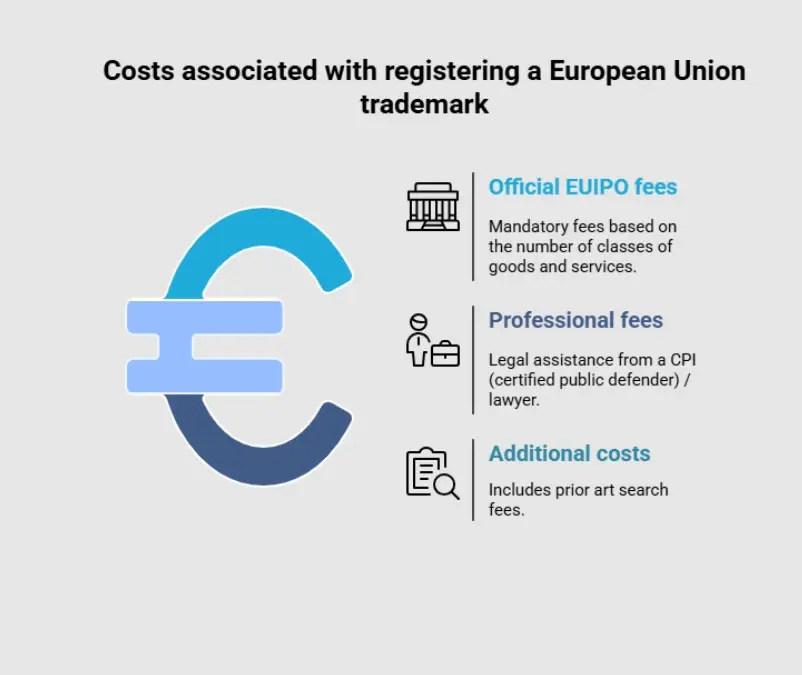
The next step is to determine the cost of registering a trademark with a lawyer or industrial property attorney. The cost of registration varies depending on the number of classes of goods and services designated. In addition, the fees of the lawyer or industrial property attorney must also be considered, as well as optional costs such as those related to prior art searches.
Application submission and registration
Once the registration cost has been determined, you will then need to file an application with the EUIPO (European Union Intellectual Property Office). This application must include all the necessary information about your trademark, the subject of the registration, such as the sign (word mark or logo) and the classes of goods and services designated. The EUIPO will then examine your application.
If there are no oppositions filed against the trademark application, the registration process, from the date of filing to official registration, generally takes around four to six months.
Once accepted by the EUIPO, the trademark will be officially registered for a period of 10 years and you will receive a registration certificate.
2025 Update: What you need to know about official taxes
To ensure that this article remains up to date, it is important to note that the official filing fees of the European Union Intellectual Property Office (EUIPO) are subject to annual adjustments. It is essential to check the official fee schedules directly on the EUIPO website at the time of filing each year.
For example, in 2024, the basic fees for a European Union trademark (EUTM) covering one class have generally remained stable compared to 2023, but an increase in agency fees and specialized prior art search fees should be anticipated.
The importance of using an Industrial Property Attorney remains unchanged, as this professional ensures that your application complies with current regulations and administrative practices of the EUIPO.
Conclusion
The cost of registering a European trademark with a lawyer or industrial property attorney is an important consideration for any company wishing to protect its trademark. Although the cost of registering a trademark may vary, it remains a necessary and significant investment in the protection of your intangible assets, guaranteeing you protection for a minimum of 10 years (a trademark can be renewed indefinitely).
Dreyfus & Associés assists its clients in managing complex intellectual property cases, offering personalized advice and comprehensive operational support for the complete protection of intellectual property.
Nathalie Dreyfus with the support of the entire Dreyfus team
FAQ
1. What is the European Union Intellectual Property Office?
The European Union Intellectual Property Office (EUIPO) is the entity responsible for registering European Union trademarks (EUTMs).
2. Is a prior art search mandatory before filing a trademark?
A prior art search is not strictly mandatory for filing a trademark with the EUIPO, but it is strongly recommended. It allows you to check whether an identical or similar trademark already exists and to assess the risks of opposition, thus avoiding unnecessary costs and procedures.
3. What rights does registering a European Union trademark with the EUIPO confer?
Registering a European Union Trademark (EUTM) with the EUIPO provides uniform protection in all current EU member states. The filing fees cover this pan-European protection.
4. How long is a European trademark valid for?
The registration of a European Union trademark (EUTM) is valid for a period of 10 years from the date of filing the application and is renewable indefinitely for periods of 10 years.
5. What is an opposition procedure and how does it affect the registration timeframe?
An opposition procedure is legal action brought by the owner of an earlier trademark who believes that your new trademark application infringes on their rights. If an opposition is filed, the registration timeframe can be significantly extended (often by more than a year) and requires the intervention of your attorney or industrial property attorney to reply to the opposition.