


Introduction
In the digital age, intellectual property litigation risk no longer arises only from obvious copying. It often develops much earlier: a trademark launched without clearance searches, third-party software or images used under misunderstood licences, work commissioned without an adequate IP assignment, uncontrolled use of generative AI, or confidential know-how uploaded to an external tool.
Clear intellectual property rights before launching a product or service
Conduct availability and clearance searches
A company can itself create litigation risk by adopting a sign, technology or content that conflicts with an earlier right.
Before selecting a new brand, businesses should therefore investigate not only earlier trademarks but also relevant company names, trade names, domain names and other potentially conflicting rights. A search limited to identical signs may provide false comfort: the INPI specifically highlights the relevance of visual, phonetic and conceptual similarities when assessing earlier marks.
Technology projects may similarly require patent and freedom-to-operate analysis. Websites, applications and marketing campaigns should be reviewed for third-party photographs, music, fonts, software, databases, interfaces and other licensed assets.
The relevant question is therefore not merely “What does the company own?”, but also “What is the company actually entitled to use?”
Do not confuse copyright protection with registration
Under French law, an eligible work is protected by copyright, provided the legal requirements for protection are satisfied, as a consequence of its creation. There is no general requirement imposed by the French Intellectual Property Code to register a work with a copyright office in order for French copyright to arise.
A “©” notice may be informative or deterrent, but it does not create the right. Evidence remains crucial, however. The INPI's e-Soleau service can establish the existence of deposited material at a particular date. It is an evidentiary mechanism, not an intellectual property title.
Secure the contractual chain with employees, contractors and partners
Establish exactly who owns each asset
Paying for a creation does not necessarily mean acquiring the underlying intellectual property rights.
This issue frequently arises where a business commissions a developer, agency, photographer or designer. Under French copyright rules, an assignment must identify the rights assigned and define the permitted scope of exploitation, including its extent, purpose, geographical scope and duration.
Employment also does not automatically transfer every copyright work created by an employee. Specific statutory regimes exist, however. In particular, subject to the applicable statutory conditions, economic rights in software created by an employee in the performance of their duties or following their employer's instructions vest in the employer.
Every significant project should therefore document the author, the owner, the contractual or statutory basis for ownership, and the exact uses that have been authorised.
Treat confidentiality as an operational requirement
An NDA is important, but confidentiality should not exist only on paper.
French trade-secret legislation requires, among other conditions, that protected information have actual or potential commercial value because it is secret and be subject to reasonable protective measures.
NDA clauses should therefore be supported by restricted access rights, document classifications, controlled external sharing, logging where appropriate, employee exit procedures and clear rules governing the use of external digital tools.
Control generative AI, open-source software and third-party digital content
Generative AI has added a new layer to IP risk. An employee may upload confidential source code to an external service, reproduce a client's protected document in a prompt, or commercially publish generated material without checking whether protected elements have been reproduced.
The French CNIL recommends that organisations adopt internal policies defining permitted and prohibited uses of generative AI, control the disclosure of confidential information and train users to review both inputs and outputs.
The EU AI Act also imposes copyright-related obligations on providers of general-purpose AI models, including the requirement to maintain a policy aimed at complying with EU copyright law. Those provider obligations do not replace the user company's own review of the way AI-generated output will ultimately be exploited.
The same discipline applies to open-source software. Open source does not mean free of legal conditions. Businesses should maintain an inventory of dependencies, versions and licences and assess the obligations attached to them before commercial deployment.
Build evidence and monitoring mechanisms before a dispute occurs
Effective IP management does not end when a trademark, patent or design is registered.
Businesses should maintain a reliable repository containing contracts, licences, successive versions of creative works, internal approvals, evidence of use, invoices and project documentation. Such records can be decisive when the provenance of an asset or the scope of an authorisation must be demonstrated quickly.
Monitoring trademarks, online marketplaces, platforms and domain-name registrations can also identify infringements before they become entrenched. The appropriate response can then be proportionate: preserve evidence, conduct a legal assessment, contact the operator, send a cease-and-desist letter, initiate an alternative dispute mechanism or commence court proceedings where necessary.
What are the four essential steps for preventing IP disputes?
An effective IP risk-management framework should:
- identify both company assets and third-party rights before products, services or campaigns are launched;
- secure ownership and licences contractually, including with employees, developers, agencies, designers and independent contractors;
- govern digital uses, particularly generative AI, open-source components, databases and licensed content;
- document and monitor rights, so that ownership, authorisation and earlier creation or use can be established efficiently.
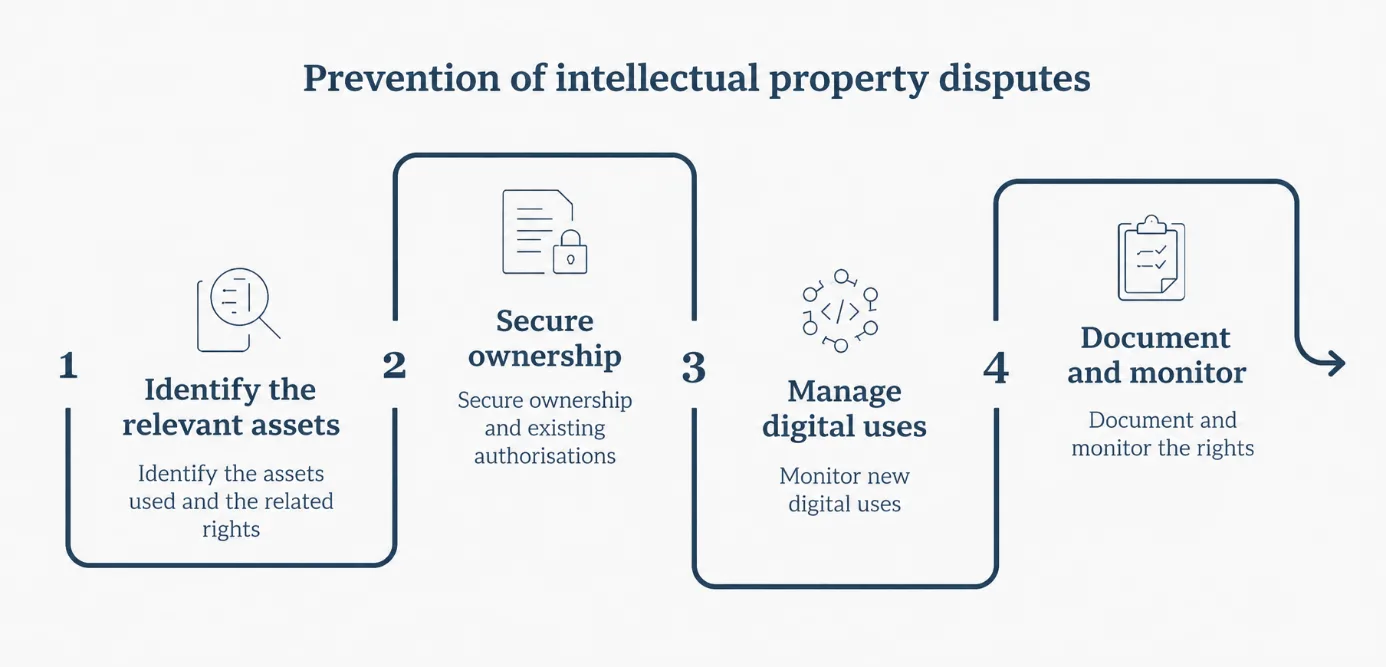
The objective is to make IP compliance a normal business process rather than an emergency response.
Conclusion
Reducing the risk of intellectual property litigation in the digital age requires moving legal review upstream: before a trademark is selected, before an external developer is retained, before third-party code is integrated and before AI-generated or AI-assisted material is released publicly.
Dreyfus Law Firm assists its clients in managing complex intellectual property cases, offering personalized advice and comprehensive operational support for the complete protection of intellectual property.
Nathalie Dreyfus with the support of the entire Dreyfus team
Q&A
Can an idea or concept be protected before it is commercialised?
An abstract idea is not protected as such. Once materialised, however, different forms of protection may become relevant: copyright for an original expression, patents for qualifying inventions, trademarks for distinctive signs and designs for product appearance. Before materialisation, confidentiality, contractual safeguards and reliable evidence of the project's development can be particularly important.
Does registering a domain name automatically protect the name as a trademark?
A domain-name registration does not, by itself, create an industrial property title. Domain names and trademarks are legally distinct. A domain name may, however, constitute a prior right under certain circumstances.
How long does a company have to bring an infringement action in France?
A five-year limitation period applies to a number of French IP infringement actions, including trademark, patent and design claims, generally by reference to when the right holder knew or should have known the relevant last fact enabling the action to be brought. The precise calculation remains dependent on the right and factual chronology concerned.
Is French intellectual property protection sufficient when a company expands internationally?
Industrial property rights are territorial. Businesses entering foreign markets should determine where their trademarks, patents or designs require protection. Trademark owners, for example, may use national, regional or international filing routes depending on their target markets.
What should a business do after receiving an IP infringement cease-and-desist letter?
The first priority is to preserve evidence and verify the rights relied upon, their ownership and validity, the allegedly infringing conduct and any applicable contracts or licences. An immediate admission or an unplanned alteration of evidence may complicate the response. The legal assessment should determine whether the appropriate strategy is to contest the claim, remedy the position, negotiate, enter into a licence or coexistence agreement, or defend formal proceedings.
This publication is intended for general public guidance and to highlight issues. It is not intended to apply to specific circumstances or to constitute legal advice.