

Sommaire
Introduction
Creating a trademark, whether a name and/or a logo, is often a pivotal moment in the development of a business. However, before initiating a formal filing with the French IP Office (INPI) or any comparable authority, it is essential to verify that the proposed sign is available and does not conflict with earlier rights. This is precisely the purpose of a prior art search: an essential step to anticipate legal risks, safeguard your investments, and build a sustainable trademark strategy.
What Is a trademark prior art search?
Filing a trademark grants, under trademark law, an exclusive right to use the sign for specific goods and services.
However, such registration requires that the chosen sign be distinctive and available: it must not infringe any pre-existing rights (trademarks, company names, trade names, business names, domain names, etc.).
A prior art search is therefore the preliminary verification used to identify such earlier rights before filing.
Several types of searches may be necessary:
- Exact-match search: identifies signs that are strictly identical (same spelling, same logo, same classes of goods/services) to the one you intend to file.
- Similarity search (phonetic, visual, conceptual): a deeper examination to detect signs that are close enough to trigger a likelihood of confusion. This level is particularly critical for assessing risks of opposition, invalidity, or infringement.
Thus, the absence of identical trademarks is not sufficient: similarity must also be assessed to identify potential risks.
How to conduct an effective prior art search?
Recommended tools and databases
To perform a thorough search, it is advisable to use:
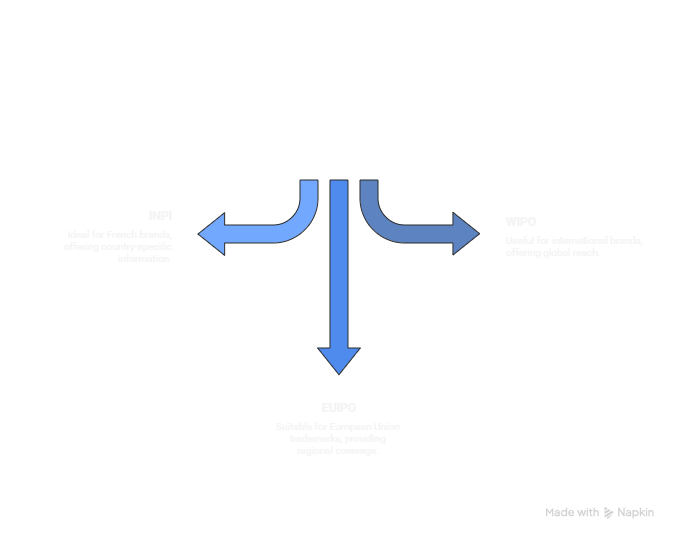
- The INPI “Marques” database for French trademarks.
- The EUIPO database for EU trademarks and the WIPO database for international trademarks.
- Professional services (IP attorneys, law firms) when a similarity analysis is required.
Relying solely on a general-purpose search engine is strongly discouraged.
Legal analysis: beyond simple automated searches
A truly useful prior art search requires professional legal analysis:
- Assessment of the likelihood of confusion based on phonetic, visual or conceptual criteria, and the perception of the relevant public.
- Examination of the goods and services covered, in accordance with the principle of specialty.
- Consideration of other rights beyond trademarks: company names, trade names, domain names, business names, etc.
- Verification of the actual use of the earlier sign (reputation, age, geographical scope), which may affect the assessment of the risk.
This work demands legal expertise, making the involvement of an IP attorney or trademark attorney highly advisable.
When and by whom should the search be conducted?
- When?: Before any filing. It should be carried out as soon as the name, trade name, domain name, or logo is being conceived.
- By whom?: The applicant may perform preliminary checks, but a professional (IP attorney or specialist lawyer) is strongly recommended for a reliable, risk-based interpretation.
Legal and strategic implications of a prior art search
Securing registration and avoiding opposition or invalidation
Without a prior search, filing a trademark may lead to:
- Opposition by the holder of earlier rights after publication,
- Invalidation proceedings years after registration if the trademark is deemed too similar to an earlier sign,
- Infringement proceedings if the trademark is used commercially.
For instance, in the Huella case of May 7, 2025, the application for a trademark covering leather goods (Class 18) was refused due to the presence of an earlier trademark protected for cosmetics (Class 3). More details can be found on this case in our previously published article.
Thus, a prior art search is the first line of defence in securing the validity and long-term enforceability of your trademark.
Protecting investments and trademark reputation
Trademark development often involves substantial investments: branding, marketing, packaging, communication, digital presence, etc.
A conflict arising after launch may result in refusal of registration, forced withdrawal, or a complete rebrand, each carrying significant financial, logistical and reputational consequences.
A prior art search protects the business against these risks by providing a stable and secure framework from the outset.
Structuring a strategic trademark portfolio
Beyond a simple verification exercise, a prior art search helps to build a smart filing strategy. The applicant is advised to:
- Identify priority or defensive classes based on current or future activities,
- Adjust the sign (spelling, logo, wording) to maximise distinctiveness,
- Consider complementary filings (domain names, trade names, company names) to strengthen market presence,
- Prepare for future monitoring to detect potentially conflicting new filings.
A comprehensive search is therefore not merely a compliance measure but a genuine strategic tool for managing intangible assets.
Conclusion
A prior art search is the cornerstone of any effective trademark protection strategy. It allows businesses to anticipate legal risks (opposition, invalidity, infringement), safeguard investments, establish a strong trademark reputation, and develop a coherent trademark portfolio. Neglecting this step exposes the company to significant financial and reputational consequences that can be difficult to remedy.
We strongly encourage every entrepreneur, start-up, and established company to incorporate this process into their trademark development strategy, ideally with the support of an experienced professional.
Dreyfus & Associés assists its clients in managing complex intellectual property cases, offering personalized advice and comprehensive operational support for the complete protection of intellectual property.
Nathalie Dreyfus with the support of the entire Dreyfus team
Q&A
1. Is a prior art search legally required before filing a trademark?
No. It is not a statutory requirement, but it is essential in practice because it determines whether earlier rights could block registration or restrict the use of your trademark.
2. Why is a simple Google search insufficient to verify availability?
Many earlier rights are not visible through search engines. Only official databases (INPI, EUIPO, WIPO, domain name registries) reveal registered rights, and only legal analysis can assess the likelihood of confusion.
3. Should I check only trademarks, or also domain names and company names?
A complete search should include domain names, company names, trade names and business names, as these rights can also be invoked, especially when they are well-known.
4. Does a prior art search guarantee the absence of future conflicts?
It significantly reduces the risk but cannot provide absolute certainty. New filings may still arise after the search, which is why ongoing monitoring is recommended.
5. Does a prior art search guarantee that my trademark will be registered?
No search can guarantee registration. The outcome depends on the applicant’s strategic choices, the behaviour of holders of earlier rights and subsequent filings. A combined strategy (search + filing + monitoring) provides the highest level of security.
This publication is intended for general public guidance and to highlight issues. It is not intended to apply to specific circumstances or to constitute legal advice.