

Introduction
Filing an opposition against a European Union Trademark (EUTM) application without holding a registered prior right may appear intuitive where a sign has been used for several years. In practice, however, acting without an enforceable title is often a legally fragile and economically risky strategy.
In a context of increasing filings before the EUIPO and intensified competition among European market players, it is essential to assess the strength of one’s rights before taking action. A poorly grounded opposition may not only fail but also weaken a company’s strategic position.
The legal framework for opposing an EU trademark
Regulation (EU) 2017/1001 on the European Union Trademark (EUTMR) provides that an opposition must be based on a prior right valid within the European Union.
Such prior rights may include in particular:
- a national trademark registered in a Member State;
- an earlier European Union trademark;
- an international registration designating the EU;
- a well-known trademark within the meaning of the Paris Convention.
In the absence of such a right, an opposition is, in principle, bound to fail.
Contrary to common belief, mere commercial use of a sign in several Member States is not sufficient. The EU system is built upon the legal certainty attached to registration.
Earlier unregistered use: limited and strictly regulated protection
The exception under article 8(4) EUTMR: a narrow path
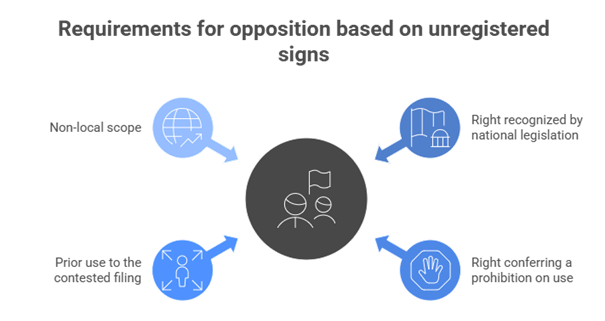
There is a limited exception. Article 8(4) EUTMR allows an opposition to be based on a non-registered sign used in the course of trade, provided that:
- the right is recognised under the national law of a Member State;
- that right entitles its holder to prohibit use of the later trademark;
- the use predates the contested filing;
- the sign is of more than mere local significance.
There is no EU-wide “unregistered European trademark.” The assessment must be conducted country by country.
A demanding evidentiary burden
In practice, the EUIPO requires substantial evidence, such as:
- dated invoices and contracts;
- detailed turnover figures;
- documented advertising campaigns;
- media coverage;
- proof of geographic market presence.
EU case law confirms that the burden of proof is heavy and the interpretation strict. For example, in a decision of July 9, 2010 (T-430/08), concerning the company name “Grain Millers GmbH & Co. KG,” invoked for flour products in Germany, it was argued that the company could not rely on its trade name.
The General Court of the European Union held, however, that under German law, pursuant to Article 5(2) of the Markengesetz, rights in a trade name arise from its first use in the course of trade, without the need for formal registration.
Procedural and strategic risks of opposing without prior rights
A high risk of rejection
A poorly founded opposition may result in:
- loss of official opposition fees;
- legal costs;
- a possible order to bear the other party’s costs;
- loss of strategic credibility.
Furthermore, a rejection decision may be used by the applicant to strengthen its commercial position.
A boomerang effect on trademark strategy
Acting without registered rights often reveals a structural weakness: lack of anticipation in protection strategy.
This may:
- encourage third parties to file similar signs;
- weaken the company’s position in negotiations;
- expose it to counterclaims.
In some cases, an unsuccessful opposition may even prompt the applicant to initiate infringement proceedings once registration is granted.
Alternatives and effective strategies to secure your position
1. Prompt filing of a national or EU trademark
If the contested application is still under examination, a coordinated strategy may be considered. However, a later filing does not allow action against an earlier application.
2. Subsequent invalidity action
Once the trademark is registered, an invalidity action may be appropriate, particularly if based on:
- a demonstrable prior right;
- the applicant’s bad faith (Article 59 EUTMR);
- infringement of a personality right or recognised trade name.
3. Strategic negotiation
In many cases, a transactional approach is more effective than a fragile opposition.
A well-reasoned cease-and-desist letter may assert the rights relied upon, outline the risks incurred, and open the door to an amicable solution: withdrawal of the application, limitation of goods and services, or a coexistence agreement.
This strategy often produces faster, more controlled and less costly results than formal EUIPO proceedings.
4. Preventive portfolio management
We systematically recommend:
- Conducting regular audits of signs in use;
- Filing defensive applications;
- Implementing EUIPO monitoring;
- Defining a coordinated multi-jurisdictional strategy.
Conclusion
Taking action against a European Union trademark application without a registered prior right is rarely a winning strategy.
Before filing any opposition, a thorough legal assessment is essential. Holding a solid prior right remains the cornerstone of any effective action.
Dreyfus & Associés assists its clients in managing complex intellectual property cases, offering personalized advice and comprehensive operational support for the complete protection of intellectual property.
Nathalie Dreyfus with the support of the entire Dreyfus team
FAQ
1. What is the difference between an opposition and an invalidity action?
An opposition is filed during the examination phase of a trademark application and aims to prevent registration based on prior rights. An invalidity action is brought after registration and seeks retroactive cancellation of the trademark, based on relative grounds (prior rights, bad faith) or absolute grounds (lack of distinctiveness, public policy, etc.).
2. Is prior use of a trade name sufficient?
Only if the applicable national law allows the holder to prohibit use of a later trademark and if the sign is of more than mere local significance.
3. Can bad faith be invoked without holding a formal prior right?
Yes. Bad faith may be relied upon, particularly in invalidity proceedings, even without a registered trademark. However, evidence must demonstrate an intention to harm or unfairly appropriate the value of an existing sign.
4. Is there an EU-wide “unregistered European trademark”?
No. There is no unitary protection for an unregistered trademark across the European Union. Only certain national laws recognise non-registered signs under strict and territorially limited conditions.
5. Can a domain name used for several years constitute an enforceable prior right?
Yes, but only if it is recognised as a distinctive sign protected under applicable national law and if it entitles its holder to prohibit use of a later trademark. Mere use is insufficient; it must be substantial, prior and legally enforceable.
This publication is intended to provide general guidance and to highlight certain legal issues. It is not intended to apply to specific situations or to constitute legal advice.