

Sommaire
Introduction
Filing a trademark in the United States is an essential step for any business seeking to secure its growth in the world’s largest market. However, the U.S. system differs significantly from the French or European model: in the United States, trademark rights are fundamentally based on actual use in commerce. Unlike in the European Union, where registration alone creates a right, U.S. law requires that the trademark be genuinely used in interstate commercial activity.
For a foreign entrepreneur who has not yet launched products or services in the United States, this requirement may constitute a major obstacle. It is precisely to address this need that the USPTO created the Intent-to-Use (ITU) mechanism. This system allows a trademark to be filed even before it is used, provided that the applicant has a bona fide intention to use it in the near future. It is a particularly strategic tool, offering the ability to secure a sign, obtain a priority date, and prepare for an orderly entry into the U.S. market.
In this article, we present a rigorous and detailed explanation of the mechanics, steps, advantages and risks associated with this framework. Our aim is to support French and European companies in building a robust trademark strategy that complies with U.S. requirements.
Understanding the “intent-to-use” basis in the United States
The Intent-to-Use system is built on a simple yet decisive principle: allowing an applicant to reserve a trademark that has not yet been used, while maintaining the historical connection between use and protection. Unlike filings made in France before the INPI or before the EUIPO, the USPTO does not immediately register a trademark filed under an ITU basis. It will only be registered once use is demonstrated.
This approach aims to prevent speculative filings while allowing foreign companies to anticipate their market entry. In other words, the U.S. legislator seeks to encourage genuine, well-founded projects and discourage filings made for convenience. For this reason, the declaration of intent must be specific, sincere, and well-founded: a purely theoretical intention is insufficient.
The filing bases available before the USPTO include use in commerce (Section 1(a)), intent to use (Section 1(b)), and filings based on foreign rights. For foreign companies preparing entry into the U.S. market, the ITU basis remains the most commonly used mechanism.
The full process of an Intent-to-Use application
Initial filing
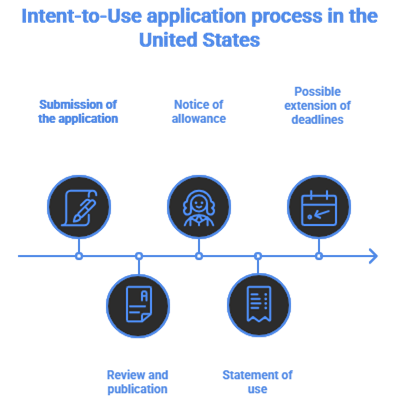
The applicant submits its trademark application to the USPTO under Section 1(b). At this stage, no proof of use is required, but the applicant must declare under oath that it has a real and bona fide intention to launch its products or services in the United States in the short or medium term. This declaration carries legal consequences.
Examination and publication
Once filed, the application undergoes the standard examination process: assessment of distinctiveness, analysis of potential conflicts, and review of the goods and services description. If no objections are raised, the application is published in the USPTO’s Official Gazette. Third parties then have an opposition period during which they may challenge the registration on the basis of prior rights or likelihood of confusion.
Notice of Allowance (NOA)
After publication and in the absence of opposition, the USPTO issues a Notice of Allowance. This step confirms that the trademark may proceed to registration once proof of use is provided. The trademark is therefore not yet registered, but it is accepted in principle.
Statement of Use (SOU)
The applicant has an initial six-month period to file a Statement of Use, accompanied by a specimen demonstrating commercial use. This proof may take the form of a photograph of the product, a screenshot of an online sales page, packaging, invoices, or any document showing actual use in interstate commerce.
If use began before issuance of the NOA, it is possible to submit an Amendment to Allege Use, allowing the registration process to be accelerated.
Extensions of time
If the company has not yet begun use, it may request up to five successive six-month extensions. In total, the applicant has a maximum of three years from the NOA to submit proof of use. Otherwise, the application will be abandoned and the priority date lost.
Strategic considerations for French and European companies
The Intent-to-Use mechanism is a major strategic tool. It allows applicants to secure a crucial priority date in sectors where filings proliferate, such as cosmetics, fashion, technology or wellness. For a European company in an expansion phase, an ITU filing provides the necessary time to plan a commercial launch without risking being overtaken by a local competitor.
However, this flexibility requires strict discipline. An undocumented intention to use may be challenged, particularly in the context of an opposition or a cancellation action. Likewise, insufficient or weakly substantiated use may result in invalidation of the registration.
We strongly recommend retaining documents that demonstrate preparation for use: market studies, exchanges with U.S. distributors, prototypes, pre-orders, or advertising developments. These elements reinforce the credibility of the original intention.
Finally, once the trademark is registered, the obligation to use it continues. The owner must file periodic maintenance declarations to preserve its rights, failing which the registration may be cancelled.
Conclusion
The Intent-to-Use system offers a particularly valuable strategic framework for foreign companies, provided it is used with rigor and caution. This mechanism enables applicants to secure priority, anticipate entry into the U.S. market, and prepare for a commercial launch in optimal conditions. However, it also imposes strict deadlines, close monitoring of use, and ongoing vigilance.
Dreyfus & Associés assists its clients in managing complex intellectual property cases, offering personalized advice and comprehensive operational support for the complete protection of intellectual property.
Nathalie Dreyfus with the support of the entire Dreyfus team
Q&A
1. Does an Intent-to-Use filing provide immediate protection against counterfeiting?
It grants a priority date, but full protection arises only upon registration.
2. Is the U.S. system compatible with a European filing?
Yes. Coordinating both strategies is recommended to harmonise priority claims and use requirements.
3. What types of documents constitute valid proof of use?
Product photographs, packaging, sales pages, invoices, screenshots, or labels.
4. Is a simple publication on a website sufficient?
No. Use must occur in interstate or international commerce.
5. Can the goods and services be amended after filing?
Substantive modifications are prohibited; only clarifications of the wording are allowed.
This publication is intended to provide general guidance to the public and to highlight certain issues. It is not intended to apply to specific situations nor to constitute legal advice.