

Introduction
In December 2009, the new Montenegrin regulation applicable to .me domain names entered into force, entitled Regulation on Procedures for the Registration and Use of Domain Names under the National .ME Domain. This regulation paved the way for the introduction of an arbitration mechanism in addition to theUDRP (Uniform Domain-Name Dispute Resolution Policy), which had until then been the preferred means of resolving disputes relating to this extension.
This arbitration mechanism represents a structural development in the domain name dispute resolution framework, as it now makes it possible to address more complex situations that go beyond the strict scope of cybersquatting, and to integrate contractual, commercial, or strategic issues closely linked to contemporary domain name use.
The legal and institutional framework of the .me domain
From its launch in 2007, the .me extension enjoyed immediate and unparalleled success. Although formally attached to Montenegro, it quickly established itself as an extension with a clear international vocation, with more than 320,000 domain names registered within just a few months, an unprecedented pace for a ccTLD and a clear indication of its attractiveness to economic players and trademark owners worldwide.
The .me is a ccTLD operated in accordance with international standards, while remaining subject to Montenegrin law. This hybrid nature explains the early integration of the UDRP and the gradual opening to complementary national mechanisms.
The UDRP procedure as applied to .me domain names
The UDRP and arbitration are not mutually exclusive. They serve distinct yet complementary purposes, offering rights holders a broader strategic range. While the UDRP is often described as a form of arbitration, it is in fact a specific extrajudicial administrative procedure.
The UDRP is characterized by a deliberately narrow scope, limited to situations of manifest abuse, based on strictly defined criteria, and leading exclusively to technical remedies, namely the transfer or cancellation of the disputed domain name. It does not produce res judicata effects, as state courts remain competent in all circumstances. The procedure remains particularly well suited to cases of clear bad faith, but it shows its limits when confronted with complex contractual or commercial disputes.
For further information on the UDRP framework, readers are invited to consult our previously published guide.
The arbitration procedure applicable to .me domain names
The Montenegrin regulation governing .me domain names provides for the implementation of an autonomous arbitration mechanism, distinct from the UDRP procedure. The coexistence of these two dispute resolution avenues requires prior strategic reflection, based on the nature of the dispute, the economic interests at stake, and the legal effect sought.
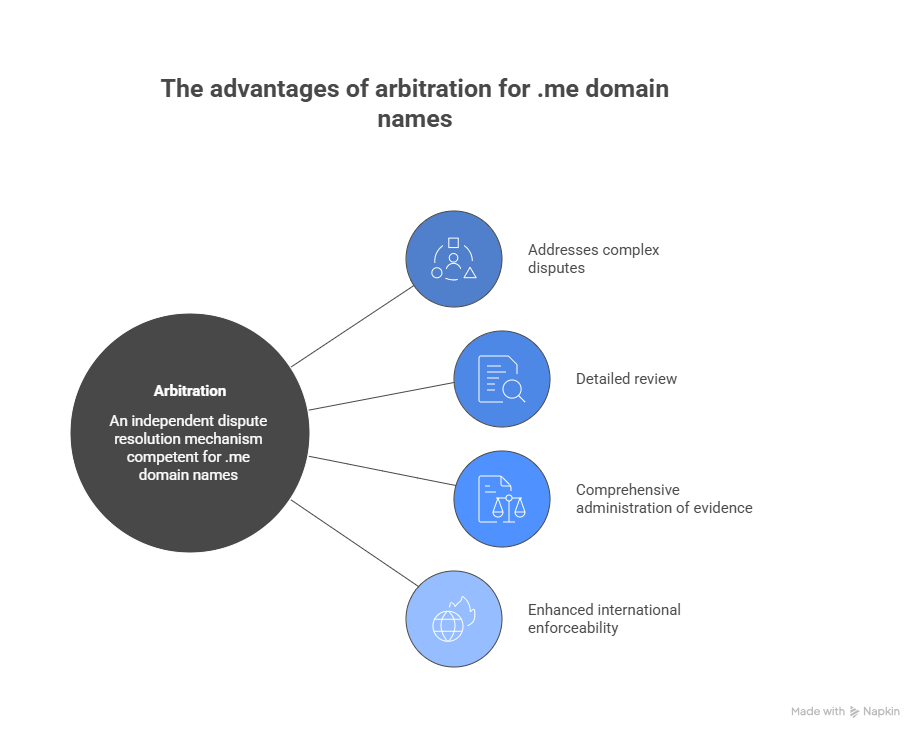
Fully falling within the scope of arbitration law, this mechanism is based on the existence of an arbitration agreement, whether express or implied. It is distinguished by its ability to address complex disputes involving contractual, commercial, or competitive elements, whereas the UDRP remains confined to cases of abusive registration and use of domain names, in particular cybersquatting. The procedure allows for in-depth examination, extensive administration of evidence, and results in an arbitral award capable of recognition and enforcement at the international level, notably under the New York Convention.
For trademark owners, arbitration therefore constitutes a complementary tool with significant strategic value. It offers a more flexible and structured dispute resolution framework when the domain name forms part of an existing business relationship, while ensuring a comprehensive assessment of the dispute and a decision with enhanced legal force.
Conclusion
The introduction of arbitration for .me domain names, alongside the UDRP procedure in Montenegro, significantly strengthens the enforcement tools available to rights holders. It allows the legal response to be tailored to the increasing complexity of domain name uses.
Dreyfus & Associés law firm assists its clients in designing bespoke strategies that integrate all available mechanisms for resolving digital disputes.
Nathalie Dreyfus, with the support of the entire Dreyfus team.
Q&A
1. Does arbitration allow remedies other than the transfer or cancellation of the domain name ?
Yes. Unlike the UDRP, arbitration may, depending on the applicable framework, address broader claims, such as contractual obligations, corrective measures, or future commitments between the parties.
2. Is arbitration riskier for a trademark owner than the UDRP procedure ?
Arbitration is not riskier, but it is more demanding. It requires thorough legal preparation, strong factual arguments, and a clear strategic vision, whereas the UDRP is based on strict and limited criteria.
3. Can one freely choose between the UDRP procedure and arbitration for a .me dispute ?
Yes, in most cases. The choice depends on the nature of the dispute, the objectives pursued, and the respondent’s profile. Prior analysis is essential to avoid an inappropriate or ineffective procedure.
4. Is arbitration confidential, unlike the UDRP procedure ?
Yes. Confidentiality is one of the major advantages of arbitration, particularly valued by companies seeking to avoid public exposure of sensitive or strategic disputes.
5. Is arbitration suitable for disputes involving international groups ?
Absolutely. Arbitration offers procedural, linguistic, and legal flexibility, making it particularly well suited to international groups operating across multiple markets and facing cross-border issues.
This publication is intended for general public guidance and to highlight issues. It is not intended to apply to specific circumstances or to constitute legal advice.