

Sommaire
Introduction
The Uniform Rapid Suspension (URS) procedure is particularly effective when the primary goal is to stop a clear trademark infringement quickly through a domain name, without initiating a heavier procedure aimed at transferring the domain. It complements the UDRP by offering a faster and generally less expensive route, but with a deliberately limited remedy: suspension (not recovery) of the domain name.
URS: what the procedure can do (and what it cannot)
The promise: fast suspension, no transfer
URS allows a trademark owner to file a complaint for infringement of its rights, leading to the temporary suspension of the disputed domain name without any transfer of ownership. The suspension remains in place until the end of the registration period, after which the domain name is expected to become available again.
Strategic implication: URS is ideal when the priority is to stop a fraud or abusive use, rather than to recover a digital asset.
The standard: a procedure reserved for “clear-cut” cases
URS is designed for the most obvious infringements. It is not comfortable territory where the file involves a serious factual or legal dispute (plausible competing rights, potentially descriptive use, broader commercial dispute). This approach is expressly supported by ICANN: URS is intended as a fast-track mechanism for clear cases.
The three elements to prove (the “three-part test”)
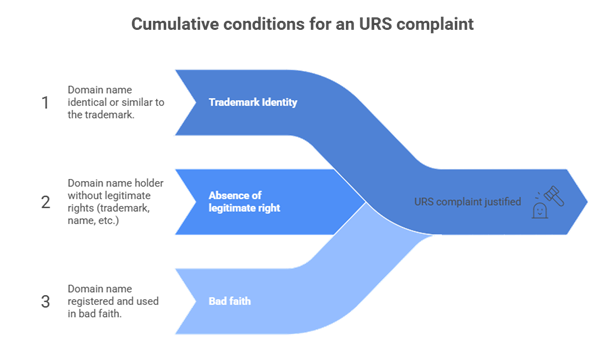
To succeed in an URS complaint, the complainant must establish three cumulative elements:
- The domain name is identical or confusingly similar to a word trademark or figurative trademark owned by the complainant (a valid national/regional registration in current use, or judicially validated), and the complainant must be able to prove both the registration and the use;
- The domain name holder has no legitimate right or interest;
- The domain name was registered and is being used in bad faith.
Which Top-Level Domains (TLDs) are eligible for URS?
Before recommending URS, it is essential to verify the eligibility of the relevant extension, as URS is not intended to apply indiscriminately to all TLDs. As a rule, URS was designed for the new gTLDs introduced under the ICANN program, meaning it primarily applies to domain names registered under those new extensions. Conversely, for legacy gTLDs (for example, .com, .net, or .org), URS is not automatically available and the “standard” route generally remains the UDRP.
There are, however, specific cases: certain so-called “legacy” extensions have incorporated URS following amendments or renewals of their Registry Agreement, so that an extension historically “outside URS” may become eligible depending on the applicable framework. In practice, the most robust approach is therefore to confirm, on a TLD-by-TLD basis, whether URS is available, and then to choose between URS and UDRP depending on the objective pursued (rapid neutralization or transfer).
When URS is strategically better than the UDRP
1) Phishing, fake shop, impersonation: neutralization comes first
When the domain name is used for fraud (phishing, payment pages, a fake store replicating the trademark, misleading redirects), the economic priority is often to stop the abuse before anything else. In this context, URS is strategic because it specifically targets obvious abuse and can lead to rapid suspension.
2) Short-window campaigns: sales, launches, events
Where infringement is opportunistic (Black Friday, holiday season, product launches, influencer-driven campaigns), the key issue is not the ownership of the domain name but the loss of revenue and consumer confusion over a short time frame. URS is then a proportionate response: fast, tailored to obvious cases, and compatible with a multi-channel enforcement strategy.
3) Volume: “cloned” series of registrations (same pattern, same actor)
URS is also relevant where multiple domains follow the same abusive pattern: trademark + generic term, typos, geographic variants, or multiple extensions. Providers offer fee schedules adapted to volume, which can make URS economically rational in “anti-raid” operations.
4) When transfer offers no immediate value
If the domain name has no real portfolio value (no marketing value, no “clean” traffic, no portfolio coherence), pursuing a transfer under the UDRP may be disproportionate. URS allows us to cut the abuse and let the domain expire, with a possible one-year extension if needed.
Limitations: when URS is not the right tool
1) Where recovering the domain name is a business issue
URS does not transfer ownership. If the domain name is strategic (trademark + core business term, product name, recurring campaign name), the UDRP (or a national procedure) is more suitable, as it can result in a transfer.
2) Where there is a serious dispute
URS is designed to exclude “debatable” situations. If a potentially legitimate use exists (criticism site, parody, descriptive use, plausible prior rights, contractual dispute), the URS complaint may be denied, as the examiner must reject the complaint whenever a substantial factual dispute arises.
3) Where evidence of trademark use is weak
URS requires a clean file (rights, use, bad faith, lack of legitimate interest). Operationally, the procedure is strict and leaves little room to “fix” weaknesses afterwards: an incomplete or poorly structured filing can significantly undermine the case.
Conclusion
URS is a strategic route when a rapid response is required, focused on neutralizing a clear infringement, on an eligible TLD, with an evidentiary record capable of meeting the clear and convincing evidence standard. Conversely, as soon as the goal is to recover the domain name, or where a serious dispute is foreseeable, the UDRP (or a targeted court action) becomes the natural option again.
It is also advisable to strengthen your upstream framework through an integrated strategy combining targeted filings for key signs, continuous monitoring of risky registrations and content, and a graduated response depending on urgency (notice, takedown requests to intermediaries, then URS or UDRP where suspension or transfer is required).
Dreyfus & Associés assists its clients in managing complex intellectual property cases, offering personalized advice and comprehensive operational support for the complete protection of intellectual property.
Nathalie Dreyfus with the support of the entire Dreyfus team
Q&A
1. What is the deadline to respond to an URS complaint?
In principle, the respondent has 14 calendar days to file a response.
2. What level of proof does URS require?
The complainant must prove its case by clear and convincing evidence and show that there is no substantial factual dispute.
3. How much does an URS proceeding cost?
Costs depend on the provider and the number of domain names involved. By way of indication, centers such as Forum, ADNDRC, and MFSD publish fee schedules: for a straightforward case (1 domain), fees usually start at a few hundred, then increase by tiers or with an additional per-domain fee.
4. Is there an appeal mechanism under URS?
Review/appeal mechanisms exist under the URS rules and the provider’s supplemental rules (deadlines, fees, conditions).
5. In which cases is URS not recommended?
Where the objective is transfer, or where the case raises serious factual or legal issues (potentially legitimate use, credible competing rights).
This publication is intended for general public guidance and to highlight issues. It is not intended to apply to specific circumstances or to constitute legal advice.