


Sommaire
Introduction
The protection of a design relies less on creative intuition than on the rigorous mastery of the technical requirements applicable to filing. In practice, many rights that are nevertheless strategic prove to be fragile, or even unenforceable, due to errors made at the stage of graphical formalisation. In a context of increased competition and frequent litigation, the technical quality of the filing directly determines the scope and effectiveness of legal protection.
We set out below the essential technical recommendations to be followed in order to secure a design filing, both under French and European law, adopting a pragmatic approach focused on evidence and enforceability of rights.
Understanding the central role of graphical representation in the protection of designs
Graphical representation as the sole scope of protection
In design law, only what is represented is protected. Neither creative intent, nor function, nor textual description can compensate for a deficient representation. Design offices, whether the INPI or the EUIPO, assess novelty and individual character exclusively on the basis of the filed visuals.
An imprecise, overloaded or ambiguous representation mechanically results in a reduction of the scope of protection, or even increased vulnerability in the event of cancellation action.
Fundamental technical requirements to be respected
The visuals must comply with strict standards, both in substance and in form. In particular, we recommend:
- Clear images, without parasitic shading or reflections;
- A neutral, uniform or white background, without any decorative elements;
- A complete absence of textual elements, logos or measurements;
- Perfect consistency between the different views.
In addition, where the design comprises several elements, each element must be represented separately, while also being shown as part of the overall product, in order to allow a clear understanding of the global appearance as well as of each component taken individually.
Structuring views and variants to control the scope of protection
Multiplying views without diluting protection
An effective filing is based on a balance between exhaustiveness and readability. The views must make it possible to fully understand the appearance of the product, without introducing contradictions. In practice, the following views are generally recommended:
- Front and rear views;
- Right profile and left profile views,
- Top and bottom views;
- A perspective view.
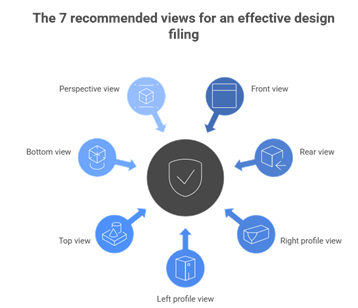
Any inconsistency between these views may be exploited by a third party to challenge the scope of the right, particularly in infringement proceedings.
Managing variants and options strategically
Where the product includes variants (alternative shapes, interchangeable patterns, removable elements), several strategies may be considered.
Either the variants may be included in a coherent multiple filing, or separate design filings may be made. Poor management of variants exposes the right holder to a double risk: overly narrow protection, or conversely, partial cancellation for lack of novelty.
Anticipating office technical requirements and litigation risks
Neutralising non-claimed elements
In order to precisely delimit the scope of protection and exclude visible but non-claimed elements, offices allow the use of several graphical neutralisation techniques, provided they are applied clearly, consistently and without ambiguity.
- Broken lines: the reference technique for explicitly excluding visible but non-claimed elements, in particular functional or standardised parts.
- Dotted lines: an accepted alternative for clearly indicating excluded elements, provided they are applied uniformly across all views.
- Distinct colour treatment: a technique used to visually differentiate claimed elements from neutral elements, provided that the protected scope remains immediately identifiable.
- Voluntary blurring effect: a method enabling the neutralisation of secondary elements without removing them entirely from the representation.
- With boundaries: a technique aimed at precisely delineating the claimed parts by contrast with the surrounding visual environment.
The use of these techniques must form part of a homogeneous and anticipated graphical strategy, as imprecise or inconsistent neutralisation may weaken the validity of the design and its effectiveness in litigation.
Avoiding any confusion with technical function
A design must never give the impression of protecting a technical solution. Shapes dictated exclusively by function are excluded from protection. An inappropriate representation may lead the office or the court to consider that the appearance is dictated by technical constraints, resulting in invalidity.
We therefore recommend a prior cross-analysis between design law, patent law and competition law, in order to properly guide the filing strategy.
Conclusion
A legally effective design filing is based on a technical, strategic and anticipatory approach. The quality of the representations determines the strength of the right, its economic value and its ability to withstand litigation.
Mastering the technical recommendations applicable to design filings makes it possible to transform an aesthetic creation into a robust and enforceable legal asset. Such rigour is now essential to secure innovation, enhance portfolio value and prevent disputes.
Dreyfus & Associés assists its clients in managing complex intellectual property cases, offering personalized advice and comprehensive operational support for the complete protection of intellectual property.
Nathalie Dreyfus with the support of the entire Dreyfus team
FAQ
1. How many views are recommended when filing a design?
As many as necessary to understand the complete appearance, without unnecessary redundancy, within a limit of ten views per filing. In this respect, seven views are taken into account for protection, while up to three additional views may be included without extending the scope of protection.
2. What is the purpose of filing ten views if only seven are taken into account for protection?
Additional views facilitate a global understanding of the design by illustrating certain angles, details or specific configurations that cannot be fully perceived through the protected views alone. These supplementary views play a pedagogical and interpretative role, assisting the office or the judge in assessing the overall appearance.
3. Must colours be filed?
Only where they contribute to the claimed overall impression.
4. Can a poor representation invalidate a design?
Yes, in particular where there is ambiguity or contradiction between the views.
5. Should the filing be adapted depending on the country?
Yes, certain formal and practical requirements vary between offices.
6. Is a technical drawing sufficient?
No, it must reflect appearance, not function.
This publication is intended to provide general guidance to the public and to highlight certain issues. It is not intended to apply to specific situations or to constitute legal advice.