

Sommaire
Introduction
In the contemporary sports economy, performance alone is no longer enough to create sustainable value. Media visibility, presence on social networks, the ability to unite a community and attract business partners are now essential levers. In this context, the possession of trademarks by athletes is an essential legal and strategic tool. It allows to transform a notoriety, by nature volatile, into a structured intangible asset, secure and exploitable, in the service of a long-term patrimonial and entrepreneurial strategy.
The trademark, a key asset for athletes
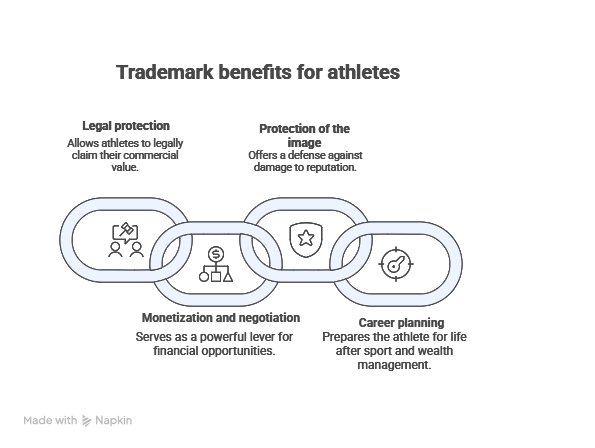
The trademark confers on its owner an exclusive right of use over a distinctive sign for specific goods and services. For an athlete, this right presents a major interest: it allows to legally appropriate its commercial value, regardless of its sporty performances.
In a highly competitive and globalized environment, the trademark plays a structuring role. It provides a clear legal framework, enforceable against third parties, and facilitates the defense actions against unauthorized uses such as counterfeiting or parasitism. In the absence of a deposit, an athlete exposes himself to significant risks, particularly in systems based on the principle of “first to file”, where third parties can legally appropriate a name, a pseudonym or a sign that has become famous. This is notably the case of Neymar, whose name was registered as a trademark by a third party (TEU, 14 May 2019; T 795/17). The athlete had the possibility to contest the validity of the trademark, subject to the assessment of the INPI or the judges, in particular by invoking the bad faith of the registrant who exploits the name of a third party for his personal benefit. On the other hand, this means having to initiate trademark cancellation proceedings, which in turn has a financial and temporal cost.
The variety of signs eligible for trademark protection
Contrary to a generally accepted idea, the trademark of an athlete is not limited to their patronymic name. Depending on the case, can be protected:
• The civil noun, when it has distinctive character;
• A sports pseudonym or nickname recognized by the public;
• A logo or stylized signature;
• A slogan, motto or phrase associated with the athlete;
The deposit must however be carefully prepared. Not all signs are automatically protectable, and a prior legal analysis is essential to assess the distinctiveness, the possible presence of earlier trademarks and consistency with the commercial objectives of the athlete.
The trademark as a monetization and negotiation lever
The holding of trademarks considerably strengthens the position of the athlete in his contractual relations. In sponsorship, equipment or partnership agreements, the question of ownership of the used signs is central. An athlete who masters its trademarks retains increased bargaining power and avoids permanent transfers or excessive dependencies towards economic partners.
Trademarks are also the foundation of diversified monetisation strategies. They allow for the development of licensing, merchandising, co-branding, or even the creation of product and service ranges. In a structured framework, the trademark becomes an asset that generates recurring revenues, regardless of the duration of the sports career.
In terms of heritage, trademarks can be valued, brought to a company, licensed or transmitted. They are thus fully integrated into a logic of management and optimization of intangible assets.
Trademarks, image and legal risk management
Athletes are among the prime targets of Internet rights violations: counterfeits, fake products, fraudulent accounts on social networks, misleading sites or parasitic uses. In this context, the trademark is a particularly effective protection tool.
It allows to act quickly with platforms, registrars, hosts or customs authorities, often without having to demonstrate a complex fault. It also provides a sound legal basis to combat reputational damage and risks of confusion in the public mind.
Moreover, the trademark facilitates articulation with other rights, such as image rights or copyright. It provides additional legal certainty, particularly in a digital environment where the boundaries between business operations and personal communication are increasingly blurred.
Anticipate the post-career thanks to trademarks
The sports career is, in essence, limited in time. Injuries, performance drop or personal choices can end it abruptly. The trademark, on the other hand, is long-term, offering stable valuation support, likely to fit into a long-term heritage logic. It allows the athlete to perpetuate their notoriety beyond the competition.
Many reconversion projects today rely on pre-existing trademarks: academies, consulting activities, media, product lines, foundations or philanthropic commitments. By anticipating these developments, the trademark strategy becomes a tool for securing the professional and financial future of the athlete.
It also participates in the construction of a heritage, by permanently associating a name or a sign with values, an expertise or a specific universe.
Conclusion
The opportunity to own trademarks for athletes relies on a proactive and structured approach to intellectual property. By transforming sports awareness into a legal asset, the trademark becomes a real tool for economic and strategic management. Experience shows that athletes who have anticipated these challenges have a real freedom of action, much greater than those who would have neglected them.
Dreyfus & Associates assists its clients in managing complex intellectual property cases, offering personalized advice and comprehensive operational support for the complete protection of intellectual property.
Dreyfus & Associates is partnered with a global network of intellectual property law firms.
Nathalie Dreyfus with the help of the entire team at Dreyfus & Associates
Q&A
1.Can a trademark be filed personally or must it be through a company?
Both options are possible. The deposit can be made on a personal basis, which may offer more flexibility in operation, or through a company, which may have tax or patrimonial advantages. The choice depends on the overall strategy for managing the athlete’s rights.
2.Do trademarks protect against fake accounts on social networks?
Yes, they are an effective legal basis for requesting the removal of fraudulent accounts.
3.When should an athlete consider a branding strategy?
Ideally as soon as possible, before any significant media exposure or signing of commercial contracts.
4.What happens if a third party files a trademark with the name of an athlete?
If a third party files a trademark with the name of an athlete without his consent, the latter may initiate opposition or cancellation proceedings, especially if the trademark was filed in bad faith or if it creates confusion in the mind of the public. It is also possible to request the cancellation of the trademark if the filing infringes the image rights of the athlete.
5.Can an athlete file a trademark in several countries?
Yes, an athlete can register their trademark in several countries depending on their commercial ambitions. He can choose to file his trademark at the national level or use systems like the Madrid system (WIPO) for a simplified international registration, covering several countries in a single application
6.How can an athlete use their trademark to enter sectors other than sports?
An athlete can use their trademark to diversify into sectors such as fashion, wellness products, technologies, or media. By using his name or image, he can create partnerships with trademarks in these sectors, relying on his reputation and network to expand his activities beyond the sports field.
The purpose of this publication is to provide general guidance to the public and to highlight certain issues. It is not intended to apply to particular situations or to constitute legal advice