


Sommaire
- 1 Introduction
- 2 Ensuring, at an early stage, that the variety is eligible for protection
- 3 Securing ownership of the plant variety right from the outset
- 4 Formal requirements for filing
- 5 Filing the application and conduct of the procedure before the CPVO
- 6 The DUS Examination: a lengthy and decisive phase
- 7 Applicants outside the European Union: key regulatory points of attention
- 8 Anticipating common errors and international coordination
- 9 Conclusion
- 10 Q&A
Introduction
The protection of plant varieties is a major strategic issue for breeders, seed companies, research institutes and investors. Within the European Union, the plant variety right (PVR) provides a harmonised, demanding and highly technical legal framework. Certain mistakes—often made prior to filing—may result in the definitive loss of rights.
It was Regulation (EC) No. 2100/94 of 27 July 1994, known as the Basic Regulation, which established at EU level a specific system for the protection of plant varieties, referred to as the Community Plant Variety Protection system (CPVP).
This system provides for the grant of a single intellectual property title: the Community Plant Variety Right (Community PVR), issued by the Community Plant Variety Office (CPVO), the sole authority competent at EU level for implementing this protection system.
Unlike national plant variety rights, which are granted by national offices and are strictly limited in territorial scope to the State concerned, the Community plant variety right allows, through a single filing, the securing of exclusive rights covering the entire European market.
The purpose of this article is to provide a comprehensive, structured and chronological checklist designed to anticipate risks and to effectively secure an application for plant variety protection within the European Union.
Ensuring, at an early stage, that the variety is eligible for protection
Before taking any steps, it is essential to verify that the variety in question actually meets the conditions for protection under EU law. Above all, the variety must result from a characterised breeding activity, excluding any mere discovery.
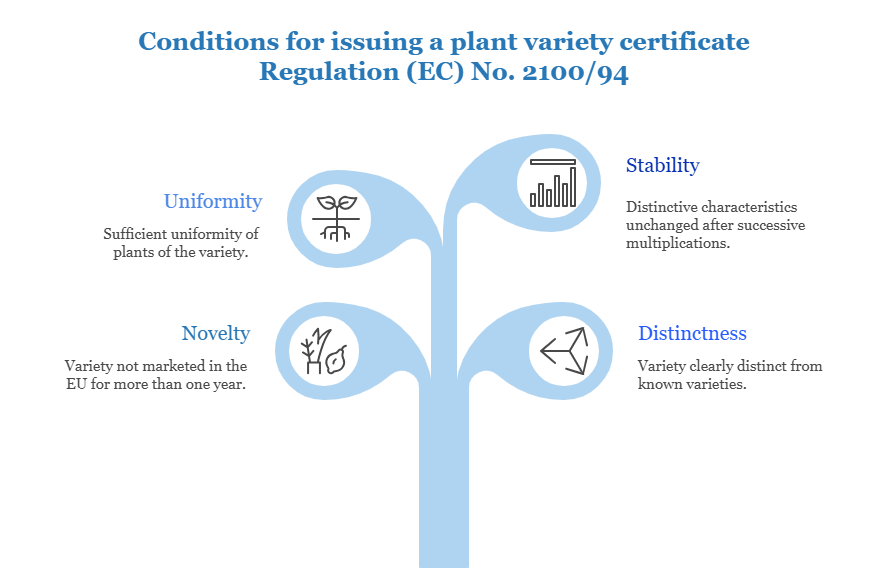
Beyond this initial assessment, attention must focus on compliance with the fundamental criteria for protection: novelty, distinctness, uniformity and stability.
• Novelty requires that the variety has not been commercialised, with the breeder’s consent, beyond the authorised time limits prior to filing. Even limited or indirect marketing may be sufficient to destroy novelty.
• Distinctness means that the variety must be clearly distinguishable from any other known variety at the filing date, by at least one relevant and observable characteristic.
• Uniformity requires that the plants constituting the variety show sufficient consistency in the expression of their characteristics, taking into account the mode of reproduction.
• Stability, finally, means that the essential characteristics of the variety remain unchanged after repeated propagation or at the end of each cycle of reproduction.
These criteria are assessed globally as part of the technical examination conducted by the CPVO. The absence of any one of them is sufficient to justify rejection of the application.
In practice, novelty is very often the main point of concern. Any marketing activity, even on a limited scale, occurring prior to filing may lead to an irreversible loss of rights. Field trials, exchanges of plant material or inadequately controlled technical communications are frequently at the origin of subsequent difficulties.
Securing ownership of the plant variety right from the outset
Ownership of rights is a central issue in the plant variety protection procedure. It is essential to identify precisely the breeder in the legal sense, whether a natural person or a legal entity.
Where the variety results from collective work involving employees, industrial partners or research institutes, an in-depth analysis of the contractual relationships is required. Employment contracts, collaboration agreements or research conventions may contain decisive clauses regarding ownership of results. In the absence of prior clarification, the applicant exposes itself to subsequent claims likely to seriously weaken the protection.
Formal requirements for filing
The preparation of the filing dossier should not be treated as a mere administrative formality. It requires the collection of precise and consistent technical information relating to the variety, its origin and its breeding method.
The filing dossier notably includes:
• the full identity of the breeder and, where applicable, its representative,
• the exact botanical designation of the variety,
• the proposed variety denomination, compliant with European rules,
• a detailed technical questionnaire specific to the species concerned.
Particular care must be taken with the variety denomination. This is subject to specific rules, distinct from trademark law, and must allow clear, stable and non-misleading identification of the variety. A poorly chosen denomination may give rise to objections, delay the procedure or result in refusal.
Applications before the CPVO may be filed in several official EU languages; however, English remains the preferred working language.
Representation by a specialised advisor helps to avoid formal irregularities likely to delay the procedure.
Filing the application and conduct of the procedure before the CPVO
Once the application has been filed and the fees paid, a formal examination is carried out before the technical examination phase is opened. This phase involves the designation of a competent examination office for the species concerned, responsible for carrying out the distinctness, uniformity and stability tests.
The choice of this office may have a significant impact on the duration of the procedure and on subsequent technical exchanges. In addition, the timely submission of plant material in accordance with the required conditions is a critical step. Any failure in this respect may result in rejection of the application or a substantial extension of time limits.
The DUS Examination: a lengthy and decisive phase
The DUS examination lies at the heart of the plant variety protection procedure. It is based on in-depth comparative tests, generally spread over several growing cycles.
In practice, this examination is entrusted to an authorised examination office competent for the species concerned, in accordance with Article 55 of the Regulation.
The examination generally involves:
• the supply of compliant plant material,
• trials conducted over one or more growing cycles,
• strict adherence to a timetable, which varies depending on the species and the filing period.
The duration of the examination depends in particular on the growing season applicable to the variety. In practice, the full procedure most often extends over two to three years, or even longer for certain perennial species.
At this stage, objections may be raised if the variety appears insufficiently distinct from existing varieties or if difficulties are identified in terms of uniformity or stability.
This phase requires rigorous technical preparation and anticipation of the examination office’s expectations. An incorrect assessment of the criteria or insufficient documentation may lead to failure, sometimes after several years of proceedings.
Applicants outside the European Union: key regulatory points of attention
Where the applicant is established outside the European Union, additional regulatory constraints must be taken into account at an early stage of the project. The transfer of plant material into the EU may be subject to strict phytosanitary rules, specific customs formalities and, depending on the country of origin and the species concerned, prior authorisations.
Furthermore, certain States apply particular restrictions on the export of biological resources or specific tax regimes likely to affect the circulation of plant material or the structuring of financial flows.
Failure to anticipate these aspects may result in delays, unforeseen costs or even prevent continuation of the procedure. A prior analysis of the applicable regulatory, customs and tax constraints is therefore essential.
Anticipating common errors and international coordination
Among the most frequent errors are:
• premature disclosure of the variety; strict traceability of the first uses of the variety is therefore essential,
• a non-compliant or conflicting denomination, making it necessary to conduct a thorough availability search prior to filing, not only in respect of existing variety denominations but also relevant prior rights,
• poor coordination between national, European and international filings.
The filing of a community plant variety right is only one component of an international protection strategy. It must be coordinated with systems in place in third countries that are members of the International Union for the Protection of New Varieties of Plants (UPOV), which, although based on common principles, present significant national specificities.
Poorly managed timing between initial commercialisation, Community filing and filings in third countries (United States, Latin America, Asia, Africa) may lead to irreversible loss of protection in strategic territories.
Conclusion
Filing a plant variety right in the European Union requires a rigorous approach, combining law, agronomic expertise and economic strategy. A comprehensive legal and administrative checklist is the most effective tool to secure the breeder’s rights and optimise the long-term valorisation of the variety.
Dreyfus & Associés is in partnership with a global network of lawyers specialising in Intellectual Property.
Nathalie Dreyfus with the assistance of the entire Dreyfus team
Q&A
1.What is a Community plant variety right (CPVR)?
A Community plant variety right is a unitary intellectual property title granted by the Community Plant Variety Office (CPVO). It confers on its holder an exclusive right to exploit a new, distinct, uniform and stable plant variety throughout the entire territory of the European Union.
2.What is the difference between a national plant variety right and a Community plant variety right?
A national plant variety right has effect only within the territory of the State that granted it. By contrast, a Community plant variety right provides uniform protection in all EU Member States through a single filing, making it the preferred option for breeders targeting the European market as a whole.
3.What do the DUS tests carried out as part of the procedure involve?
DUS tests are designed to verify that the variety is distinct, uniform and stable. They are conducted by authorised examination offices and focus on specific technical characteristics. These tests may extend over several growing cycles and represent the longest and most technical stage of the CPVR procedure.
4.When should an application for plant variety protection be filed?
Ideally, before any commercialisation or public disclosure likely to affect the novelty of the variety.
5.Can a variety be protected both by a plant variety right and a trademark?
Yes, but these protections serve different purposes. The variety denomination is subject to specific rules and must not be confused with a commercial trademark.
6.How long does the plant variety protection procedure take?
The duration varies depending on the species, but the DUS examination generally extends over several years.
7.What happens in the event of an error regarding ownership of rights?
An ownership error may lead to claims, disputes or, in some cases, invalidation of the plant variety right.
8.Can an applicant outside the EU apply for a European plant variety right?
Yes, but the applicant must anticipate the phytosanitary, customs and regulatory rules applicable to the export of plant material into the European Union.
This publication is intended to provide general guidance to the public and to highlight certain issues. It is not intended to apply to specific situations nor to constitute legal advice.