


Sommaire
Introduction
Commercial identity encompasses all signs through which the public identifies a company, such as its corporate name, trade name, business sign, visual identity, or digital presence. The protection of these elements is governed by distinct legal regimes that are often less structured and less predictable than trademark law.
In a context where a company’s name and image circulate across borders instantaneously, securing distinctive signs has become a non-negotiable requirement. Trademark registration does not encompass the entirety of a company’s commercial identity; however, it constitutes its most solid legal foundation. It grants an exclusive right over a specific sign (name, logo, slogan) in relation to precisely designated goods and services. In the absence of registration, a third party may file and appropriate an identical sign. Conversely, a registered trademark enables its owner to initiate opposition proceedings, bring counterfeiting actions, and consolidate a legally controlled intangible asset.
Why is trademark filing essential to preserve its legal identity?
Under French law, a trademark constitutes an industrial property title governed by Articles L.711-1 et seq. of the French Intellectual Property Code. Registration confers upon its holder an exclusive right of use for the designated goods and services, subject to the principles of specialty and territoriality.
This exclusive right produces immediate and structured legal effects. In particular, it allows the holder to:
- Prohibit the use of an identical or similar sign for identical or similar goods or services;
- Take action against the use of a similar sign creating a likelihood of confusion;
- File opposition against a subsequent trademark application within statutory deadlines;
- Initiate infringement proceedings before specialized courts;
- Challenge domain name registrations reproducing or imitating the trademark;
- Exploit the sign through licensing, franchising, or assignment.
A registered trademark therefore constitutes a right enforceable erga omnes. By contrast, in the absence of registration, protection relies on unfair competition or parasitism claims under Article 1240 of the French Civil Code. Such actions require proof of fault, damage, and causation, an evidentiary burden considerably more uncertain than in trademark infringement proceedings. Registration thus transforms commercial use into a legally consolidated property right.
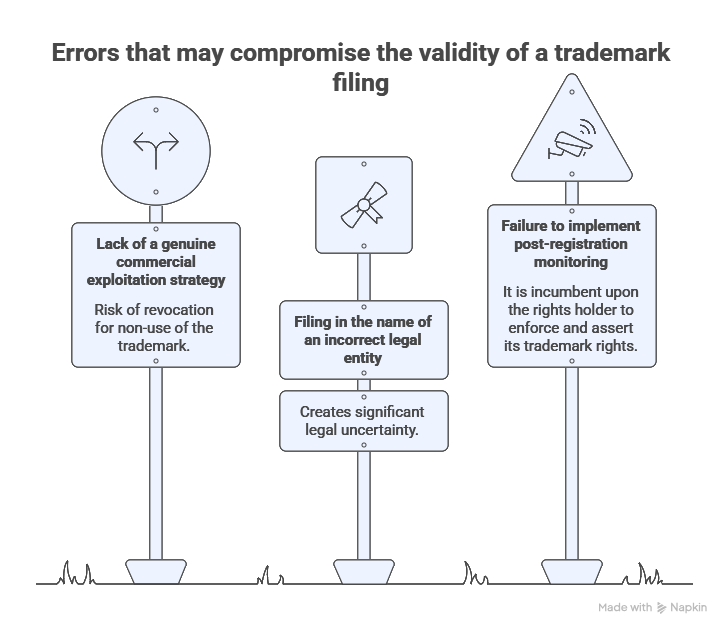
This protection nevertheless requires consistency between the registered sign and the actual business activity. The selection of classes under the Nice Classification and the drafting of specifications must correspond to a genuine, documented, and coherent business project. Recent case law confirms that trademark filing may not be diverted from its economic purpose. The decision of the French Intellectual Property Office (INPI) dated September 13, 2024 (NL 23-0183) concerning bad faith filing confirms that a speculative filing intended solely to block a third party, without genuine intent to use, is liable to cancellation.
A detailed analysis of this decision is available here:
How to integrate trademark filing into a comprehensive protection strategy?
Trademark registration is not an end in itself. To achieve full effectiveness, it must form part of a coordinated strategy encompassing all means of identification and exploitation of the sign.
Consistency between trademarks and domain names is essential. Filing a trademark without securing the corresponding strategic domain names (.fr, .com, or relevant country-code extensions) exposes the company to opportunistic registrations capable of generating confusion, traffic diversion, or fraud. An effective protection strategy therefore requires proactive domain name registration and ongoing monitoring of competing filings.
This protection must also be aligned with digital compliance. The exploitation of a trademark on a website or digital platform requires compliance with legal obligations relating to mandatory disclosures, personal data protection, and commercial communication rules. Deficiencies in this area may weaken the reputation attached to the sign and compromise its economic value.
A trademark is a territorial right whose scope depends on the chosen title. A filing with the INPI provides protection limited to France. A filing with the European Union Intellectual Property Office (EUIPO) produces unitary effect throughout the European Union. The Madrid International Registration System enables protection to be extended to specifically designated States.
The choice of territorial scope must not be dictated solely by the company’s present situation; it should reflect its foreseeable business development. A trademark protected only in France will not prevent identical use in Germany or Spain. Conversely, a European Union trademark may be vulnerable if an earlier right exists in a single Member State. Legal security therefore requires a forward-looking assessment of target markets, competitive risk areas, and planned expansion.
We invite you to read a previously published article outlining best practices in trademark filing and portfolio management strategy:
Finally, a registered trademark must be viewed as a structured intangible asset. It may be licensed, assigned, contributed in kind, or valued in the context of financing or restructuring operations. Integrating trademark filing into a comprehensive strategy therefore means securing not only a distinctive sign but also a central component of the company’s intangible assets, controlled geographically and economically exploitable.
Conclusion
Ultimately, trademark filing constitutes the foundational act in securing your commercial identity from a legal standpoint. When properly prepared, it transforms a mere distinctive sign into an exclusive right that is enforceable, exploitable, and economically valuable. Poorly anticipated, it exposes the business to opposition proceedings, invalidity actions, or loss of rights. Effective trademark protection therefore requires a methodical, forward-looking, and economically coherent approach. Securing your trademark today means strengthening the long-term legal and financial value of your business.
Dreyfus & Associés assists its clients in managing complex intellectual property cases, offering personalized advice and comprehensive operational support for the complete protection of intellectual property.
Nathalie Dreyfus with the support of the entire Dreyfus team
FAQ
1. Can a trademark be filed before the company is incorporated?
Yes. An individual may file a trademark prior to company incorporation. The trademark must subsequently be assigned or contributed to the company to avoid any uncertainty regarding ownership.
2. Should the name or the logo be filed first?
A word trademark generally provides broader protection, independently of graphic stylization. A figurative trademark protects a specific visual representation. Both filings may be complementary depending on the protection strategy.
3. Does a trademark automatically protect the corresponding domain name?
No. A trademark grants a right to prohibit use, but it does not automatically reserve the corresponding domain name, which must be registered separately.
4. Can a trademark be modified after registration?
No. A registered trademark cannot be substantially modified. Any material alteration requires a new filing.
5. Can a trademark be cancelled several years after registration?
Yes. An invalidity action may be brought at any time if an absolute or relative ground for refusal existed at the time of filing.
The purpose of this publication is to provide general guidance to the public and to highlight certain issues. It is not intended to apply to particular situations or to constitute legal advice.