

Sommaire
- 1 Why IP is a business-critical issue for game studios
- 2 1. Copyright: Your first line of defence
- 3 2. Trademarks: Protecting your studio’s identity and your game’s brand
- 4 3. Design rights: The visual protection studios overlook
- 5 4. Patents: Protecting technical innovation in gameplay
- 6 5. Contracts: The invisible infrastructure of your IP
- 7 6. Generative AI and emerging IP Iisues
- 8 7. Integrating IP into the development cycle
- 9 FAQ — Intellectual Property and video games
- 10 Conclusion: IP as a strategic investment from day one
Why IP is a business-critical issue for game studios
The global video game market generates over $200 billion in annual revenue.. This value is largely based on intangible assets , characters, code, music, narrative universes, studio names, and franchises. These are exactly what intellectual property (IP) law is designed to protect.
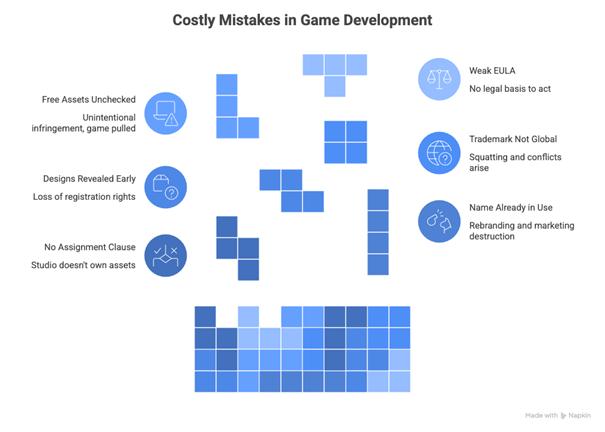
Yet IP mistakes remain remarkably common in the industry, especially among independent studios: no written contracts with freelancers, a game name that’s already in use, designs revealed before they’re protected… These oversights can block a launch, trigger years of litigation, or force an expensive rebrand in the middle of a marketing campaign.
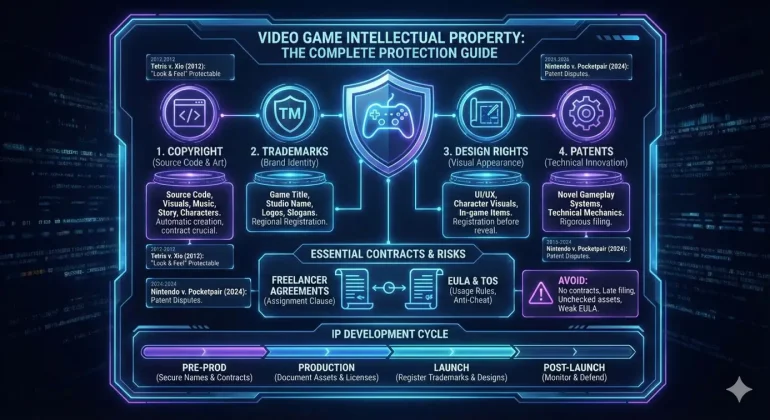
This guide covers the four pillars of IP as they apply to video games copyright, trademarks, design rights, and contracts and illustrates each with verified, real-world legal cases. A FAQ at the end addresses the most frequent questions from the sector.
1. Copyright: Your first line of defence
What copyright covers in a video game
A video game is a complex multimedia work. In the UK, this is reflected in the Copyright, Designs and Patents Act 1988 (CDPA), which does not protect games as a single category, but does protect each of their individual components separately. In the US, a similar multi-layered approach applies under Title 17 of the US Code.
The protectable elements of a game typically include:
- Source code and game engine protected as literary works (software)
- Visuals, artwork, and illustrations protected as artistic works
- Music, sound effects, and voice acting protected as musical works and sound recordings
- Story, dialogue, and narrative universe protected as literary or dramatic works
- Characters and environments protectable if they display sufficient originality
- Databases (game content catalogues, asset libraries) — protected under database rights if they result from substantial investment
The central requirement is originality: the work must be the author’s own intellectual creation, reflecting free and creative choices. Artistic meritis not a criterion,a simple mobile game can be as fully protected as a AAA blockbuster.
One important limitation applies in all major jurisdictions: copyright does not protect ideas, concepts, or game mechanics as such,only their specific expression. The US Copyright Office states this explicitly: copyright does not protect the idea for a game, its name, or the method of playing it. This distinction has generated some of the most important litigation in the industry (see cases below).
Automatic protection — But not automatic ownership
In the UK and across the EU, copyright arises automatically at the moment of creation. No registration is required, and protection lasts for the author’s lifetime plus 70 years for most works (50 years from the date of creation for computer-generated works and sound recordings under UK law).
But automatic protection is not the same as automatic ownership — and this is where the most costly traps lie.
For employees: Works created by an employee in the course of their employment generally belong to the employer, under Section 11(2) of the CDPA (UK) and the “work made for hire” doctrine (US). However, work created outside the scope of employment may belong to the employee, unless the contract states otherwise.
For freelancers and external contractors: The default position in both the UK and US is that contractors retain copyright in their creations, unless there is a written agreement to the contrary. Without an explicit assignment clause, a studio may not own the artwork, music, or code it commissioned and paid for.
Key takeaway: Without clear title to all the game’s assets, a studio cannot commercially exploit, license, or enforce its IP against infringers. A missing contract can jeopardise an entire project. This is one of the most common and most avoidable mistakes in the industry.
Should you register anyway?
Although registration is not required for copyright to exist, formal registration offers meaningful practical advantages in several jurisdictions:
- United States: Registration with the US Copyright Office is not mandatory, but it is required before filing an infringement lawsuit, and it enables statutory damages and attorney’s fees significantly strengthening your enforcement position.
- China: A registration certificate from the National Copyright Administration facilitates takedown requests on digital platforms and provides presumptive evidence of ownership in disputes.
- UK: No formal registration system exists for copyright, but date-stamped archives, version histories, and signed contracts serve as strong evidence of authorship and creation date.
🔍 Case study #1 — Tetris Holding v. Xio Interactive (2012): The “Look and Feel” of a game is protectable
Background: Xio Interactive developed Mino, a mobile game that replicated Tetris gameplay using different visual assets. Xio argued it had only copied uncopyrightable gameplay mechanics, not the protected expression of the game.
Ruling: The US District Court of New Jersey ruled against Xio, finding that while individual game mechanics are not copyrightable, the overall “look and feel” of a game, the combination of shapes, colours, and audiovisual presentation can be protected if it is sufficiently original. The court found that Mino reproduced that overall impression closely enough to constitute infringement, despite the different art assets.
What changed: This decision, alongside the related Spry Fox v. Lolapps case (the Triple Town/Yeti Town dispute), established that cloning a game’s aesthetic presentation carries legal risk even when individual mechanics are unprotectable. It reinforced the application of existing copyright principles.
Practical lesson: If you are designing a game that is closely inspired by an existing title, ensure that the visual presentation, UI design, and audiovisual combination are meaningfully distinct not just that the game mechanics are reworded. The “look and feel” doctrine is a real enforcement tool.
🔗 Reference: Tetris Holding, LLC v. Xio Interactive, Inc., US District Court, D.N.J., 2012 — analysed on Wikipedia: IP Protection of Video Games
🔍 Case study #2 — Bungie v. AimJunkies (2023): A well-drafted EULA is worth millions
Background: Bungie, the developer of Destiny 2, sued Phoenix Digital Group, the operator of AimJunkies.com for developing and selling cheat software that enabled aimbots and other unfair advantages in the game.
Ruling: The US federal court in Seattle awarded Bungie $4.3 million in damages for copyright infringement and violations of the Digital Millennium Copyright Act (DMCA). One of the key engineers behind the cheat had reverse-engineered the game’s code to build the tool — in direct violation of the End User Licence Agreement (EULA) he had accepted when downloading the game. The court also sanctioned the defendant for deliberately destroying financial evidence.
In 2024, the court rejected a motion for a new trial, making the decision final.
How it worked legally: The EULA was central to the case. By accepting the EULA, the cheat developer had entered into a binding contract that expressly prohibited reverse engineering and the development of unauthorised tools. This gave Bungie a direct contractual claim, on top of the copyright and DMCA claims.
Practical lesson: Your EULA and software licence are active legal instruments. A well-structured EULA creates the legal basis to pursue cheaters, cheat developers, and anyone who circumvents your technical protection measures. The $4.3 million award in this case was made possible by a properly drafted licence agreement.
🔗 Reference: Bungie, Inc. v. Phoenix Digital Group LLC (AimJunkies), US District Court, W.D. Wash., 2023 — confirmed in AFJV
2. Trademarks: Protecting your studio’s identity and your game’s brand
More Than just a name
A trademark can cover a game title, a studio name, a logo, a slogan, a character icon, or any other distinctive sign associated with your identity. Trademarks are the tools that protect what makes players recognise you and what investors use to value your assets.
Registration is done by classes under the International Nice Classification. For a game studio, the most relevant classes typically include:
- Class 9: Downloadable game software, apps
- Class 41: Entertainment services, esports, tournaments
- Class 25: Clothing and textile merchandise
- Class 28: Games, toys, collectibles
- Class 35: Online retail and commercial services
Registering in only one class leaves the door open for third parties to use your brand in other sectors.
Territoriality: Protection stops at the border
A trademark registered in the UK protects only the UK. A US trademark protects only the US. Studios with international ambitions must plan their filing strategy based on current and future target markets, not just where they are today.
Key considerations by jurisdiction:
- European Union: A single EU Trade Mark application at the EUIPO provides protection across all 27 member states.
- United States: You can file on the basis of intent to use before you launch commercially, securing your priority date ahead of release. But registration will only be granted once actual use in commerce has been demonstrated.
- China: The first-to-file system means that whoever registers first wins. Local actors may register your brand before you do, then block your market entry or demand payment to transfer it. Early filing in China is a strategic necessity, even before you have any Chinese audience.
The Paris Convention priority right gives you 6 months from your first filing to extend protection to other countries while retaining the original priority date, a powerful tool to spread costs and test the market before committing to global coverage.
Practical checklist
- Run clearance searches before making your name public
- Reserve domain names as early as possible
- File your trademark before any major public announcement (trailer, Kickstarter, game show)
- Use ™ to signal a trademark claim (even without registration); only use ® in countries where registration has been granted — misuse of ® can be illegal
🔍 Case study #3 — AM General v. Activision Blizzard (2020): Real-World trademarks in games
Background: AM General, the manufacturer of the Humvee military vehicle, sued Activision Blizzard in 2017 for featuring recognisable Humvee vehicles in the Call of Duty franchise without authorisation or royalty payments.
Ruling: The US District Court of New York dismissed AM General’s claims in March 2020. The court applied the Rogers v. Grimaldi test (1989), which provides First Amendment protection for artistic works that use trademarks when there is an “artistic relevance” to the underlying work and the use does not “explicitly mislead” consumers as to the source or endorsement of the content.
Important nuance: This protection is largely specific to US law. In the UK and EU, using a third party’s registered trademark in a commercial product without consent is generally actionable, even in a creative context. A broadly similar dispute involving Ferrari and Grand Theft Auto IV was litigated in France (Paris Court of Appeal, September 2012), where Ferrari’s claims were ultimately rejected but after detailed analysis of the specific similarities involved, not on broad First Amendment grounds.
Practical lesson: Representing real-world branded products in a game, vehicles, weapons, consumer electronics, sports equipment carries varying legal risk depending on jurisdiction. In the US, the First Amendment provides meaningful but not absolute protection. In Europe, the risk is higher. When in doubt, use fictional designs inspired by real-world aesthetics rather than identifiable reproductions.
🔗 Reference: AM General LLC v. Activision Blizzard, Inc., S.D.N.Y., March 2020 — analysed on NYU JIPEL
3. Design rights: The visual protection studios overlook
Design rights protect the appearance of a product — its shape, lines, colours, textures — independently of its function. In the video game context, this applies to:
- Character designs and costumes
- User interface elements (HUD, menus, icons)
- In-game weapons, vehicles, and items
- Decorative skins and cosmetic items
This form of protection is frequently underused, despite offering broad, flexible, and cost-effective coverage.
Registered vs. Unregistered Rights
Registered design rights provide protection for up to 25 years (renewable in 5-year periods). At the EUIPO, registering a single design costs less than €350 in official fees. In the UK (post-Brexit), the equivalent process runs through the Intellectual Property Office (IPO).
Unregistered design rights arise automatically upon first public disclosure. In the UK, unregistered design right protects the three-dimensional aspects of an original design for up to 15 years (or 10 years after first marketing). The UK Supplementary Unregistered Design (SUD) available to UK applicants protects the full appearance including decorative elements for 3 years from first disclosure.
The critical timing point: For registered rights, you generally must file within 12 months of first public disclosure. A trailer, a social media post, or a convention demo can start that clock. Once the novelty window closes, registration becomes impossible.
4. Patents: Protecting technical innovation in gameplay
Patents protect technical inventions, in the gaming industry, this may include certain technical implementations of gameplay systems or rendering technologies, provided they meet patentability requirements.”. Their use is less common in games than in hardware, partly because game mechanics in the abstract are not patentable. However, the technical implementation underlying those mechanics may be.
Notable examples of patented game technology include: Namco’s minigame loading screen patent, the dialogue choice wheel used in BioWare’s Mass Effect, the Nemesis system from Middle-earth: Shadow of Mordor, and Valve’s various Steam platform patents.
🔍 Case study #4 — Nintendo v. Pocketpair (Palworld) (2024): Patents on gameplay systems
Background: On September 19, 2024, Nintendo and The Pokémon Company announced a patent infringement lawsuit against Pocketpair, the Japanese developer behind Palworld, alleging that the game infringed patents related to monster-capturing mechanics.
Key development: Japan’s Patent Office rejected one of the Nintendo patent families cited in the suit, finding it lacked novelty with prior art cited from Monster Hunter 4, ARK: Survival Evolved, and Pokémon GO itself.
The in-game impact: Despite the patent validity dispute, on November 30, 2024, Pocketpair released a patch removing the ability to throw spheres to summon creatures, replacing it with a stationary summoning mechanic. Significant design concessions made under legal pressure before the case was fully decided.
Why this matters for studios: A patent doesn’t need to be valid to be expensive. Defending a patent infringement suit, even successfully, costs millions and forces game design changes mid-development or post-launch. For studios, this raises two concrete questions: (1) if you develop a genuinely inventiontechnical mechanic, assess its patentability early; (2) if you are inspired by mechanics from established franchises, check the patent portfolios of the market leaders in that space.
🔗 Reference: Nintendo Co., Ltd. v. Pocketpair Inc., Tokyo District Court, filed Sept. 2024 — followed on Livv.eu
5. Contracts: The invisible infrastructure of your IP
IP rights only have value if you actually own them. Contract management is the foundation of that ownership and it’s where independent studios most often leave themselves exposed.
The essential contracts
With freelancers and external contractors: Every contract must include a clear assignment of rights clause, specifying which works are covered, the scope of the assignment (reproduction, distribution, adaptation), the territory, and the duration. Without this clause, the contractor retains copyright in their work.
With co-development partners: A written agreement between studios should define how IP is split in the event of commercial success, acquisition, or dispute before a single line of code is written.
Non-Disclosure Agreements (NDAs): Protect sensitive information shared with external parties contractors, investors, potential partners before a formal agreement is in place. An NDA doesn’t need to be complex to be effective but still has to define the sensitive information.
End User Licence Agreements (EULAs): Define what players can and cannot do with your game. For user-generated content mods, custom levels, skins , your EULA can legitimately include automatic licence provisions that grant the studio rights to publish and monetise player-created content, provided the clause is clearly drafted.
🔍 Case study #5 — Capcom v. Data East (1994): Character design and the limits of copyright
Background: Capcom sued Data East over alleged similarities between characters in Street Fighter II and Fighter’s History, claiming the latter game copied character designs and fighting styles.
Ruling: The US District Court ruled largely in favour of Data East, finding that most of the similarities cited by Capcom were based on stock characters, fighting stances, and common martial arts conventions,elements too generic to be protected by copyright. Only a small number of specific, highly distinctive design elements were found potentially protectable.
Why it still matters: This case remains a landmark for character design strategy. It establishes that generic archetypes (a large wrestler, a nimble female fighter, a fireball-throwing hero) cannot be monopolised through copyright. But the specific visual expression of those archetypes, the original combination of costume design, colour palette, proportions, and distinctive features can be.
Practical lesson: When designing characters, document the specific creative choices that make them original (design briefs, concept art iterations, creative direction documents). This documentation is what establishes copyright in the distinctive elements, and distinguishes your characters from unprotectable generic archetypes in court.
🔗 Reference: Capcom Co., Ltd. v. Data East Corp., N.D. Cal., 1994 — discussed on Wikipedia: IP Protection of Video Games
6. Generative AI and emerging IP Iisues
The use of generative AI in game development raises IP questions that are still being resolved by courts and legislators worldwide:
Ownership of AI-generated content: In the UK, the CDPA makes limited provision for “computer-generated works” (where there is no human author), granting copyright to “the person by whom the arrangements necessary for the creation of the work are undertaken” typically the company operating the AI tool. In the US, the Copyright Office has made clear that purely AI-generated content cannot be registered, but human-curated selections and arrangements of AI output may qualify.
Training data: The use of copyrighted works to train AI models is the subject of active litigation in the US (including suits against Stability AI, Midjourney, and others) and ongoing regulatory development in the EU under the AI Act. Studios using AI-generated assets should carefully review the terms of service of the tools they use and assess their exposure.
Practical recommendation: Document all human creative contributions in your AI workflow save prompts, iteration sequences, and manual modifications to generated content. This documentation may be decisive in establishing copyright protection and defending your rights.
7. Integrating IP into the development cycle
Pre-production
- Run clearance searches on game names and distinctive signs
- Reserve domain names
- Sign contracts with all contributors, including assignment of rights clauses, before work begins
- Keep visual concepts confidential until a registration decision is made
Production
- Maintain rigorous asset documentation: version histories, creation evidence
- Verify the licences on all third-party assets (fonts, textures, plug-ins, audio libraries, Unreal/Unity Marketplace assets)
- Track first disclosure dates for any design elements you plan to register
Launch
- File trademark applications in key markets before marketing campaigns go live
- Complete a copyright audit: confirm all assignment contracts are in place
- Register strategic designs before public trailers and reveals
Post-Launch
- Monitor actively for copies, clones, and fraudulent apps on stores
- Update your IP strategy for DLC, updates, merchandise, and sequels
- Extend trademark coverage as you enter new markets
FAQ — Intellectual Property and video games
Are game mechanics protectable by copyright?
No and this is a fundamental principle across all major jurisdictions. The US Copyright Office states explicitly that copyright does not protect the idea for a game or its method of play. In the UK, the idea–expression distinction embedded in the CDPA leads to the same result. A battle royale structure, a turn-based system, or a resource-gathering loop cannot be owned through copyright. However, the specific, original expression of those mechanics the visual design, the audiovisual combination, the distinctive “look and feel” can be protected, as the Tetris v. Xio case demonstrated. Gameplay mechanics may also be protectable via patents if they involve a sufficient technical invention.
Does a logo created by a freelance designer automatically belong to the studio?
No. In both the UK and the US, the default position is that a contractor retains copyright in work they create, unless there is a written agreement transferring those rights. Without an assignment clause, the designer is technically the copyright owner which means the studio cannot legitimately register the logo as a trademark, and cannot fully enforce it against third parties. This situation is common in studios that work with freelancers through platforms without formalised contracts.
Can a video game character be protected?
Yes, through multiple overlapping layers. An original character can be protected by copyright (for its graphic and narrative elements), by trademark (if its name or image is registered), and by design rights (for its visual appearance). Protection is strongest when all three layers apply. Note that the general concept of a character type cannot be monopolised a “fire-wielding mage” or “armoured space soldier” as a concept is not protectable. What is protectable is the specific, original visual expression of that character.
Can a studio freely use classical music in a game?
In most jurisdictions, musical works enter the public domain 70 years after the death of the composer (although the exact duration may vary depending on the country and the date of publication).However, a specific recording of that music is protected by separate performer’s rights and sound recording copyright even if the underlying composition is public domain. To use Beethoven in a game, you either need to create your own recording or use a recording explicitly released under a free licence. Always verify that the sheet music edition used is also in the public domain, as modern critical editions may carry their own copyright.
Is a fan game based on an existing franchise legal?
Not without the rights holder’s autorisation unless a narrow exception (such as fair use or parody) applies. A fan game using protected characters, worlds, names, or visual assets constitutes copyright infringement (and potentially trademark infringement). Some publishers tolerate fan games informally others, notably Nintendo, actively enforce against them. Informal tolerance does not create a legal right, and a single cease-and-desist can end a project. If fan game creation is something your studio wants to support, consider publishing explicit fan content guidelines with a formal licence, as several major studios now do.
How do I protect a game name before announcing it publicly?
The recommended sequence: (1) run a clearance search to confirm the name is available; (2) reserve the corresponding domain names; (3) file a trademark application in your priority markets before any public announcement. In the UK, file with the UK Intellectual Property Office (UKIPO); in the United States, file with the USPTO (including on an intent-to-use basis if applicable). You may then rely on the Paris Convention’s six-month priority right to extend protection internationally while retaining your original filing date.
What happens if a freelancer uses my game’s assets after our contract ends?
If you have a properly drafted assignment agreement, you are supposed to have a clear infringement claim. Without that agreement, the freelancer may have legitimate rights in the assets they created. Even with a contract, retain all evidence of the collaboration, emails, briefs, version histories, invoices to establish authorship and the validity of the assignment in any dispute.
Can a publisher claim rights over mods created by players?
Yes, if the EULA is drafted to include that. Most major publishers use EULAs that grant them a broad licence over user-generated content created using their game or tools. The enforceability of such clauses varies by jurisdiction and depends on how clearly they are written. Under UK and EU consumer protection law, unfair clauses may be struck down. A creator whose mod contains genuinely original elements such as new characters, new scripts, original code may retain copyright in those original contributions, even if the publisher holds a licence to publish the mod through the game’s platform.
Are NFTs linked to game items protected by IP law?
An NFT is a cryptographic certificate associated with a digital asset.and donot a transfer of intellectual property rights. Buying an NFT representing a game character does not confer copyright in that character, unless the sale contract explicitly says so. The question of how NFTs interact with existing IP frameworks is still developing legally. Studios using NFTs or blockchain-based in-game economies should ensure their terms of sale clearly define what the buyer does and does not acquire.
What does a basic IP strategy cost for an independent studio?
There is no single answer, but here are indicative official fee ranges (2024-2025, before legal fees):
- Copyright: £0 / $0 (automatic protection) + contract drafting costs
- EU Trade Mark (EUIPO): ~€850 for one class, ~€50 per additional class
- UK Trade Mark (IPO): ~£170 for one class, ~£50 per additional class
- US Trade Mark (USPTO): ~$250–$350 per class
- International Trade Mark (WIPO/Madrid): from ~750 CHF + per-country fees
- EU Registered Design (EUIPO): ~€350 for one design
- UK Registered Design (IPO): from ~£50 for one design, with reduced per-design fees for multiple applications filed together. (fees increasing ~25% from April 2026)
A realistic starting IP strategy for an independent studio can begin under £3,000 / €3,500 covering priority markets, then expand progressively as the studio grows.
Conclusion: IP as a strategic investment from day one
Intellectual property is not administrative housekeeping reserved for large studios. It provides protection to for your creativity, secures your revenue, and strengthens your position with investors, partners, and competitors.
The cases in this guide reflect a consistent reality: IP disputes happen at every level of the industry, from independent creators to the industry’s biggest players. What distinguishes well-prepared studios is anticipation: contracts signed before the first asset is created, trademarks filed before the first trailer, designs registered before the first convention reveal.
Whatever your budget, scalable protection is achievable. The key is to integrate IP into your development process from the start — not as an afterthought once the game is done, but as a core part of building something worth protecting.
Sources and references
| Reference | Link |
| Tetris Holding, LLC v. Xio Interactive, Inc., D.N.J., 2012 | Wikipedia: IP Protection of Video Games |
| Bungie, Inc. v. Phoenix Digital Group (AimJunkies), W.D. Wash., 2023 | AFJV |
| AM General LLC v. Activision Blizzard, S.D.N.Y., 2020 | NYU JIPEL |
| Nintendo Co., Ltd. v. Pocketpair Inc., Tokyo District Court, 2024 | Livv.eu |
| Capcom Co., Ltd. v. Data East Corp., N.D. Cal., 1994 | Wikipedia: IP Protection of Video Games |
| Copyright, Designs and Patents Act 1988 (UK) | legislation.gov.uk |
| US Copyright Office — Copyright and Video Games | copyright.gov |
| Harper James — Guide to IP rights in gaming (2024) | harperjames.co.uk |
| Arnall Golden Gregory — Decoding IP Law for Game Developers (2024) | agg.com |
| CITMA — Copyright and Video Games | citma.org.uk |
| WIPO — IP and the Video Game Industry | wipo.int |
| Triniti Legal — Legal Guide to the Game Industry (2024) | triniti.eu |
This guide is intended for general informational purposes only and does not constitute legal advice. For any specific situation, consult a qualified IP attorney or trade mark attorney in your jurisdiction.