

Sommaire
Introduction
Consumer law is undergoing a major development with the introduction of a new mechanism: the “three-click” right of withdrawal for contracts concluded online within the European Union. Stemming from Directive (EU) 2023/2673, which amends Directive 2011/83 on consumer rights, this reform requires professionals to fundamentally rethink their digital interfaces, customer journeys and internal compliance processes.
This transformation forms part of the European Consumer Agenda 2030 and reinforces a well-established objective: ensuring a fair, transparent digital environment free from misleading practices or dark patterns.
A new digital right of withdrawal: the “three-click” mechanism
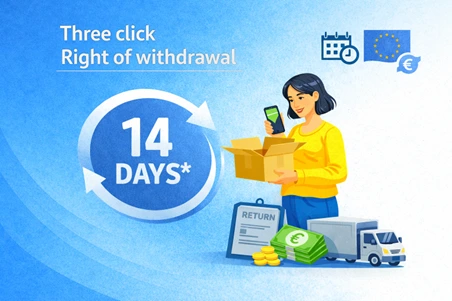
Strengthening the 14-day right of withdrawal
The right of withdrawal, enshrined in Directive 2011/83 and transposed in France under Articles L.221-18 et seq. of the Consumer Code, allows consumers to withdraw from a contract within 14 days without providing any justification.
The novelty does not lie in the duration of the withdrawal period itself, but in the way this right must now be exercised online.
Professionals must implement a clear, accessible and permanent electronic mechanism enabling consumers to withdraw from the contract through:
- A clearly identifiable button labelled “Withdraw from the contract here” or similarly unambiguous wording;
- An explicit confirmation via a second button labelled “Confirm withdrawal”;
- A confirmation sent to the consumer on a durable medium.

This feature must remain available throughout the entire withdrawal period.
A response to manipulative interfaces
This reform is part of the broader fight against manipulative interfaces. European authorities have identified that certain websites made cancellation complex, concealed or discouraging.
Making withdrawal difficult may now be classified as:
- A misleading commercial practice;
- An aggressive commercial practices;
- A dark pattern.
The principle is straightforward: the ease of subscribing must correspond to the ease of cancelling.
Technical obligations imposed on e-commerce operators
UX/UI and digital architecture adaptation
Operators must review their interfaces to:
- Ensure the withdrawal button is clearly visible and unambiguous;
- Maintain access to the mechanism throughout the withdrawal period;
- Allow easy identification of the contract concerned;
- Record each step of the process for evidentiary purposes.
Traceability and proof
Professionals must be able to demonstrate:
- The effective presence of the withdrawal button;
- The proper functioning of the withdrawal pathway;
- The sending of confirmation on a durable medium (e-mail, downloadable PDF).
A lack of traceability will significantly increase litigation risk.
Territorial scope and contracts concerned
A clearly extraterritorial reach
EU consumer law applies not only to businesses established within the EU but also to third-country operators targeting EU consumers.
Businesses will be deemed to target the EU market where they:
- Deliver to a Member State;
- Use a specific EU Member State language;
- Accept payment in euros;
- Conduct marketing campaigns directed at EU consumers.
Which contracts are concerned?
The reform applies to:
- Distance contracts;
- Financial services concluded at a distance;
- Digital subscriptions;
- Tangible goods sold online.
Traditional exceptions remain (immediately executed digital content with express consent, personalised goods, etc.).
Sanctions, risks and interaction with unfair commercial practices
Significant financial penalties
Each Member State determines applicable sanctions. In France, non-compliance may result in:
- A fine of up to €75,000 for legal entities;
- Additional administrative penalties;
- Enforcement action by the DGCCRF.
European authorities cooperate through the CPC (Consumer Protection Cooperation) network, reinforcing cross-border enforcement risks.
Heightened legal risk: extension of the withdrawal period
In the absence of a compliant mechanism:
- Consumers may exercise withdrawal by any means;
- The 14-day period may be extended;
- The company may be accused of obstructing consumer rights.
National authorities are already demonstrating increased vigilance in this regard.
Conclusion
European consumer law continues to pursue transparency and contractual balance in the digital environment. The three-click right of withdrawal represents a major regulatory development, combining enhanced consumer protection with increased accountability for economic operators.
This reform should not be viewed as a purely technical adjustment but as a central component of digital contractual governance and overall compliance (Digital Services Act, unfair commercial practices framework, GDPR).
Dreyfus & Associés assists its clients in managing complex intellectual property cases, offering personalized advice and comprehensive operational support for the complete protection of intellectual property.
Nathalie Dreyfus with the support of the entire Dreyfus team
Q&A
1. Does the withdrawal period remain 14 days?
Yes, except for specific exceptions applicable to certain services.
2. Can a consumer withdraw by other means than the designated button?
Yes. The three-click mechanism does not eliminate other lawful methods of exercising the right (e-mail, letter, model withdrawal form).
3. Does the right of withdrawal apply to immediately accessible digital content (streaming, downloads)?
It remains applicable unless the consumer has expressly waived the right before immediate performance and acknowledged the loss of that right.
4. Must the consumer provide justification?
No. Withdrawal remains without cause.
5. Does this mechanism apply only to financial services?
No. Although the amending directive concerns financial services, it modifies the general directive on consumer rights.
6. How can compliance be demonstrated during an inspection?
The professional must retain comprehensive documentation: time-stamped screenshots, technical logs, proof of confirmation sent on a durable medium, archived withdrawal requests and refund traceability.
This publication is intended to provide general guidance and highlight certain legal issues. It is not intended to apply to specific circumstances nor to constitute legal advice.