


Sommaire
Introduction
In a context where plant innovation is rapidly evolving through biotechnology, plant breeding and genetic engineering, economic actors increasingly seek to maximize the legal protection of their innovations while securing their competitive advantage in the marketplace. A recurring question concerns the compatibility of filing both a plant variety right and a patent in relation to the same research subject: is it possible to obtain both a Plant Variety Right (PVR) and a patent without creating conflicts between these rights?
This issue lies at the heart of intellectual property strategies in the plant sector. It raises questions regarding the scope of protection, commercial exploitation and potential litigation risks, all of which must be carefully managed by innovative companies.
Conditions of protection and protected subject matter: patent and plant variety right (PVR)
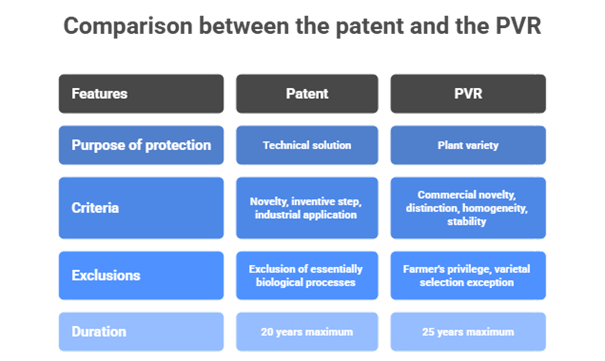
The consistency of a simultaneous filing strategy relies on a fundamental distinction: a patent protects a technical invention, whereas a plant variety right protects a specific plant variety. The legal criteria and underlying logic of these two regimes differ significantly.
The patent: protection of a technical solution
A patent protects a technical solution to a technical problem. However, no patent is granted for plant varieties as such. Plant varieties are defined subgroups of a plant species that are distinguished from other varieties by specific hereditary characteristics.
In other words, plants obtained through crossing and selection are excluded from patentability under Article 53(b) of the European Patent Convention (EPC).
In the plant field, a patent may therefore cover only:
- An isolated gene with an identified technical function;
- A genetic transformation process;
- A technical breeding method.
To be patentable, the invention must satisfy the classical criteria of novelty, inventive step and industrial applicability (Article 52 EPC).
In order to prevent patents relating to plants obtained by technical processes from inadvertently covering plants obtained through essentially biological processes, the European Patent Office often requires the introduction of a disclaimer.
In practice, the claims, which define the scope of protection sought, must therefore explicitly specify that the invention does not cover plants obtained by essentially biological processes.
The patent thus protects a technology or functional mechanism, independently of any specific plant variety.
The plant variety right (PVR): protection of a plant variety
Plant varieties are protected under a separate intellectual property regime: plant variety protection.
A Plant Variety Right protects a distinct plant variety that satisfies the following criteria:
- Commercial novelty,
- Distinctness,
- Uniformity,
- Stability.
The PVR grants its holder an exclusive right over the production, commercialization and exploitation of the reproductive material of the protected variety.
However, the regime includes specific features, such as:
- The farmer’s privilege (Article 14 of the Council regulation (EC) no 2100/94).
- The breeder’s exemption (Article 15(c) of Council Regulation (EC) No 2100/94).
Unlike patents, the PVR does not protect a technical process, but rather the plant variety itself, defined by its genetic and phenotypic characteristics.
Possible compatibility or legal barriers?
What European and French law allow
According to case law and the practice of the offices (notably the European Patent Office), it is possible to obtain both a patent and a PVR for different aspects of the same innovation:
- The PVR protects the variety as such (its genetic and phenotypic definition).
- The patent protects a technical invention that may be used across several varieties such as a gene conferring resistance or an innovative cultivation method.
Protection may therefore be cumulative where the protected subject matter is legally distinct, for example, a patented genetic mechanism applicable to multiple varieties and a specific variety protected by a PVR.
Potential areas of conflict and exclusion
Nevertheless, conflicts may arise in certain situations, particularly where patent claims are drafted too narrowly or too specifically, leading in practice to coverage of an identifiable plant variety. This could create an overlap with the scope of the PVR and raise issues of exclusion from patentability under European and French law, since plant varieties cannot be patented.
These grey areas require very careful claim drafting and, in some cases, dialogue with patent offices, to ensure that the two forms of protection remain clearly distinct.
In some configurations, the exploitation of one right may depend on the use of the other. To prevent technological deadlock, the law allows, under certain conditions, the granting of compulsory licences in cases of dependency between a patent and a plant variety right, particularly under Directive 98/44/EC on the legal protection of biotechnological inventions.
This mechanism ensures a balance between exclusive rights and the dissemination of innovation, while guaranteeing equitable remuneration for the holder of the earlier right.
Strategic trade-offs for plant innovators
Impact on commercial exploitation
A simultaneous filing strategy must be aligned with commercial and profitability objectives:
- Market coverage: a patent may deter competitors from using a patented technology in other varieties, while the PVR guarantees exclusive control over the protected variety’s name and propagating material.
- Cross-licensing: it may be strategic to structure separate licence agreements: one PVR licence for varietal exploitation and one patent licence for the underlying technology, to maximise revenues without unduly restricting innovation.
- Management of exceptions: certain European legal systems allow exceptions such as the farmer’s privilege or farm-saved seed under specific conditions, which directly affect commercial strategy.
A coordinated approach enables protection of the varietal creation while ensuring maximum commercial impact, particularly in highly competitive sectors such as commercial agriculture or specialised horticulture.
Management of litigation risks
The simultaneous filing of a patent and a PVR may give rise to specific disputes, in particular concerning:
- Definition of the scope of protection: divergent interpretations of patent claims or of the scope of the protected variety may lead to infringement or invalidity actions.
- Scientific developments: where varietal traits are progressively optimised, it must be assessed whether such improvements remain within the scope of the existing PVR or justify a new patent filing, in order to avoid overlap and portfolio fragility.
In this context, it is essential to draft clear and differentiated claims and to conduct a structured analysis of the respective fields of protection of the patent and the COV in order to avoid any overlap that could weaken the rights.
Conclusion
The simultaneous filing of a plant variety right and a patent can constitute a powerful strategy when structured around legally distinct and complementary subject matter. It requires disciplined drafting, a precise understanding of European legal regimes, and careful anticipation of commercial and litigation risks.
Dreyfus & Associés assists its clients in managing complex intellectual property cases, offering personalized advice and comprehensive operational support for the complete protection of intellectual property.
Nathalie Dreyfus with the support of the entire Dreyfus team
FAQ
1. Can a PVR be filed first and a patent later?
Yes, both sequences are possible. Filing a PVR first does not in itself destroy the novelty of a patent, provided that the technical invention has not been publicly disclosed. However, commercialisation or detailed technical disclosure of the variety may jeopardise patentability.
2. Does simultaneous filing affect a company’s financial valuation?
A combined patent and PVR portfolio may enhance valuation during fundraising, M&A transactions or due diligence. Investors assess the robustness, remaining term and strategic coherence of the rights.
3. Are the rules identical outside the European Union?
No. Legal regimes vary by jurisdiction. Some countries strictly apply the UPOV Convention, while others adopt broader interpretations of patentability in the life sciences. An international strategy requires a country-by-country analysis.
4. Can trade secrets complement a patent and a PVR?
Yes. Technical information such as protocols, parental lines or agronomic data may be protected as trade secrets. This does not replace patent or PVR protection but may strengthen the overall strategy.
5. Can a patent block exploitation of a variety protected by a third party?
Yes. If a variety incorporates a trait covered by a third party’s patent, exploitation may require a licence, even if the variety itself is protected by a PVR. Ownership of a PVR does not guarantee freedom to operate.
This publication is intended to provide general guidance and highlight certain issues. It is not intended to apply to specific situations nor to constitute legal advice.