


Sommaire
Introduction
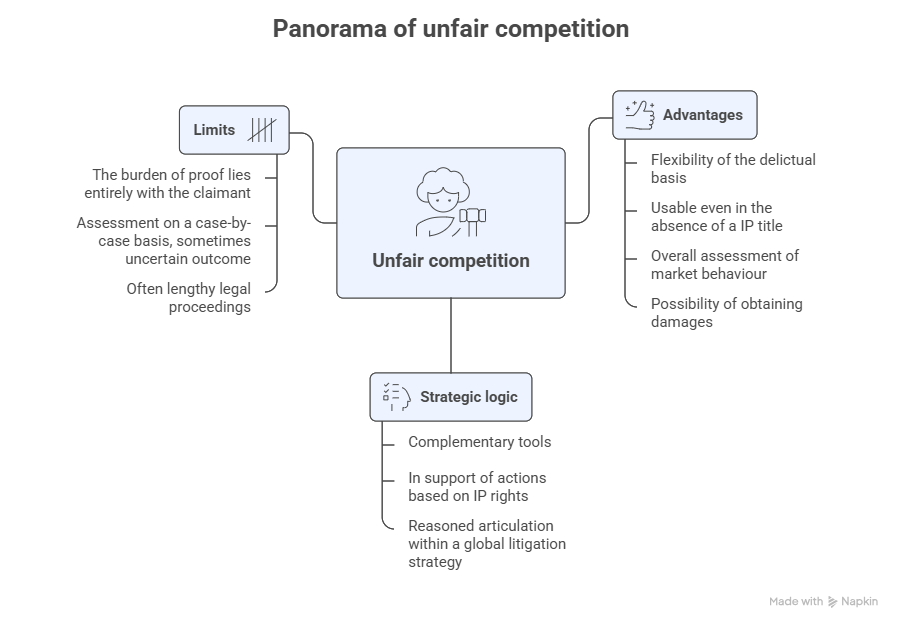
Unfair competition, based on Article 1240 of the French Civil Code, is sometimes perceived as a generalist action, whose implementation can be delicate due to the requirement to demonstrate a fault, a prejudice and a causal link.
This flexibility, often criticized, nevertheless constitutes its main strength: unfair competition remains almost always mobilizable, provided that there is an infringement on the normal play of competition and this, regardless of the field concerned.
The functional limitations of traditional procedures according to the configuration of the dispute
-
Trademark law
Trademark law is a central instrument for the protection of distinctive signs. It is however based on the existence of valid, registered and enforceable prior rights, as well as on an analysis structured around the goods and services concerned.
However, litigation practice reveals many situations in which these conditions do not allow for an effective understanding of digital breaches.
Some domain names indeed exploit unregistered signs while other disputes involve operators outside the field of specialty covered by the trademark, while taking unfair advantage of the economic value of the sign.
Moreover, the unfair competition action has the advantage of not subordinating protection to the distinctive character of the domain name. It makes it possible to sanction the wrongful use of a name, as soon as it produces an adverse economic effect on a competing operator, regardless of the nature of the sign.
In these configurations, the strictly formal analysis of trademark law shows its limits. The action in unfair competition then allows to refocus the debate on the economic reality of behaviors, by sanctioning the concrete effects produced on the market, regardless of classifications or labels.
-
UDRP procedures and related mechanisms
UDRP procedures and related mechanisms offer a quick and operational response to domain name conflicts. Their effectiveness, however, relies on a deliberately limited normative framework, focused on precise and cumulative criteria.
These procedures do not allow for the award of damages, nor the overall understanding of structured digital parasitism strategies, particularly when they are sustainable or involve a plurality of domain names, mirror sites or communication channels. Where the UDRP requires a standardized demonstration of bad faith, unfair competition makes it possible to understand the entire economic behavior, its effects on the market and the harm suffered.
For more information about the UDRP procedure, please refer to our previously published guide.
The conditions of the unfair competition action applied to domain names
Unfair competition is based on a now well-established triptych: a fault, a harm and a causal link.
-
The characterization of the fault
The fault can take several forms, frequently retained by the courts:
- Economic parasitism, notably through the registration or exploitation of a domain name in the economic wake of an established player, in order to unduly profit from its investments.
- Risk of confusion: The case law indicates that regardless of the existence of a private right and any requirement of distinctiveness, unfair competition can be considered as soon as the use of a second domain name creates, in a competitive context, a risk of confusion with a domain name previously exploited. (Court of Cassation, civil, Commercial Chamber, October 13, 2021 No.19-23.597)
- Diversion of traffic through imitation of architecture, content or editorial line
Contrary to certain administrative procedures focused on the ownership of rights, unfair competition focuses on the effect produced on the public.
-
The prejudice and the proof of the commercial disturbance
The actual harm does not have to be quantified in an exhaustive manner. Judges widely admit the demonstration of a commercial disturbance, loss of chance or damage to the image, in particular when the disputed domain name unduly captures part of the traffic or alters the public perception as to the origin of the services offered.
Strategic articulation of the different foundations
An action based on unfair competition is neither a recourse in principle nor a legal remedy superior to other available mechanisms for disputes relating to domain names. It is part of a range of complementary legal tools, the mobilization of which must be assessed in light of the specific circumstances of each case.
Depending on the configuration of the dispute, the nature of the rights invoked, the behavior of the domain name holder and the objectives pursued, an action based on trademark law or an extrajudicial procedure such as UDRP can offer a fully satisfactory response, especially when the impairment is circumscribed and clearly characterized.
Unfair competition is relevant when the analysis reveals actions that are not apprehended by a strictly formal reading of the sign, but reflect an overall economic behavior.
Conclusion
Unfair competition does not respond to all domain name conflicts, but it remains an option of general application when a behavior reveals a faulty economic behavior.
Based on tort liability, it offers a flexible and transversal reading grid, allowing to assess situations on a case-by-case basis, taking into account the reality of uses and their effects on the market.
Dreyfus & Associates assists its clients in managing complex intellectual property cases, offering personalized advice and comprehensive operational support for the complete protection of intellectual property.
Nathalie Dreyfus with the support of the entire Dreyfus team
FAQ
1. Can we act in unfair competition without being a direct competitor of the domain name holder?
Yes. The case-law accepts that the existence of a direct competitive relationship is not always required where the conduct in question disrupts normal market activity or causes an identifiable economic disturbance.
2. Must an intent to harm be demonstrated to characterize unfair competition?
No. Unfair competition is a strict civil liability: intent is not required. Only the faulty character of the behavior and its economic effects count.
3. Does a subsequent change of domain name make the fault disappear?
No. The cessation of actions does not retroactively erase the fault or the harm already caused. It can however be taken into account in the assessment of damages
4. Does unfair competition allow the domain name to be transferred?
In principle, an unfair competition action does not allow the direct transfer of a domain name to be ordered. On the other hand, the judge may order measures of cessation or prohibition on a periodic basis, which may lead, in practice, to the abandonment or deactivation of the disputed domain name.
5. Can unfair competition be retained in the absence of proven confusion?
Yes. As regards unfair competition, certain behaviour, in particular economic parasitism, may be sanctioned independently of any risk of confusion, insofar as it reflects an improper appropriation of investments or the reputation of an operator.
The purpose of this publication is to provide general guidance to the public and to highlight certain issues. It is not intended to apply to particular situations or to constitute legal advice.