

Sommaire
Introduction
In its decision Monster Energy Company v. Onyx of November 13, 2025 (n° 23-11.522), the French Supreme Court (Cour de cassation) clearly reaffirmed a guiding principle of French trademark law: the likelihood of confusion must be assessed on the basis of the signs as filed and the goods or services as designated in the registrations or applications, without taking into account the actual conditions under which the trademarks are used on the market.
In the specific context of opposition proceedings, the Court recalled that the analysis must remain tied to the industrial property title itself, rather than to the commercial, graphic, or promotional choices effectively implemented by the operators.
The ruling therefore falls within a longstanding and coherent line of case law, previously established in matters of trademark infringement, invalidity actions, and comparison of signs.
Background of the dispute: an opposition between “THE BEAST” and “La Bête”
The company Monster Energy Company, notably the owner of the European Union word trademarks REFRESH THE BEAST! and HYDRATE THE BEAST!, registered for beverages, filed an opposition against the application for registration of the semi-figurative sign La Bête BIÈRE DE CARACTÈRE, which designated, among other things, beer, mineral water, and fruit juices.
The litigation concerned goods that were at least partially identical or similar, in a sector where the overall perception of the signs plays a decisive role.
The Director General of the French Trademark Office (INPI) initially found the opposition partially justified. However, the Versailles court of appeal subsequently annulled that decision.
To rule out any likelihood of confusion, the Court of Appeal found that the visual, phonetic, and conceptual similarities between the signs were relatively weak. It further held that the figurative elements of the contested sign, particularly its graphic presentation, colors, and visual impact on store shelves, gave the sign a distinctive appearance capable of excluding any likelihood of confusion in the mind of the consumer.
It is precisely this method of analysis that the French Supreme Court censured.
The decision of the French Supreme Court: a twofold censure
The Cour de cassation overturned the reasoning of the Versailles Court of Appeal for two reasons.
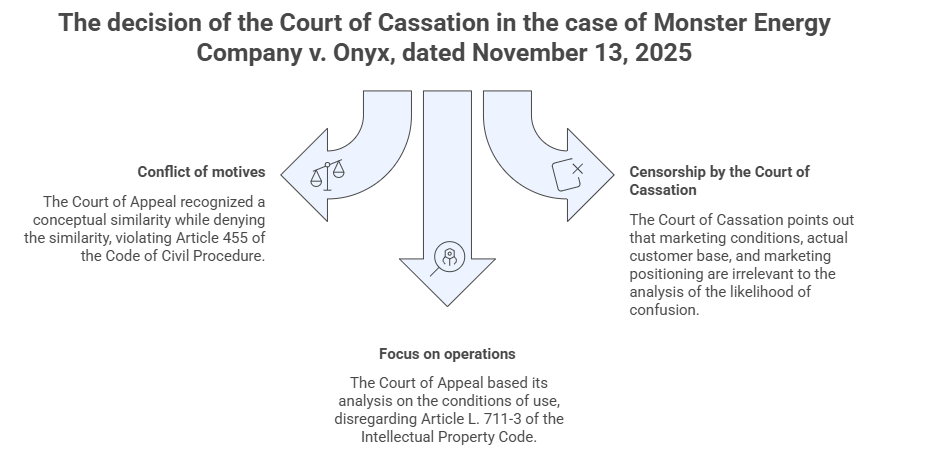
- First, it identified a contradiction of reasoning under Article 455 of the French Code of Civil Procedure. The Court of Appeal had acknowledged a certain conceptual proximity between the signs while subsequently asserting that no conceptual similarity existed.
- Second, the Supreme Court held that the judges had violated Article L.711-3 of the French Intellectual Property Code by basing their analysis on the actual conditions under which the signs were used in commerce.
The Court reiterated that the likelihood of confusion is assessed primarily in relation to the signs as filed and the goods or services as designated in the registrations or applications for registration, regardless of the specific terms of commercial exploitation of the trademarks.
In the present case, by emphasizing that the beverages were primarily chosen on store shelves and that the visual aspect of the packaging played a decisive role for consumers, the Court of Appeal departed from this methodological framework.
This approach is consistent with well-established case law. In trademark infringement matters, the Supreme Court reaffirmed the same principle in the decision Palladium of June 28, 2023 (n°22-10.759) , as well as in the significant decision Cora of March 27, 2019 (n°17-31.605). In each of these cases, the Court held that conditions of commercialization, the actual customer base, or marketing positioning are irrelevant to the assessment of the likelihood of confusion.
The scope of the rule at the stage of comparing the signs
Another key contribution of the November 13, 2025 decision lies in clarifying the distinction between comparison of the signs and global assessment of the likelihood of confusion.
For instance, the Tour de France decision of March 19, 2025 (n° 23-18.728) may be compared with the Monster Energy case. In that matter, the French Supreme Court censured a decision where the Court of Appeal had taken into account the well-known exploitation of the earlier trademark in connection with a cycling competition when comparing the signs.
The Supreme Court held that by considering how the public actually associated the trademark with a specific sporting event, the Court of Appeal had departed from a comparison based solely on the intrinsic characteristics of the signs.
In both cases, the Supreme Court refused to allow the analysis to shift toward external elements unrelated to the trademark registration, such as:
- the particular reputation of the trademark arising from its use,
- the presentation of the product on retail shelves,
- or the actual packaging of the goods.
The position of the CJEU: a more nuanced approach
European case law adopts a slightly different approach. The Court of Justice of the European Union (CJEU) clarified in a decision of March 4, 2020 (C-328/18 P) that conditions of commercialization may constitute a relevant factor in the overall assessment of the likelihood of confusion.
However, these elements may intervene only at a specific stage of the analysis. The CJEU emphasizes that the comparison of the similarity between signs must be carried out exclusively on the basis of their intrinsic characteristics.
Thus, while conditions of commercialization may be considered in the overall assessment of the likelihood of confusion, they cannot influence the comparison of the signs themselves.
Conclusion
The decision of November 13, 2025 provides a new illustration of the methodological rigor adopted by the French Supreme Court in assessing the likelihood of confusion.
By reaffirming that this assessment must be conducted independently of the conditions under which trademarks are used, the Court confirms a structuring principle of French trademark law: the protection of a trademark is determined primarily by its registration in the register, rather than by the way it is exploited on the market.
For businesses, this case law highlights the importance of a rigorous trademark filing and protection strategy, based on a thorough prior-rights analysis and carefully drafted specifications of goods and services.
Dreyfus assists its clients in managing complex intellectual property matters by providing tailored advice and comprehensive operational support to ensure the full protection of intellectual property rights.
Dreyfus Law Firm works in partnership with a global network of intellectual property attorneys.
Nathalie Dreyfus, with the assistance of the entire Dreyfus team.
Q&A
1. What is the difference between opposition proceedings and a trademark infringement action?
Opposition is a preventive administrative procedure aimed at preventing the registration of a new trademark that would infringe prior rights. It takes place before the trademark is registered. By contrast, a trademark infringement action is a judicial procedure brought after a sign has been registered or used, in order to sanction an infringement of trademark rights.
2. Who can file an opposition to a trademark application?
An opposition may be filed by the holder of a protected prior right. This may include a registered trademark, a European Union trademark, an international trademark designating France, a company name, a trade name, a domain name, or even a geographical indication, provided that these rights are capable of creating a likelihood of confusion with the applied-for trademark.
3. Is the assessment of likelihood of confusion the same in French law and EU law?
The French Supreme Court traditionally adopts a strict approach, emphasizing that the analysis must rely on the trademarks as registered and the goods or services as designated in the filings. The CJEU, for its part, accepts that certain elements relating to the commercial context may be considered in the overall assessment of the likelihood of confusion, without affecting the intrinsic comparison of the signs.
4. Is the likelihood of confusion assessed in the same way across all economic sectors?
No. The assessment of likelihood of confusion takes into account the level of attention of the relevant public, which may vary depending on the goods or services concerned. For example, consumers generally exercise greater attention when purchasing technical or expensive products than when buying everyday consumer goods.
5. Does the absence of opposition mean that a trademark does not infringe any prior rights?
No. The absence of opposition does not guarantee the definitive validity of a trademark. A registered trademark may still be challenged later through infringement proceedings or an invalidity action based on prior rights. For this reason, companies should conduct thorough prior art searches before filing a trademark application.
This publication is intended to provide general guidance to the public and to highlight certain issues. It is not intended to apply to specific situations or to constitute legal advice.