

Sommaire
Introduction
In 2026, the European Union launched a comprehensive evaluation of the Community plant variety rights system, which has been the cornerstone of the protection of plant innovations for nearly thirty years. This process could pave the way for a major reform of the European plant breeders’ rights regime, with direct consequences for plant breeders, seed companies and the entire agri-food chain.
As European agriculture faces structural challenges (climate change, food security, the ecological transition and biotechnological developments), the European Commission aims to determine whether the current legal framework remains fit for purpose. This strategic reflection comes at a time of rapid evolution in plant breeding techniques and intensifying global competition.
The evaluation launched by the European Commission: objectives and methodology
A public consultation opened in 2026
On January 26, 2026, the European Commission officially launched a public consultation aimed at assessing the effectiveness of the Community plant variety rights system.
This consultation invites all stakeholders in the sector to share their experience and observations, including plant breeders, seed companies, farmers, research institutes, public authorities and civil society organisations.
Open for a twelve-week period until April 20, 2026, this initiative seeks to identify the strengths and weaknesses of the current framework, particularly Regulation (EC) No 2100/94, in order to determine whether it should be revised.
The evaluation criteria adopted by the Commission
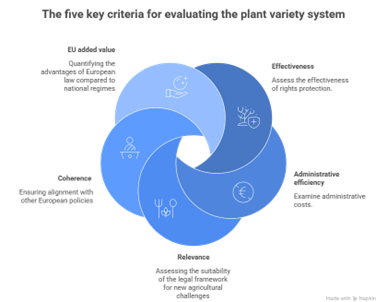
In accordance with the European “Better Regulation” framework, the evaluation is based on five key criteria:
• Effectiveness: assessing whether the system effectively protects breeders’ rights
• Administrative efficiency: examining administrative costs for the Office (CPVO) and its users
• Relevance: determining whether the system addresses modern challenges
• Coherence: ensuring that the regime is consistent with other EU policies
• Added value: measuring the benefits of an EU-level system compared with national regimes
The analysis will notably focus on the 2011–2024 period in order to assess the sector’s evolution and the real impact of the system on agricultural innovation.
Possible reform scenarios for the plant variety rights regime
Although the Commission has not yet presented a legislative proposal, several possible reform directions can already be identified.
Modernisation of administrative procedures
One potential avenue concerns the simplification of the plant variety rights application process.
Industry stakeholders notably mention:
• Full digitalisation of procedures before the CPVO
• Shorter examination timelines for varieties
• Harmonisation of practices among national examination offices
Such modernisation would aim to reduce administrative costs for breeders, particularly innovative SMEs.
Clarification of the farmer’s privilege
Another sensitive issue concerns the farmer’s privilege, namely the possibility for farmers to reuse part of their harvest as seed, even if it comes from protected varieties.
This exception, provided for under EU law, regularly sparks debate between:
• Farmers, who favour maintaining this right
• Breeders and seed companies, who seek stronger protection for their varieties
A reform could clarify the conditions of this exception in order to reduce legal disputes.
Integration of new breeding techniques
Biotechnological innovation represents a central challenge. Modern breeding techniques, such as genome editing , new genomic techniques (NGTs), and the use of artificial intelligence in breeding programmes, raise questions about the adequacy of the current plant variety protection framework.
The European Union may also seek to clarify the relationship between plant variety rights and patents covering biotechnological inventions, a particularly sensitive issue for the seed industry.
Strategic implications for breeders and seed companies
Increasing global competition
The global seed market is currently dominated by a limited number of major international groups.
In this context, reforming the European framework could:
• Strengthen the competitiveness of European breeders
• Secure research investments
• Improve legal protection against international competition
A lever for the agricultural transition
New plant varieties, particularly those developed using new genomic techniques (NGTs), play a key role in the ecological transition of agriculture. They notably enable:
• The development of disease-resistant varieties
• Crops adapted to climatic stress
• Reduced pesticide use
Plant variety rights therefore constitute a strategic legal tool to support the objectives of the European Green Deal and the Farm to Fork strategy.
Conclusion
The evaluation currently conducted by the European Commission marks a key step in the evolution of plant variety rights in Europe. The results of the consultation are expected to be published in an evaluation report, which could lead to a revision of the founding 1994 Regulation.
For companies operating in the seed sector, this reform represents both a major legal challenge and a strategic opportunity for agricultural innovation.
The coming years will therefore be decisive in defining the balance between breeders’ protection, food sovereignty and the sustainability of European agriculture.
Dreyfus & Associés assists its clients in managing complex intellectual property cases, offering personalized advice and comprehensive operational support for the complete protection of intellectual property.
Nathalie Dreyfus with the support of the entire Dreyfus team.
Q&A
What are the main challenges currently facing the European plant variety rights system?
Among the main challenges are the rapid evolution of breeding technologies, the need to support agricultural innovation, international competition in the seed sector and the search for a balance between the interests of breeders and those of farmers.
Could the reform modify the procedures for protecting plant varieties?
An evolution of the legal framework could lead to modernised administrative procedures, including the digitalisation of applications and improved cooperation between national and European offices.
What impact could a reform of European plant variety rights have on the seed sector?
A reform could alter the balance between breeders’ protection and farmers’ rights, while influencing conditions for innovation and investment in plant breeding. It could also strengthen the competitiveness of European companies and support the development of new varieties adapted to climate and agricultural challenges.
How can companies anticipate a potential reform of the European system?
Industry stakeholders should closely monitor the work of the European Commission, participate in public consultations and adapt their intellectual property strategies accordingly. Active legal and regulatory monitoring can help anticipate changes to the protection framework and secure investments in plant breeding.
Is the European plant variety rights system aligned with international rules?
Yes. The European regime is part of the international framework governing plant variety protection, particularly the UPOV Convention, which ensures a certain level of consistency between protection systems across different countries.
This publication is intended to provide general guidance and highlight certain issues. It does not aim to address specific situations and should not be considered legal advice.