

Sommaire
Introduction
With the digital transformation of businesses, several signs may now be used to identify a company: the company name, the trademark, the trade name, and the domain name. These concepts are frequently confused, although they operate under distinct legal frameworks.
In practice, many business owners believe that reserving a domain name automatically grants them exclusive rights over a name. However, these various signs do not follow the same rules regarding creation, attribution, and protection.
Understanding the distinction between these two concepts is essential in order to avoid disputes relating to prior rights, unfair competition, or cybersquatting.
Although a company’s name and a domain name may be identical, they are governed by different legal regimes and do not benefit from the same level of protection.
What is a company name?
The company name is the official name of a legal entity. It allows a company to be identified in legal terms, like a family name identifies a natural person.
In France, a company’s name is chosen when the company is incorporated and is included in its articles of incorporation. In practice, protection of this distinctive sign takes effect upon the company’s registration in the National Business Register, which confers legal personality on the company. Case law thus recognizes that the corporate name constitutes a distinctive sign protected against the risk of confusion (for example: Cass. com., March 12, 1985, No. 84-17.163).
The company name must also be used in the company’s legal and business dealings. It therefore appears on contracts, invoices, administrative and commercial documents, as well as in the website’s legal notices.
It is important to distinguish the corporate name from other related concepts:
A trade name is the name used in business to identify a business entity. A trade name may differ from the company’s corporate name and, as such, constitutes a distinctive mark used in commercial transactions.
A store sign is a visible identifier that allows the public to recognize a business, such as the name displayed on the front of a store or restaurant
What is a domain name?
A domain name is the address used to access a website. It typically consists of a name followed by a domain extension, such as .fr, .eu, or .com.
Today, this name plays a strategic role, as it determines a company’s online visibility and contributes to its digital identity.
Unlike a company name, a domain name is not assigned by a legal authority but by technical organizations responsible for managing internet domain extensions. At the international level, ICANN coordinates the domain name system and accredits registrars that sell and register domain names on behalf of users.
The management of the various domain extensions is handled by national or regional domain name registries.
– The .fr extension is administered by AFNIC,
– The .eu extension is managed by EURid.
Obtaining a domain name is based on a simple principle: first come, first served. Any operator may register an available domain name through an accredited registrar and subsequently renew the registration annually upon payment of the applicable fees.
When a domain name is registered, no systematic verification of prior rights is carried out. Consequently, it is technically possible to register a domain name that infringes an existing company name.
The main legal differences
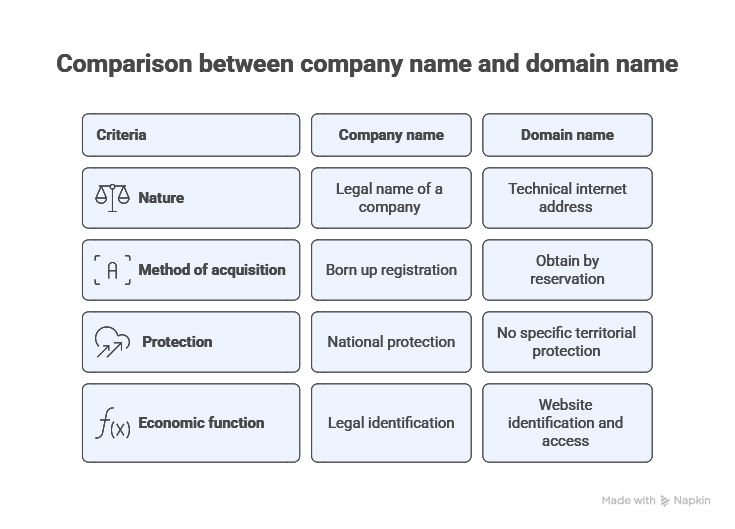
The first difference concerns the legal nature of these two signs.
• The company name is an element of company law used to formally identify a legal entity.
• The domain name was originally a technical address allowing access to a website on the global Internet.
However, practice increasingly recognise its economic and distinctive function.
The method of acquisition also differs. The company name arises upon the company’s registration in the National Register of Companies whereas a domain name is obtained simply by reserving it through a registrar.
The legal protection regime also varies.
• The company name generally benefits from protection throughout the national territory, provided that there is a risk of confusion with the activity of another undertaking.
• A domain name, by contrast, does not in itself confer an exclusive right comparable to that of a trademark or company name, nor does it benefit from a specific territorial protection regime. It primarily constitutes a unique technical address within a given extension, allowing access to a website.
This address may be visible worldwide.
Finally, their economic function differs. The company name serves to legally identify a company. The domain name primarily constitutes a technical address enabling access to a website, although it may also contribute to identifying an economic activity on the Internet.
Frequent conflicts between company names and domain names
Conflicts generally arise when several parties claim rights over the same sign. They may occur when a domain name infringes a prior company name. In such cases, courts assess in particular whether there is a likelihood of confusion in the mind of the public, taking into account the priority of the sign, the field of activity, and the conditions under which the disputed domain name is used.
Under French law, such disputes may notably be based on unfair competition, pursuant to Article 1240 of the French Civil Code.
Furthermore, Article L.45-2 of the French Postal and Electronic Communications Code provides that the registration or use of a domain name must not infringe the rights of third parties. On this basis, alternative dispute resolution procedures have been established for .fr domain names, including the SYRELI procedure managed by AFNIC.
This procedure may result in the deletion or transfer of a domain name when it infringes prior rights.
Although the company name is not expressly mentioned in this provision, it may nonetheless be invoked as a prior right in these procedures or before judicial courts.
At the European Union level, certain disputes relating to domain names are subject to specific regulation. The .eu extension is governed by Regulation (EU) 2019/517, and disputes may be resolved through an alternative dispute resolution procedure administered notably by the Czech Arbitration Court.
Conclusion
The company name and the domain name pursue different but complementary objectives. These two elements may be identical, but they are governed by different legal regimes and benefit from different levels of protection.
In a highly digitalised economic environment, it is therefore essential to adopt a coherent strategy combining company law considerations with domain name management in order to effectively secure a company’s identity over the long term.
Dreyfus Law Firm assists its clients in managing complex intellectual property matters by providing tailored advice and comprehensive operational support to ensure the full protection of intellectual property rights.
Dreyfus Law Firm works in partnership with a global network of intellectual property attorneys.
Nathalie Dreyfus, with the assistance of the entire Dreyfus team.
Q&A
Can a company use a domain name different from its company name?
A company is not required to use its corporate name as its domain name. It may choose a name that is shorter, more commercial, or better suited to its online activities.
Can a domain name be reserved before the company is created?
Yes. It is possible to reserve a domain name before incorporating a company. This practice is common in order to secure a digital identity prior to the company’s registration.
Should the existence of a trademark be checked before reserving a domain name?
This is strongly recommended. A domain name may infringe a prior trademark, which could lead to a trademark counterfeiting action or the transfer of the domain name.
Can a company own multiple domain names?
Absolutely, a company may register several domain names in order to protect its digital identity or redirect users to the same website.
Can domain names be seized or included in insolvency proceedings?
Yes, as an intangible asset, a domain name may form part of a company’s assets and may therefore be transferred or seized.