

Sommaire
Introduction
The decision ruled by the Commercial Chamber of the French Supreme Court (Cour de cassation) on January 28, 2026 (No. 24-14.760) marks a decisive milestone in the evolution of French trademark law. By confirming the non-applicability of any limitation period to invalidity actions for all trademarks in force at the time of the PACTE Law, the Court brings an end to several years of legal uncertainty.
This ruling goes beyond a purely technical clarification: it fundamentally reshapes the legal security of industrial property rights and the litigation strategies of businesses.
The introduction of the non-applicability of limitation periods by the PACTE Law
The PACTE Law (Law No. 2019-486 of May 22, 2019) profoundly transformed French trademark law by introducing a now fundamental principle: invalidity actions are not subject to any limitation period.
This principle, codified in Article L.716-2-6 of the French Intellectual Property Code, is grounded in a simple but essential rationale: a trademark that does not meet the legal requirements for validity should never be allowed to produce lasting legal effects.
This reform aligns French law with European Union law, in particular Regulation (EU) 2017/1001 on the European Union trademark, which also allows for invalidity actions without time limitation in certain circumstances.
Prior to this reform, invalidity actions were subject in practice to the ordinary five-year limitation period set out in Article 2224 of the French Civil Code, which often resulted in the consolidation of legally questionable situations. The PACTE Law departs from this approach by prioritizing the intrinsic validity of registered rights.
The January 28, 2026 decision: a clear and structuring solution
However, a major uncertainty remained: does this absence of limitation period apply to trademarks filed before 2019?
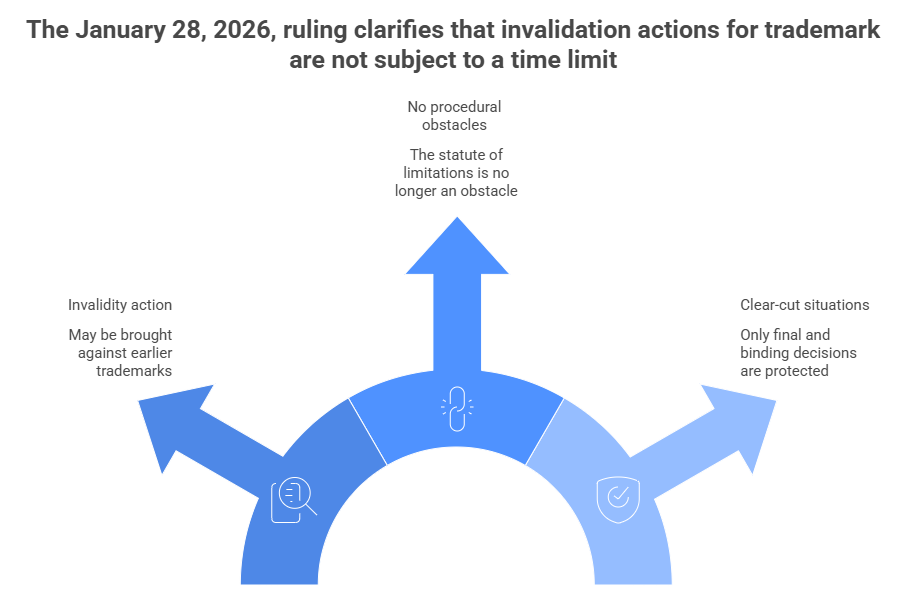
In its decision of January 28, 2026, the French Supreme Court provides a clear and unequivocal answer. It states that the absence of any limitation period applies to all trademarks in force as of May 24, 2019, regardless of their filing date and even where the invalidity action would previously have been time-barred.
This ruling has several major consequences:
• invalidity actions may now be brought against old trademarks, even those actively in use;
• limitation periods acquired under prior law no longer constitute a procedural obstacle;
• only situations definitively settled by a final court decision (res judicata) remain protected.
The Court thus adopts an immediate and broad interpretation of the reform, prioritizing the consistency of the legal system over the stability of previously acquired situations.
Immediate effect in the interest of trademark validity
One of the most significant contributions of the decision lies in recognizing the immediate effect of the new law on ongoing situations, including those that appeared definitively settled.
This approach may seem at odds with traditional civil law principles, which generally protect acquired limitation periods. However, the Court justifies this position by emphasizing the specific nature of trademark law.
The trademark register is intended to reflect valid and enforceable rights. Therefore:
• maintaining invalid trademarks solely due to the passage of time would be contrary to legal order;
• the public interest justifies allowing such trademarks to be challenged at any time.
This reasoning aligns with a broader European objective of ensuring uniformity and coherence in trademark law across the internal market.
Practical implications for rights holders
A strategic opportunity for prior rights holders
Businesses now benefit from a powerful legal tool. They may:
• challenge longstanding trademarks, even after many years of use;
• rely on various grounds, including bad faith at the time of filing;
• revive disputes previously considered definitively time-barred.
For instance, a company discovering in 2026 that a competitor is using a trademark filed in 2010 in violation of its prior rights may now initiate invalidity proceedings, even though such action would previously have been inadmissible.
Increased legal uncertainty for trademark owners
Conversely, this decision weakens the position of trademark proprietors. Their rights may now be challenged:
• without any time limitation;
• regardless of how long the trademark has been in use.
This situation calls for a structured and proactive approach, including in particular:
• regular audits of trademark portfolios;
• securing trademark filings from a legal standpoint;
• anticipation of potential litigation risks.
Conclusion
Through its decision of January 28, 2026, the French Supreme Court definitively establishes a cornerstone principle of trademark law: the non-applicability of limitation periods to invalidity actions, applicable to all trademarks in force at the time of the PACTE Law’s entry into force.
This ruling fully aligns French law with European Union law and reinforces the requirement that industrial property rights must be intrinsically valid. At the same time, a profound shift in corporate legal strategies is needed.
Dreyfus & Associés assists its clients in handling complex intellectual property matters by providing tailored advice and comprehensive operational support to ensure full protection of their IP rights.
Dreyfus & Associés is partnered with a global network of Intellectual Property attorneys.
Nathalie Dreyfus with the support of the entire Dreyfus team
Q&A
Does the absence of a limitation period mean there are no time constraints at all?
Not entirely. While time limitation no longer applies, other mechanisms such as acquiescence or specific statutory regimes may still restrict the ability to act (for instance for well-known trademarks). A comprehensive and strategic analysis remains essential.
Can all past disputes now be reopened?
No. The Supreme Court has set a clear boundary: cases that have been finally adjudicated (res judicata) remain unaffected. Only unresolved or pending matters may benefit from the new regime.
Will trademark litigation become more frequent?
This decision is likely to increase invalidity actions. The removal of time barriers creates new litigation opportunities, particularly in sectors where longstanding conflicts remained unchallenged.
Is French law now fully aligned with EU trademark law?
The alignment is now very strong. However, certain national procedural specificities remain, requiring a coordinated approach between French and EU law.
This publication is intended to provide general guidance to the public and to highlight certain issues. It is not intended to apply to specific situations or to constitute legal advice.