

A company’s domain name portfolio is a strategic intangible asset, on par with its trademarks, patents, or designs. Yet, according to a study published by CSC Global, nearly 75% of Forbes Global 2000 companies have not adopted all recommended security measures for their critical domain names. This negligence exposes organizations to significant legal, technical, and financial risks.
A domain name audit provides a comprehensive overview, identifies vulnerabilities, and optimizes the naming strategy. Dreyfus law firm, under the direction of Nathalie Dreyfus,a court-appointed expert accredited by the French Supreme Court (Cour de cassation, Trademark specialty) and the Paris Court of Appeal (Trademarks and Designs specialty), brings a rigorous methodology to this essential process.
This article details the components of an effective domain name audit, the warning signs to watch for, and the value of integrating this process into your overall intellectual property strategy.
- 10% to 30% reduction in annual costs by identifying superfluous domain names
- Detection of coverage gaps: strategic extensions, geographic markets, typographic variants
- Legal security for the portfolio: verification of ownership, compliance, and renewal deadlines
- Complete technical assessment: DNS, SSL/TLS, DNSSEC, registry lock
- Actionable deliverable with prioritized recommendations for legal counsel and IT teams
Sommaire
- 1 What is a domain name audit and why is it necessary?
- 2 The five key components of an effective audit
- 3 The value of court-appointed expertise in the audit
- 4 Warning signs that require an immediate audit
- 5 Integrating the audit into a comprehensive IP strategy
- 6 Conclusion
- 7 Frequently asked questions (FAQ)
- 8 Resources and useful links
What is a domain name audit and why is it necessary?
A domain name audit is a methodical examination of all domain names held, exploited, or monitored by a company. It analyzes their compliance with the legal rules applicable to domain names, in particular those arising from trademark law and unfair competition law, as well as their consistency with the company’s trademark strategy, technical security, and commercial relevance.
This exercise addresses several concrete challenges. First, it reveals superfluous domain names that generate unnecessary costs. A company with a portfolio of several hundred domain names can save between 10% and 30% on annual fees through a targeted audit. It then identifies coverage gaps: unregistered strategic extensions, unprotected geographic markets, and free typographic variants. Finally, it helps detect potential intellectual property infringement.
With over 1,500 existing domain name extensions and 3.7 million new ccTLD registrations in 2024, the need for a structured inventory has never been more pressing.
The five key components of an effective audit
Portfolio inventory and mapping
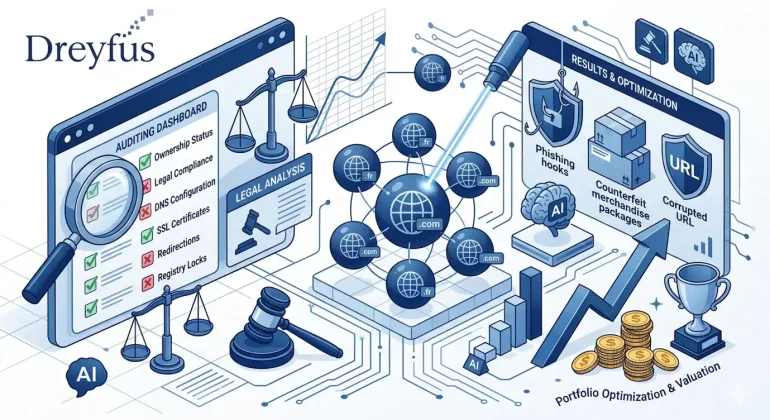
The first step is to establish a comprehensive inventory of domain names, cross-referenced with the trademark portfolio and the company’s digital assets (websites, email addresses, SSL certificates). Dreyfus law firm offers a strategic IP diagnosis and intangible asset valuation that integrates this dimension. This mapping visualizes the correlations between domain names, registered trademarks, and actual commercial activity.
Legal analysis and compliance verification
Each domain name must be examined in light of the applicable legal and contractual framework, which may vary depending on the relevant domain name extension and the rules governing the applicable domain name system.. The audit verifies, also,ownership (is the name properly registered under the company, not a former service provider?), registration conditions, renewal deadlines, and compliance with the specific rules of each registry. A domain name whose administrative holder is a former employee represents an important legal risk that an audit can identify and correct.
Technical security assessment
The technical audit examines DNS parameters (MX, SPF, DKIM and DMARC record configurations), SSL/TLS certificates, redirects, and security settings such as registry lock. According to ANSSI, 4,386 security events were handled in France in 2024, some related to DNS hijacking. This technical dimension ties into the cybersecurity and data protection challenges that businesses face.
Detection of third-party infringement risks
The audit also identifies domain names held by third parties that reproduce, imitate, or evoke your trademarks. In 2025, WIPO handled 6,282 disputes, a historic record. This analysis complements continuous monitoring and helps prioritize recovery or blocking actions based on risk level.
Strategic recommendations and action plan
The audit concludes with a detailed report accompanied by prioritized recommendations: domain names to renew first, extensions to register, names to abandon, actions to take against third parties, and technical security measures to deploy. This deliverable serves as an operational roadmap for the legal department and the IT team.
The value of court-appointed expertise in the audit
The role of court-appointed expert in intellectual property adds a distinctive dimension to audits conducted by Dreyfus law firm. The expertise of Nathalie Dreyfus, accredited by the French Supreme Court and the Paris Court of Appeal, ensures an analysis that meets the most rigorous evidentiary standards. This methodological rigor is particularly valued in contexts where the audit must serve as the basis for legal proceedings or negotiations.
For business law attorneys, this expertise is a major asset. In the context of transactions (mergers and acquisitions, fundraising, restructuring), a reliable assessment of the domain name portfolio is an integral part of intellectual property due diligence. Collaboration between business lawyers and IP specialists helps secure these transactions by identifying hidden risks before closing.
Warning signs that require an immediate audit
Certain situations should trigger an emergency audit: the detection of a phishing site replicating your visual identity, customer complaints about fraudulent communications bearing your name, the discovery of a domain name identical to your trademark registered under a new extension, or an unauthorized change in the DNS settings of one of your domains. Similarly, any major strategic operation merger, acquisition, divestiture or IPO warrants a thorough audit to secure the digital assets involved and avoid post-closing surprises.
WIPO has observed a steady increase in disputes every year since its inception, with a cumulative total exceeding 80,000 UDRP proceedings handled since 1999. This trend confirms that businesses benefit from anticipating rather than reacting, and the audit is the preventive tool par excellence.
Integrating the audit into a comprehensive IP strategy
A domain name audit should not be a standalone exercise. It fits into a comprehensive strategy that includes prior art searches before any filing, active management of the trademark and design portfolio, and continuous monitoring of all intangible assets.
Dreyfus law firm supports its clients across all these dimensions, notably leveraging its AI-powered trademark similarity analysis tool to optimize strategic decisions. This integrated approach ensures that every decision related to domain names is aligned with the company’s overall strategy.
Attorneys seeking to address their clients’ intellectual property issues can rely on Dreyfus law firm network of specialized attorneys to ensure expert handling of each case, from the initial audit through to the implementation of recommendations.
Conclusion
An unaudited domain name portfolio is a portfolio at risk. Between forgotten renewals, technical security gaps, and third-party infringements, the consequences of neglect can amount to hundreds of thousands of euros in damages.
An audit is the first step toward responsible and strategic management of your digital assets. Dreyfus law firm offers tailored support, from initial inventory to action plan, with the rigor of recognized judicial expertise. Contact us to schedule your audit.
Frequently asked questions (FAQ)
How often should a domain name audit be conducted?
A comprehensive audit should be conducted at least once a year, and systematically before any strategic operation (acquisition, fundraising, trademark launch, geographic expansion). A lighter quarterly review, focused on renewal deadlines and monitoring alerts, helps maintain constant vigilance.
What risks does a company face without a regular audit?
Without an audit, a company’s domain name portfolio may be vulnerable to risks such as renewal oversight, exploitation of its trademarks by third parties via cybersquatting, technical vulnerabilities (DNS hijacking, lack of DNSSEC), and depreciation of its intangible assets. The 2024 ANSSI report confirms that peripheral IT infrastructure, including DNS configurations, remains among the most exploited attack vectors.
Is a domain name audit useful for due diligence?
Absolutely. In the context of mergers and acquisitions or fundraising, auditing the domain name portfolio is an integral part of IP due diligence. It assesses the strength of the target’s digital assets, identifies any pending disputes, and verifies that ownership is properly established.
What is the difference between an audit and domain name monitoring?
An audit is a comprehensive snapshot of the portfolio at a given point in time, while monitoring is a continuous process for detecting threats. The two are complementary: the audit defines the strategy and identifies areas for improvement, while monitoring ensures its execution and ongoing updates.
How much does a domain name audit cost?
The cost varies based on portfolio size, the number of extensions involved, and the depth of analysis. Dreyfus law firm offers tailored audits adapted to each situation, from a quick assessment for startups to a comprehensive audit for international groups.